On this page
The normal balance is the side used to increase an account class. Determine the account class before using its normal balance to choose a debit or credit.
The foundational map
| Account class | Normal balance | Increase | Decrease |
|---|---|---|---|
| Asset | Debit | Debit | Credit |
| Expense | Debit | Debit | Credit |
| Distribution to owner | Debit | Debit | Credit |
| Liability | Credit | Credit | Debit |
| Equity | Credit | Credit | Debit |
| Revenue | Credit | Credit | Debit |
The pattern reflects the expanded accounting equation. Assets and the equity- reducing activity or owner effects are debit-normal; liabilities, equity, and equity-increasing revenue effects are credit-normal.
Normal does not mean always
An account can temporarily or incorrectly have a balance on the opposite side. A bank overdraft, overpayment, posting error, timing issue, or unusual fact can produce an abnormal balance that requires investigation or reclassification. Calling a side normal describes the account's ordinary increase direction; it does not prove that every balance on the other side is an error.
Those cases are unexpected positions that require explanation. Contra accounts are different: their opposite normal side is intentional by design, not merely an error or temporary anomaly. Accumulated depreciation, for example, offsets an asset but normally has a credit balance. The contra concept must be taught explicitly rather than treated as proof that the foundational map is unreliable.
Derive instead of memorize blindly
Suppose Cash increases. Cash represents an asset, assets are debit-normal, and an increase is therefore a debit. If Accounts Payable decreases, the liability is credit-normal, so a decrease is a debit. A debit increases Cash but decreases Accounts Payable because the two accounts have different normal balances.
For a customer service performed on credit, Accounts Receivable increases with a debit and Revenue increases with a credit. The company gained a right to collect after providing the service.
Analytical use
A normal-balance map helps a finance reader interpret raw trial-balance or ledger data, especially when positive database values do not communicate debit or credit orientation. It also helps an accounting student diagnose a balance that sits on an unexpected side before carrying it into a statement.
Neither use should become mechanical. An unexpected sign may be an error, a contra account, a genuine unusual position, or a data-extraction convention. The account definition and reporting entity decide.
Boundaries
The map does not select the account, determine recognition, or prove the entry belongs in the period. It applies after the event and account classification are understood. More advanced account families—including contra accounts, valuation allowances, and closing accounts—extend the map without changing that sequence.
Normal balance in the learning graph
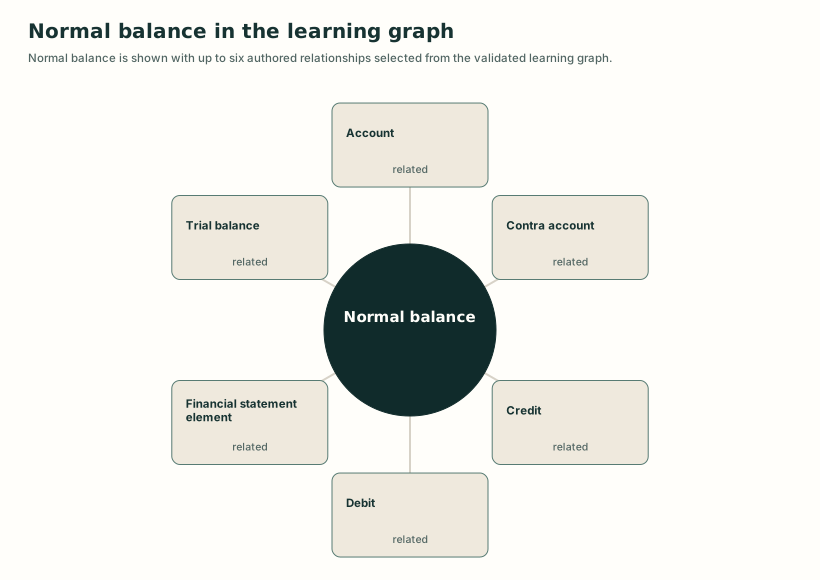
Detailed visual description
A structural map places Normal balance at the center and connects it to related concepts, prerequisite concepts, or lessons from the knowledge graph. Edge labels distinguish broader, narrower, related, prerequisite, and teaching relationships where present.
Put the concept to work
Understand this concept
- Explain how account classification determines a normal debit or credit side without making an abnormal balance impossible.
Apply this concept
- Apply the normal-side map to determine whether a debit or credit increases or decreases a basic account.
Learning resources
Choose a lesson, try an application, or inspect the sources behind this concept.
Build on these ideas
- Account — Apply
To apply this concept: Required. The account must be selected and classified before its normal side can guide recording.
- Credit — Understand
To understand this concept: Required. The learner must understand the right-side coordinate before using it as a normal side.
- Debit — Understand
To understand this concept: Required. The learner must understand the left-side coordinate before using it as a normal side.
Show 2 more prerequisites
- Financial statement element — Understand
To understand this concept: Required. The normal-side map begins with the economic classification represented by the account.
- Normal balance — Understand
To apply this concept: Required. Application depends on understanding that the map follows classification rather than cash direction.
Lessons
Worked examples and cases
Practice
- Cash service followed by a wage payment
- Customer advance and refund before performance
- Ending balance in Accounts Receivable
Show 3 more practice items
Common mistaken ideas
Sources
Related concepts
Show 4 more related concepts
Use this idea next
- Contra account — Apply
Required level here: apply. Required. The learner must map the related class and its contra to opposite normal sides.
- Contra account — Understand
Required level here: understand. Required. The defining recording pattern uses the side opposite the related account's ordinary balance.
- Credit — Apply
Required level here: understand. Required. The normal-side map determines whether a credit increases or decreases an account.
Show 4 more next steps
- Debit — Apply
Required level here: understand. Required. The normal-side map determines whether a debit increases or decreases an account.
- Normal balance — Apply
Required level here: understand. Required. Application depends on understanding that the map follows classification rather than cash direction.
- Temporary account — Apply
Required level here: apply. Required. Bringing an account to zero requires an entry on the side opposite its actual ending balance.
- Trial balance — Understand
Required level here: apply. Required. Each account balance must be placed on its debit or credit side before totals can be compared.
Used in these readings
These chapters explain or apply this concept. The label states how the chapter uses it.