An adjusting entry updates the records for a reporting-period fact not yet fully recorded. It uses the same debit and credit rules as other journal entries.
Record the missing activity
In this standalone example, Alder Services has no recorded Accounts Receivable before adjustment. It completed $4,800 of December services that will be billed in January. The customer accepted the service by year-end. No further company performance is required for the stated payment right.
Accounts Receivable changes from $0 to $4,800. The entry records December's completed work; it is not an amount selected to reach a preferred profit.
Alder also owes $2,700 for December employee services that have not been recorded. It will pay in January.
Neither entry changes Cash. Later collection or payment settles the recorded receivable or payable. The basic accrual, deferral, and depreciation adjustments taught here do not use Cash. A correction of an omitted cash transaction is a different task and may involve Cash.
Check the adjusted balances
Post each adjustment to the ledger and prepare an adjusted trial balance. Keep the unadjusted balance, adjustment, and resulting balance distinguishable. Adding $4,800 to a zero receivable produces one $4,800 asset, not two.
Equal debit and credit totals do not show that every necessary adjustment was made. The unadjusted trial balance could balance while omitting both facts. Check the reporting period and evidence as well as equal totals.
Control the handoff
Retain the unadjusted amount, source evidence, calculation, entry, posting, and adjusted amount as separate steps. A reviewer should be able to trace each adjusted balance back to the dated fact that required it. Reversing entries and later settlement belong to the next period and need their own controls.
Use the two-accrual example for the complete ledger bridge. Then complete the independent accrual practice before the timing practice.
Boundaries
An adjusting entry can record an accrual, deferral, allocation, estimate, or supported classification update. It is not a name for every late entry or error correction. The governing accounting topic supplies the recognition and measurement rule; the adjusting-entry process updates the ledger.
Adjusting entry in the learning graph
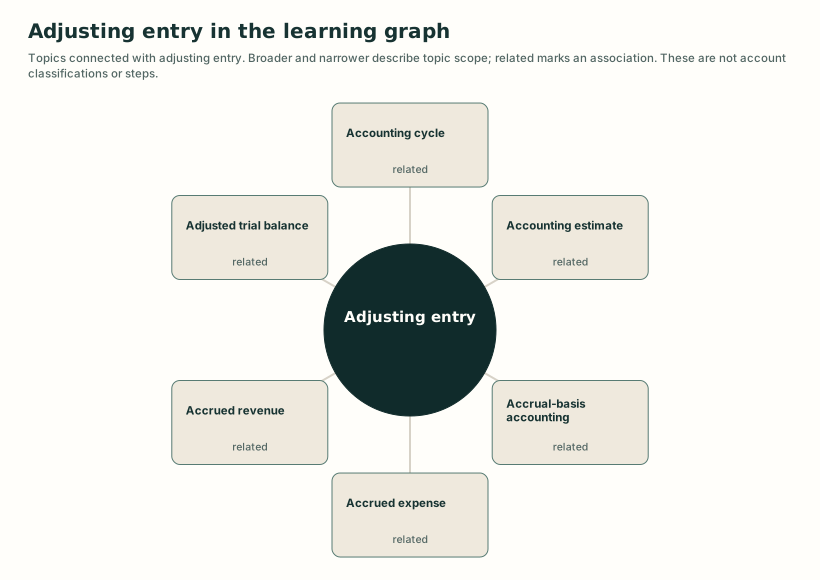
Detailed visual description
A structural map places Adjusting entry at the center and connects it to related concepts, prerequisite concepts, or lessons from the knowledge graph. Edge labels distinguish broader, narrower, related, prerequisite, and teaching relationships where present.
Put the concept to work
Understand this concept
- Explain how an adjusting entry updates an unadjusted ledger for period-end facts without treating adjustment as a cash event or an arbitrary plug.
Apply this concept
- Prepare and explain basic accrued-revenue and accrued-expense adjusting entries and their effects on the adjusted trial balance.
Learning resources
Choose a lesson, try an application, or inspect the sources behind this concept.
Build on these ideas
- Accounting cycle — Understand
To understand this concept: Required. An adjusting entry must be located between the unadjusted and adjusted reporting checkpoints.
- Accrual-basis accounting — Understand
To understand this concept: Required. The purpose of the update follows from recognizing economic activity in the appropriate period.
- Adjusting entry — Understand
To apply this concept: Required. Preparation must follow a supported period-end difference rather than a desired statement total.
Show 2 more prerequisites
- Journal entry — Apply
To apply this concept: Required. An adjustment uses the same balanced account-and-side mechanics as another journal entry.
- Trial balance — Analyze
To apply this concept: Required. The learner must distinguish the unadjusted balances from the updated adjusted balances.
Lessons
Worked examples and cases
Practice
- Convert cash collected to accrual revenue
- Name the adjustment type and write the entry
- Prepare two period-end accruals
Show 1 more practice items
Common mistaken ideas
- Mistaken idea: A balanced trial balance proves the records are correct
- Mistaken idea: A deferral means recording nothing until later
- Mistaken idea: An adjusting entry requires cash to move
Show 1 more mistaken ideas
Sources
Broader topics
Related concepts
Use this idea next
- Accrued expense — Apply
Required level here: apply. Required. The supported period-end difference is recorded and posted through an adjusting entry.
- Accrued revenue — Apply
Required level here: apply. Required. The supported period-end difference is recorded and posted through an adjusting entry.
- Adjusted trial balance — Understand
Required level here: apply. Required. The adjustments are what make it adjusted.
Show 4 more next steps
- Adjusting entry — Apply
Required level here: understand. Required. Preparation must follow a supported period-end difference rather than a desired statement total.
- Cash basis accounting — Apply
Required level here: apply. Required. The conversion is the adjusting entry stated as a difference.
- Prepaid expense — Apply
Required level here: apply. Required. Period-end consumption is transferred from the existing prepaid asset through a supported adjusting entry.
- Unearned revenue — Apply
Required level here: apply. Required. Period-end performance is transferred from the existing liability through a supported adjusting entry.
Used in these readings
These chapters explain or apply this concept. The label states how the chapter uses it.