ICFR turns reporting objectives into repeatable responsibilities and evidence. A purchase may require authorization, accurate entry, appropriate account and period classification, reconciliation, review, and controlled access. No one checkbox “controls the purchase”; a process addresses different ways the statements could be misstated.
Reasonable assurance is deliberately less than a guarantee. People can make mistakes, collude, override controls, or misjudge unusual transactions. Cost and practicality also shape design. These limits do not excuse a known gap; they explain why a control conclusion must be tied to risk, design, operation, and evidence.
From risk to evidence
Start with a specific reporting risk: fictitious equipment additions could overstate assets and income. A control objective might require additions to be real, authorized, accurately valued, and placed in service. Activities could include purchase-order approval, receiving evidence, invoice matching, physical verification, analytics over unusual locations, and review of aggregated sub-threshold items.
Management owns the process and its reporting. An auditor may test controls or audit management's assessment under the applicable regime, but the audit does not transfer ownership. A passed sample also does not prove that every transaction was valid.
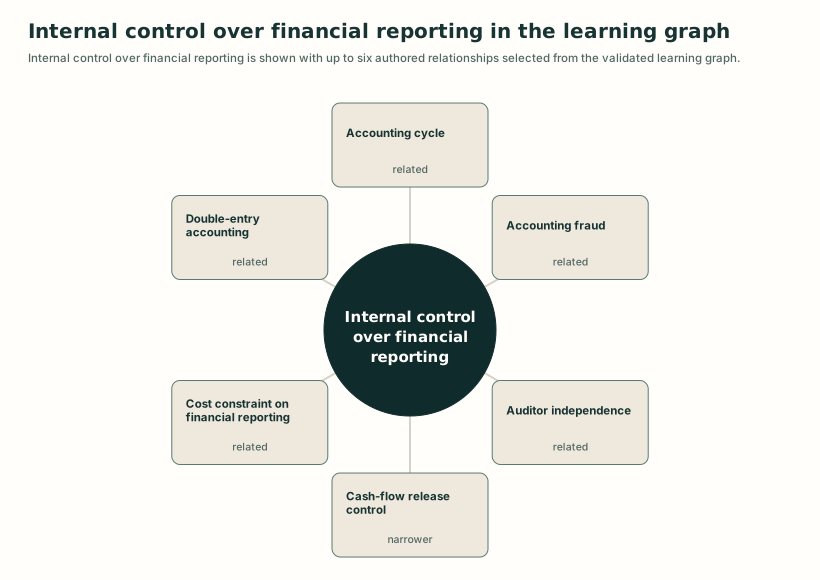
Internal control over financial reporting in the learning graph
Detailed visual description
A structural map places Internal control over financial reporting at the center and connects it to related concepts, prerequisite concepts, or lessons from the knowledge graph. Edge labels distinguish broader, narrower, related, prerequisite, and teaching relationships where present.
Put the concept to work
Understand this concept
- Explain the financial-reporting objective, reasonable-assurance boundary, and management ownership of an ICFR process.
Analyze this concept
- Map a stated misstatement risk to a control objective, control activity, responsible party, evidence, and residual limitation.
Learning resources
Choose a lesson, try an application, or inspect the sources behind this concept.
Build on these ideas
- Accounting cycle — Understand
To understand this concept: Required. Controls operate across transaction authorization, recording, adjustment, close, and reporting processes.
- Internal control over financial reporting — Understand
To analyze this concept: Required. Control mapping requires a clear objective and the distinction between design, operation, and evidence.
Lessons
Worked examples and cases
Practice
Common mistaken ideas
Sources
More specific topics
Related concepts
Show 3 more related concepts
Use this idea next
- Accounting fraud — Analyze
Required level here: understand. Helpful. Control design and override evidence help explain how a misstatement could enter and persist in reporting.
- Internal control over financial reporting — Analyze
Required level here: understand. Required. Control mapping requires a clear objective and the distinction between design, operation, and evidence.
- Verifiability — Analyze
Required level here: understand. Helpful. Source integrity, approvals, version control, and change logs help preserve a reproducible reporting process.