An auditor is paid by the organization whose reporting is examined. Independence rules manage that structural tension; they do not pretend it vanishes. Certain financial interests, employment relationships, management functions, and services can make an auditor unable—or reasonably appear unable—to evaluate evidence without favoring the client.
Independence is therefore more than personal honesty. A sincere auditor can be placed in a prohibited role, and a technically capable firm can damage the credibility of its opinion through an incompatible relationship. Conversely, the existence of an audit fee is not by itself proof of impairment; the applicable rule, entity type, engagement, period, and facts matter.
Keep the roles separate
Management makes accounting decisions and owns the financial statements. The auditor obtains evidence and expresses a bounded opinion. If the auditor designs the decision, authorizes transactions, or functions as management, later “auditing” that work creates a self-review or management-participation problem.
Rules differ across public-company, private-company, governmental, and other engagements. A CPA, CFA, or finance learner should name the governing regime before reaching a conclusion. This article provides the reasoning frame, not a substitute for current independence rules.
Auditor independence requires more than personal objectivity
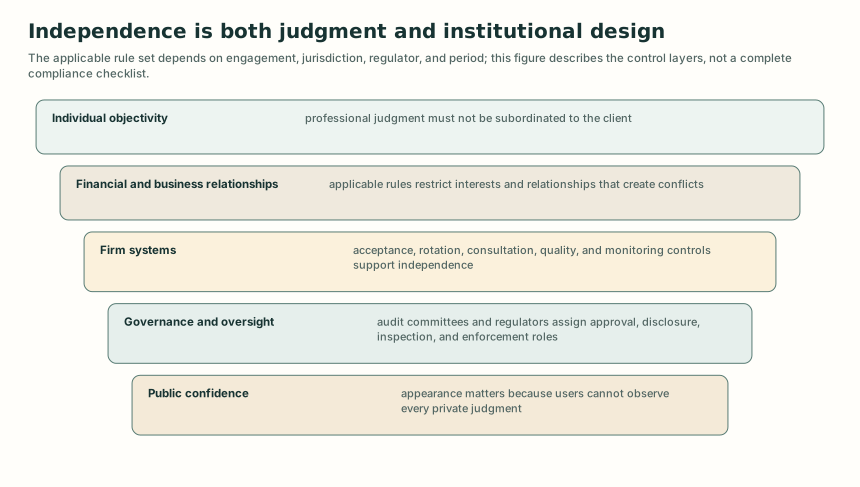
Detailed visual description
The diagram is an institutional map rather than a complete independence rule list. It directs the learner to identify the applicable engagement, jurisdiction, regulator, and effective period.
Put the concept to work
Understand this concept
- Explain why auditor independence addresses both objective judgment and relationships that can undermine reasonable confidence in that judgment.
Analyze this concept
- Analyze a service, financial interest, employment tie, fee, or management relationship for independence threats under a stated regulatory context.
Learning resources
Choose a lesson, try an application, or inspect the sources behind this concept.
Build on these ideas
- Auditor independence — Understand
To analyze this concept: Required. A fact-pattern analysis must preserve both actual-objectivity and appearance dimensions.
- Corporate governance — Understand
To understand this concept: Helpful. The external auditor is one part of a broader governance and reporting accountability system.
Lessons
Worked examples and cases
Practice
Common mistaken ideas
Sources
Related concepts
Use this idea next
- Auditor independence — Analyze
Required level here: understand. Required. A fact-pattern analysis must preserve both actual-objectivity and appearance dimensions.