On this page
Lesson details
- Estimated study time
- 20 min
- Reading context
- Chapter 1
Concept explanationUse this lesson when cash and equity seem interchangeable, or a balanced equation seems to prove that the accounting is correct.
Learning objectives (3)
Alder Design began with 2 transactions on January 2. Shareholders invested $40,000 cash in exchange for no-par common stock. Alder then paid $18,000 cash for equipment. No-par shares have no stated par value, so Alder records the full $40,000 investment in Common Stock.
After the shareholder investment, Cash and Common Stock each had a $40,000 balance. The equipment purchase shows why that equality was temporary:
| Account or class | After investment | Equipment purchase | After purchase |
|---|---|---|---|
| Cash | $40,000 | $(18,000) | $22,000 |
| Equipment | 0 | $18,000 | $18,000 |
| Total assets | $40,000 | 0 | $40,000 |
| Liabilities | 0 | 0 | 0 |
| Equity | $40,000 | 0 | $40,000 |
Alder still has $40,000 of assets, but only $22,000 is cash. The other $18,000 is equipment. Equity remains $40,000 because Alder has no liabilities in this simple snapshot.
Equity is the residual, not cash
Equity is what remains after an entity subtracts its liabilities from its assets:
Equity = Assets - Liabilities
The word residual means the amount left after a subtraction. Equity is therefore not a separate resource that sits in a bank account. It is the claim that remains after the claims of creditors.
Alder's equipment purchase changed the form of its assets. It did not change total assets, create a liability, or change equity. Setting equity equal to cash would omit the equipment that Alder controls.
Quick checkImmediately after the equipment purchase, Alder has $22,000 cash, $18,000 equipment, and no liabilities. What is its equity?
Answer: Equity is $40,000: $40,000 of total assets minus no liabilities.
Why the equation always balances
The accounting equation is:
Assets = Liabilities + Equity
Replace Equity with its definition, Assets minus Liabilities:
Assets = Liabilities + (Assets - Liabilities)
Liabilities cancel on the right side. The result is Assets = Assets. The equation defines equity as the residual after liabilities are subtracted from assets. A set of records can satisfy this equation and still contain an omitted transaction, an incorrect amount, or the wrong account.
Transaction analysis preserves that relationship. An owner investment can increase an asset and equity by the same amount. Borrowing can increase an asset and a liability by the same amount. A cash purchase of equipment can decrease one asset and increase another asset by the same amount.
The equation describes the relationship among the account classes. It does not decide whether the accountant chose the correct account class.
A balanced equation can still be wrong
Suppose an accountant records Alder's $18,000 equipment purchase as an immediate expense. Cash falls to $22,000, the equipment is omitted, and equity falls to $22,000 through the expense. The result still balances:
$22,000 assets = $0 liabilities + $22,000 equity
The arithmetic is correct, but the analysis is wrong. Alder controls equipment that the records do not show. The expense also reduces income before Alder uses the equipment to provide services.
The same error can pass a trial balance. A debit to an expense and a credit to Cash have equal amounts. The trial balance tests whether total debits equal total credits. It does not test whether Equipment was the correct account.
These 2 checks answer different questions:
| Check | What it confirms | What it cannot confirm |
|---|---|---|
| Accounting equation | Assets equal liabilities plus equity | The account classes and amounts are correct |
| Trial balance | Total debit balances equal total credit balances | The accounts, dates, and amounts are correct |
Balanced records can contain an omitted transaction, a repeated transaction, a wrong amount used on both sides, or a debit and credit to the wrong accounts. Supporting documents, account analysis, and period-end review must detect those errors.
What the equation does not say
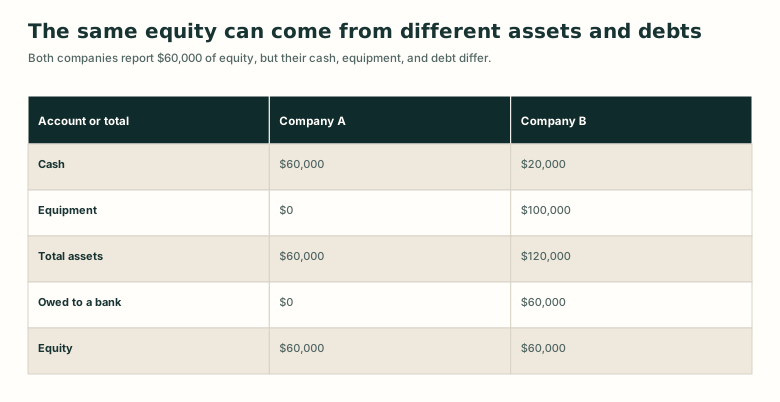
Two companies can report the same equity while holding different assets and owing different amounts. The comparison below shows why the separate account balances matter.
Both companies have $60,000 of equity. Company B also has less cash, more equipment, and $60,000 of debt. A lender or investor needs those account balances to assess each company's ability to meet near-term cash needs, its debt, and the resources it holds. The equation totals cannot provide that detail. The separate account balances show how each company reached the same residual interest.
Use the worked example Owner investment followed by an equipment purchase to apply the Alder transactions step by step. The practice question uses different amounts so that you must apply the relationship instead of repeating Alder's answer.
Detailed visual description
A comparison table with two columns. Company A holds $60,000 of cash, no equipment, total assets of $60,000, no bank debt, and equity of $60,000. Company B holds $20,000 of cash and $100,000 of equipment, total assets of $120,000, $60,000 owed to a bank, and equity of $60,000.