On this page
Lesson details
- Estimated study time
- 25 min
- Reading context
- Chapter 1
Classification reviewUse this lesson when you need to distinguish revenue, borrowing, owner investment, expense, and distribution from the direction cash moved.
Learning objectives (5)
Cash can increase without revenue, and revenue can increase before cash arrives. The accountant must identify the event that caused each change before selecting an account.
Alder Design's first-year transactions show the difference. Shareholders invested $40,000 in exchange for no-par common stock. No-par shares have no stated par value, so Alder records the full investment in Common Stock. A client paid $6,000 before Alder provided 6 months of support. Alder also completed and billed $114,100 of design work during the year. All 3 events increased an asset, but they did not have the same effect on equity.
Four changes to equity used in Chapter 1
Equity is the residual interest in an entity's assets after its liabilities are deducted. Chapter 1 uses four basic transaction types that can change that residual:
- Revenue increases equity through business performance.
- Expense decreases equity through business performance.
- An investment by an owner increases equity but is not revenue.
- A distribution to an owner decreases equity but is not an expense.
A corporation declares a dividend when its board formally approves the distribution. At that date, the corporation records the amount owed to shareholders in Dividends Payable.
Borrowing does not change equity when the loan begins. The asset and the liability increase by the same amount. A customer advance also leaves equity unchanged until the company provides the promised goods or services.
| Event | Other account effect | Effect on equity | Classification |
|---|---|---|---|
| Shareholders invest $40,000 cash | Common Stock increases $40,000 | +$40,000 | Owner investment |
| Alder borrows $20,000 cash | Notes Payable increases $20,000 | $0 | Borrowing |
| Alder bills $114,100 for completed work | Accounts Receivable increases $114,100 | +$114,100 | Revenue |
| A client pays $6,000 before support begins | Unearned Revenue increases $6,000 | $0 | Customer advance |
| Employees complete $62,000 of work for Alder; Alder pays some wages and owes the rest | Cash decreases; Wages Payable increases | $(62,000) | Expense |
| A corporation declares a cash dividend | Dividends Payable increases | Decrease | Owner distribution |
| A corporation pays a previously declared dividend | Dividends Payable decreases | $0 | Settlement of a liability |
An increase or decrease in Cash does not identify the other account. A cash receipt could come from an owner, a lender, a customer who has already received service, or a customer who will receive service later.
Detailed visual description
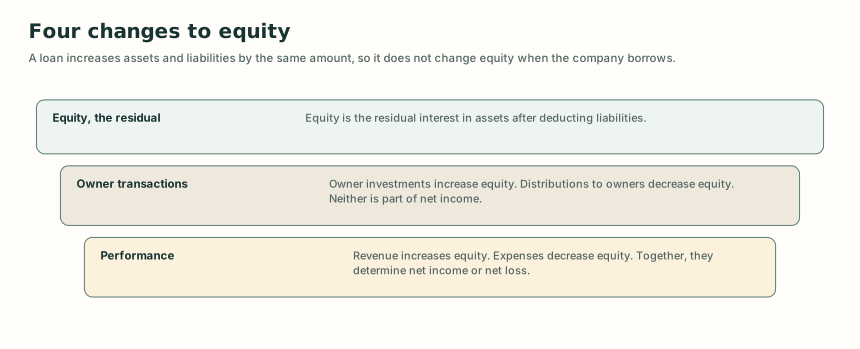
Three nested rectangles show equity and the two sources that change it. Owner investments increase equity, and owner distributions decrease it. Revenue increases equity, and expenses decrease it. Borrowing increases assets and liabilities by equal amounts, so it does not change equity when the loan begins.
Performance and owner transactions answer different questions
Revenue and expense measure business performance for the period. Owner investments and distributions describe transactions between the entity and its owners acting as owners.
Alder's $40,000 shareholder investment and its $114,100 of service revenue both increased equity. Only the service revenue belongs in net income. Treating the investment as revenue would make Alder's operating performance look better without any additional customer work.
The same distinction applies to decreases. Wages Expense reduces net income. A declared dividend reduces equity without reducing net income. Paying that dividend later reduces Cash and Dividends Payable but does not reduce equity a second time. Later chapters cover other changes in equity that do not appear in these Chapter 1 transactions.
Quick checkA customer pays Alder $5,000 for work that Alder will perform next month. A shareholder also invests $5,000. Which receipt changes equity on the receipt date?
Answer: The shareholder investment changes equity. The customer payment creates a liability because Alder has not yet performed the work, so neither cash receipt is revenue on the receipt date.
Borrowing and customer advances do not increase equity
When Alder borrows money, Cash and Notes Payable increase together. Assets and liabilities rise by the same amount, so equity does not change.
Alder's November 1 customer advance also increases an asset and a liability. Cash increases by $6,000, and Unearned Revenue increases by $6,000 because Alder still owes the customer 6 months of support. Revenue is recognized later, as Alder provides that support and reduces the obligation.
Use the event, not the cash direction
Use this order when a cash receipt or payment is easy to misclassify:
- State why the cash moved.
- Identify whether Alder performed, used a resource, borrowed, settled an existing balance, or transacted with an owner acting as an owner.
- Identify the asset, liability, or equity accounts that changed.
- Record revenue or expense only when the event represents performance in the current period.
The worked example Classify five cash transactions uses a separate set of amounts to trace these classifications through the accounting equation.