On this page
An investment by an owner brings value into the entity in exchange for an ownership interest. It can increase Cash or another asset and increase equity, but it does not report that the entity earned revenue from customers.
The owner must be acting as owner
The capacity in which a party acts matters. If a founder transfers $20,000 cash to a new company for an ownership interest, the company receives an asset and equity rises through an owner investment. If the same person pays the company for services as a customer, the analysis concerns performance and possible revenue. A person's identity alone does not classify the event; the rights, obligations, and capacity in the transaction do.
The transfer need not always be cash. An owner can contribute another asset, provide something valuable, or satisfy an entity obligation under facts that meet the applicable requirements. Whatever form it takes, the defining feature is the increase in ownership interest associated with value transferred to the entity.
Not borrowing and not market trading
Borrowing can also bring cash into a company, but it creates a creditor's claim and an obligation to repay. An owner investment creates or increases a residual interest instead. The distinction affects leverage, contractual rights, return expectations, and how future payments are classified.
A purchase of shares from an existing shareholder is different again. The buyer pays the seller; the issuing company ordinarily receives no new resource from that secondary-market trade. Ownership changes hands, but the company's assets and total equity do not increase merely because its shares traded.
This difference matters acutely to finance students. “Investors put money into the stock” can describe either primary issuance that funds the company or secondary trading between investors. Accounting students need the same separation to avoid recording a market trade as a company transaction.
Effect on the equation
In the simplest cash contribution, assets and equity rise by equal amounts. The accounting equation remains balanced, but the source of equity matters. Contributed capital is not a measure of operating performance, and a large financing round is not a burst of sales.
Later legal-form and reporting questions—share classes, par value, additional paid-in capital, noncash contributions, issuance costs, and partnership or proprietorship interests—require more specific concepts and guidance. The foundational classification comes first: did the entity receive value from an owner in the owner's capacity as owner?
Sources and currency
The definition follows FASB Concepts Statement No. 8, Chapter 4. Specific classification and measurement questions require the applicable authoritative literature and the entity's legal form.
What changes equity
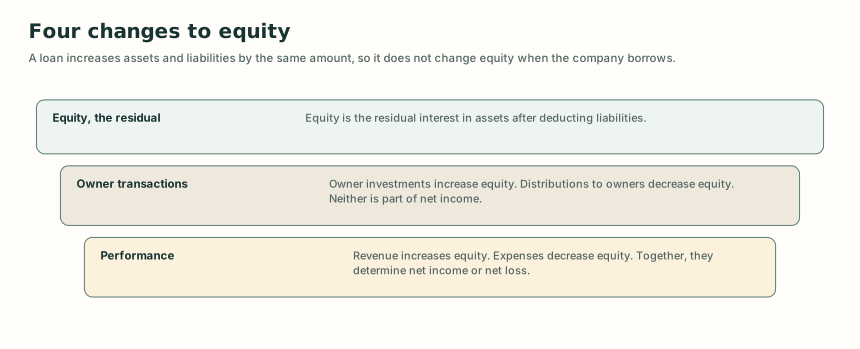
Detailed visual description
Three nested rectangles show equity and the two sources that change it. Owner investments increase equity, and owner distributions decrease it. Revenue increases equity, and expenses decrease it. Borrowing increases assets and liabilities by equal amounts, so it does not change equity when the loan begins.
Put the concept to work
Understand this concept
- Distinguish a transfer from an owner acting as owner from revenue, borrowing, and a transaction between existing investors.
Learning resources
Choose a lesson, try an application, or inspect the sources behind this concept.
Build on these ideas
- Equity — Understand
To understand this concept: Required. An owner investment is defined by its effect on and relationship to the residual ownership interest.
- Liability — Understand
To understand this concept: Helpful. The learner benefits from contrasting an ownership interest with a creditor obligation to repayment.
Lessons
Worked examples and cases
Practice
Common mistaken ideas
Sources
Broader topics
Related concepts
Show 2 more related concepts
Use this idea next
- Financing cash flow — Understand
Required level here: understand. Required. Owner-provided capital is an equity financing source outside revenue.
- Statement of changes in equity — Understand
Required level here: understand. Required. Owner investment changes equity outside performance.