The statement of changes in equity explains how each equity component moves from its beginning balance to its ending balance. It separates income from owner transactions instead of treating every equity increase as revenue.
Follow each component
In a simplified corporation, Common Stock and Retained Earnings are separate equity accounts. Share investment affects contributed capital, which records owner investment. Income and dividends affect retained earnings.
Start with the beginning balance of each account. Add or subtract the changes that belong to it, then calculate the ending balances and their total. A rollforward is this reconciliation from a beginning balance through changes to an ending balance.
Keep dividends outside income
Net income comes from the income statement. Dividends reduce retained earnings separately because distributions to shareholders are not expenses incurred in earning revenue. A net loss also reduces retained earnings.
A statement of retained earnings explains only that component. It is narrower than a statement of changes in equity, which explains all presented equity components. The standalone equity lesson shows both columns and the total.
Compare the ending amounts
Ending retained earnings and total equity must agree with the balance sheet for the same company and date. Trace a difference to the beginning balances and supported changes before altering an account.
Other corporations can have more equity components and changes than the basic example. The number of columns follows the company's equity structure; two columns are a teaching simplification, not a universal reporting rule.
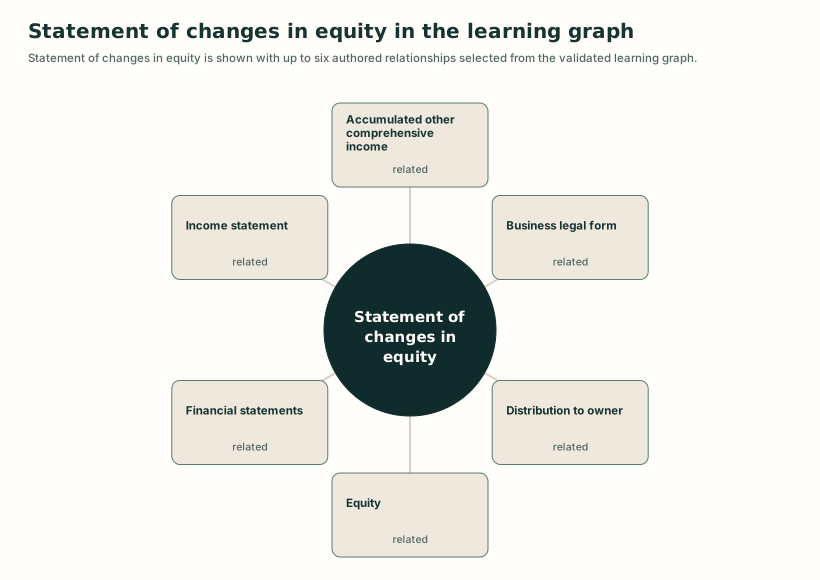
Statement of changes in equity in the learning graph
Detailed visual description
A structural map places Statement of changes in equity at the center and connects it to related concepts, prerequisite concepts, or lessons from the knowledge graph. Edge labels distinguish broader, narrower, related, prerequisite, and teaching relationships where present.
Put the concept to work
Understand this concept
- Explain how a statement of changes in equity separates beginning balances, period performance, owner investments, distributions, and ending equity components.
Analyze this concept
- Prepare and reconcile a basic contributed-capital and retained-earnings statement from beginning balances, net income or loss, investments, and distributions.
Learning resources
Choose a lesson, try an application, or inspect the sources behind this concept.
Build on these ideas
- Distribution to owner — Understand
To understand this concept: Required. Owner distribution changes equity outside net income.
- Financial statements — Understand
To understand this concept: Required. The statement is the period bridge between performance and ending balance-sheet equity.
- Investment by owner — Understand
To understand this concept: Required. Owner investment changes equity outside performance.
Show 4 more prerequisites
- Net income — Analyze
To analyze this concept: Required. The income-statement result is one input to the retained-earnings rollforward.
- Retained earnings — Analyze
To analyze this concept: Required. Beginning balance, net income, and distributions must reconcile to ending retained earnings.
- Retained earnings — Understand
To understand this concept: Required. Retained earnings carries accumulated performance and distributions as one continuing component.
- Statement of changes in equity — Understand
To analyze this concept: Required. Preparation must preserve the source and component of each equity change.
Lessons
Worked examples and cases
Practice
Common mistaken ideas
Sources
Related concepts
Use this idea next
- Financial statement articulation — Understand
Required level here: analyze. Required. The equity statement bridges performance and owner transactions to ending components.
- Statement of changes in equity — Analyze
Required level here: understand. Required. Preparation must preserve the source and component of each equity change.
Used in these readings
These chapters explain or apply this concept. The label states how the chapter uses it.