Cedar Trail's draft pension note says the plan is underfunded by $2.4 million. The general ledger says the pension liability is $3.1 million. A preliminary trustee summary says assets rose by $1.15 million. Treasury says the company contributed $1.2 million. The income statement reports $1.2 million of pension expense. Two figures match by coincidence; none explains another.
The close fails because each team is answering a different question. The actuary measures benefits attributed to service. The trustee reports restricted plan assets and cash flows. Accounting assembles periodic cost and OCI. Treasury authorizes sponsor cash. The statement recognizes funded status. The note must reconcile all of them without turning a benefit estimate into a solvency claim.
Sequence logic
```text Plan terms + reporting entity + participants + dates -> plan route and evidence map -> VBO / ABO / PBO or EPBO / APBO boundary
Actuarial movement schedule -> obligation rollforward Trustee and custodian evidence -> plan-asset rollforward Both ending balances -> funded status
Service + interest + expected return + AOCI amortization -> net periodic benefit cost
Actual-versus-expected + assumption and amendment effects -> current OCI -> ending AOCI -> later reclassification
Contribution authority + trustee receipt -> sponsor cash rail Benefit register + trustee disbursement -> benefit-payment rail
All seven -> employer entry -> statements -> note -> release ```
The ledgers share numbers without sharing meanings. Service cost increases PBO and enters pension cost. A contribution increases plan assets and uses employer cash but is not pension cost by definition. A benefit payment reduces PBO and plan assets but ordinarily creates no new sponsor expense. Actual asset return belongs in the asset rollforward; expected return belongs in periodic cost; the difference belongs in the gain-and-loss bridge.
Cumulative work and boundaries
The Cedar Trail packet supplies fictional plan documents and amendments, participant summaries, signed actuarial reports, assumption support, trustee statements, custodian values, contribution authorizations, benefit-payment registers, AOCI layers, general-ledger extracts, draft statements, and note tables. Learners produce the plan map, evidence request, obligation and asset rollforwards, funded-status bridge, cost schedule, OCI/AOCI rollforward, special- event memo, employer entry, presentation map, disclosure checklist, sensitivity explanation, and unresolved-evidence register.
The calculation family recomputes supplied accounting and actuarial results. It does not calculate participant-level benefits, select assumptions, determine fair value, classify an amendment or special event, validate legal funding, assess plan or sponsor solvency, forecast contributions, perform an actuarial valuation, or prepare the separate plan's financial statements.
Standards clock
The current lane incorporates the Topic 715 measurement-date, presentation, capitalization, multiemployer, and disclosure amendments represented by ASUs 2011-09, 2015-04, 2017-07, and 2018-14. Historical Statements 87, 88, 106, and 158 explain the architecture but are not current paragraph authority.
The June 2026 market-return cash balance proposal remains outside current GAAP. Its comment deadline is not an effective date. A future final standard enters the module only after its scope, transition, effective date, adoption status, and interactions are researched and recorded.
Module outcomes
Classify the plan and reporting entity, preserve plan terms, participants, measurement dates, assumptions, actuarial ownership, and standards-clock boundaries before selecting an accounting model.
Distinguish VBO, ABO, PBO, EPBO, and APBO, then reconcile supported obligation changes without performing an actuarial valuation.
Reconcile plan assets, actual return, expected return, contributions, benefits, and funded status without treating trust assets as ordinary sponsor liquidity.
Build and present every net periodic benefit cost component under the current service-cost and capitalization boundaries.
Route gains, losses, prior-service amounts, OCI, AOCI, and amortization once; identify amendments, settlements, curtailments, freezes, and remeasurement stops.
Apply the related but distinct other-postretirement and multiemployer boundaries, then release statements and notes from seven reconciled ledgers.
Learning sequence
Follow the dependency order, or open the lesson you need.
- Lesson 1Map the plan and reporting entity
- Lesson 2Distinguish and measure benefit obligations
- Lesson 3Roll forward the projected benefit obligation
- Lesson 4Roll forward plan assets and returns
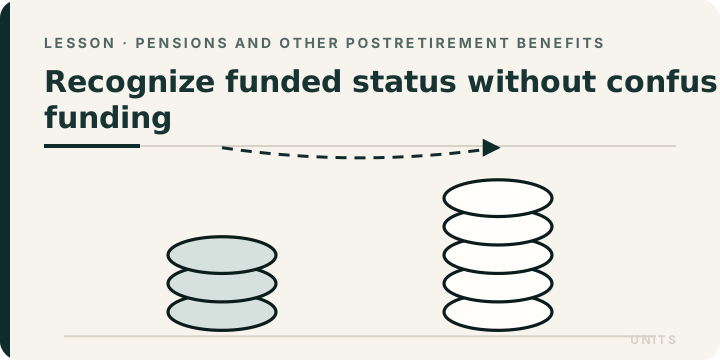
- Lesson 5Recognize funded status without confusing funding
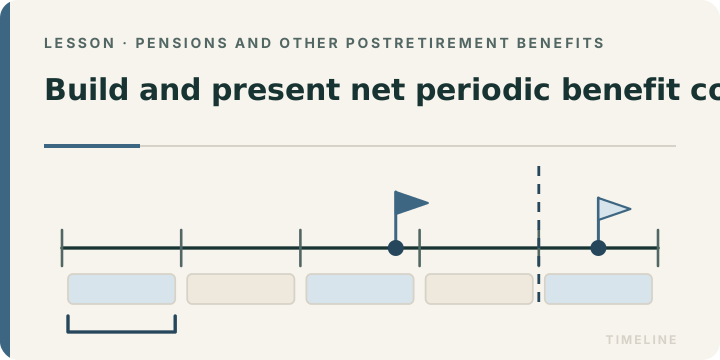
- Lesson 6Build and present net periodic benefit cost
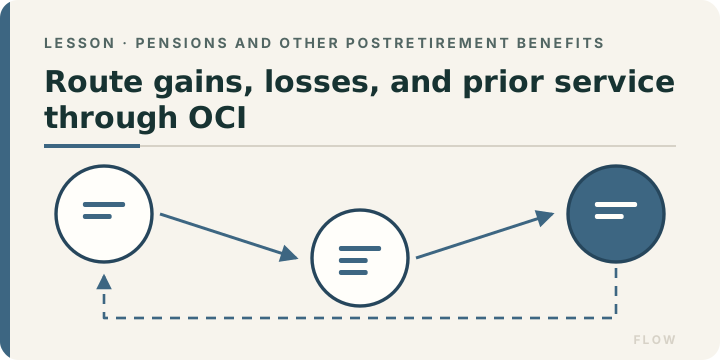
- Lesson 7Route gains, losses, and prior service through OCI
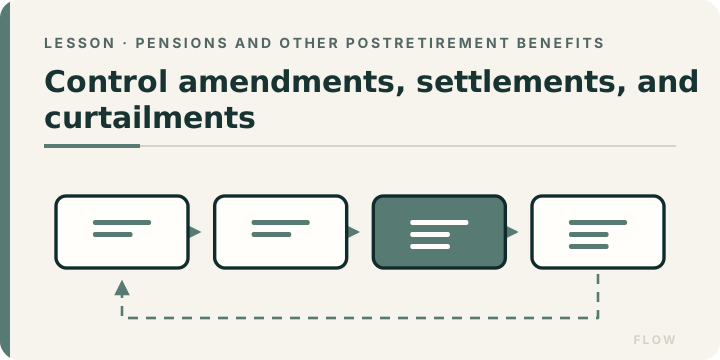
- Lesson 8Control amendments, settlements, and curtailments
- Lesson 9Reconcile the employer entry and workpaper
- Lesson 10Read assumptions, sensitivity, and disclosures
- Lesson 11Account for other postretirement benefits
- Lesson 12Release the benefit-plan close
Capstone and summative assessment
Use the cumulative case first, then test each transfer without exposing answer keys.
Summative sequence
12 scored decisions- Map the plan and reporting entity
- Distinguish and measure benefit obligations
- Roll forward the projected benefit obligation
- Roll forward plan assets and returns
- Recognize funded status without confusing funding
- Build and present net periodic benefit cost
- Route gains, losses, and prior service through OCI
- Control amendments, settlements, and curtailments
- Reconcile the employer entry and workpaper
- Read assumptions, sensitivity, and disclosures
- Account for other postretirement benefits
- Release the benefit-plan close