For one amount at t = 0, future value applies one growth factor per period:
$10,000 × (1 + 0.05)^3 = $11,576.25 at t = 3
The result is not simply “$11,576.25.” It belongs to a named date and uses a 5% annual periodic rate for three annual intervals. Taxes, fees, risk, and other excluded facts are outside the model.
At a nonnegative rate, the single-sum future value should not be below present value. At zero periods it should equal present value. Those are useful direction checks, not substitutes for recalculation.
A stream of deposits is not one single sum. Each deposit has its own starting date and therefore earns a different number of periods. Map and accumulate the cash flows separately, or use an annuity model only after the amounts, spacing, count, and payment timing satisfy that model's conditions.
Future value is an equivalence under assumptions, not a forecast. A supplied 5% rate may be a teaching input, a contractual rate, or an assumed return. The formula cannot turn an assumed investment return into a guarantee, select an accounting measurement input, or establish which alternative is preferable.
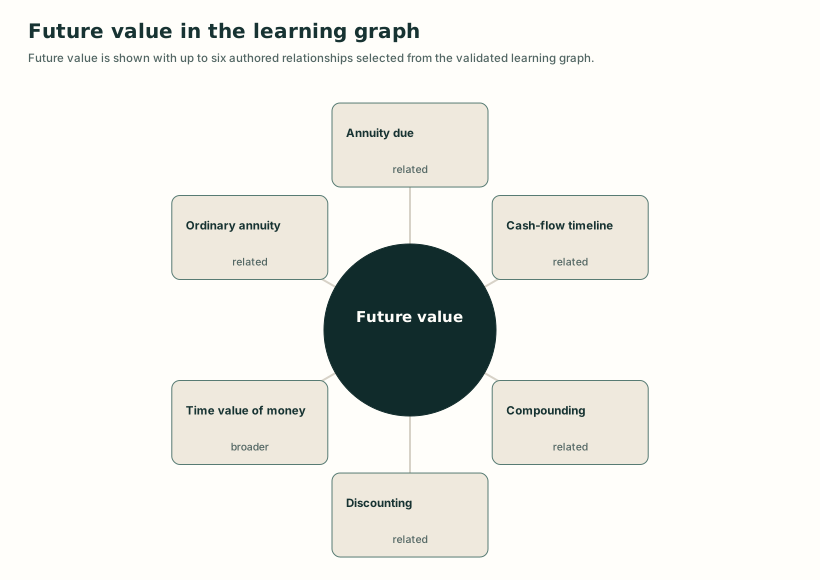
Future value in the learning graph
Detailed visual description
A structural map places Future value at the center and connects it to related concepts, prerequisite concepts, or lessons from the knowledge graph. Edge labels distinguish broader, narrower, related, prerequisite, and teaching relationships where present.
Put the concept to work
Understand this concept
- Explain future value as an equivalent amount at a named later date rather than as an automatic prediction or guaranteed balance.
Apply this concept
- Compute a single-sum future value, label its date and units, and audit the growth factor against the rate-period contract.
Learning resources
Choose a lesson, try an application, or inspect the sources behind this concept.
Build on these ideas
- Cash-flow timeline — Apply
To apply this concept: Required. The later date and number of intervals must be derived before calculation.
- Periodic interest rate — Apply
To apply this concept: Required. The rate must match each interval in the exponent.
- Time value of money — Understand
To understand this concept: Required. Future value is a common-date translation under declared assumptions.
Lessons
Worked examples and cases
Practice
Common mistaken ideas
Sources
Broader topics
Related concepts
Show 4 more related concepts
Use this idea next
- Compounding — Understand
Required level here: understand. Required. Compounding is the accumulation mechanism used to obtain a future value.