To find the current equivalent of $11,576.25 due in three annual periods at a supplied 5% annual periodic rate:
$11,576.25 ÷ (1.05)^3 = $10,000 at t = 0
The inverse check compounds $10,000 for the same three periods and returns $11,576.25. If it does not, inspect rate units, period count, signs, and rounding before interpreting the answer.
Rounding can create a small, explainable difference. The Cedar Works month-zero
value is $51,968.189786…; if it is rounded early to $51,968.19 and then
compounded for 36 months at 0.4%, the check is
$51,968.19 × (1.004)^36 = $60,000.000246… instead of exactly $60,000.
Retain the full-precision amount for the control and use the rounded amount only
for display.
Measurement meaning is not in the formula
Accounting applications need a defined measurement objective and the applicable authoritative requirements. Cash-flow amount, timing, uncertainty, risk treatment, and rate selection may all matter. A mechanically correct present value does not prove that an asset or liability should be recognized, that the result is fair value, or that the supplied discount rate is permitted.
Finance applications likewise separate calculation from rate judgment. A required return, borrowing rate, opportunity cost, or risk-free rate answers a different question. The module supplies rates so learners can master the mechanics without pretending the formula selects among them.
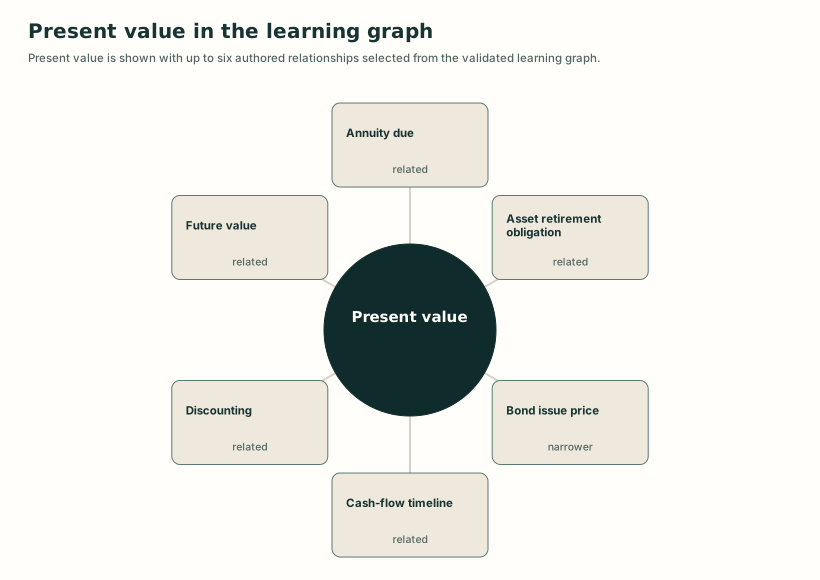
Present value in the learning graph
Detailed visual description
A structural map places Present value at the center and connects it to related concepts, prerequisite concepts, or lessons from the knowledge graph. Edge labels distinguish broader, narrower, related, prerequisite, and teaching relationships where present.
Put the concept to work
Understand this concept
- Explain present value as a current-date equivalent whose meaning depends on the cash-flow set, valuation date, rate, timing, and measurement objective.
Apply this concept
- Compute a single-sum present value, label its valuation date, and compound the result forward as an inverse-operation check.
Learning resources
Choose a lesson, try an application, or inspect the sources behind this concept.
Build on these ideas
- Cash-flow timeline — Apply
To apply this concept: Required. The valuation date and number of intervals must be explicit.
- Periodic interest rate — Apply
To apply this concept: Required. The discount rate must match the timeline interval.
- Time value of money — Understand
To understand this concept: Required. Present value translates dated cash flows under declared assumptions.
Lessons
Worked examples and cases
- Control Cedar Works' funding, service, and loan calculations
- Discount Cedar Works' target and compound it back
- Separate Cedar Trail's financing and other consideration
Show 2 more examples and cases
Practice
- Build one row of a level-payment schedule
- Discount and reverse a single sum
- Record an asset bought on a noninterest-bearing note
Show 1 more practice items
Common mistaken ideas
Sources
Broader topics
More specific topics
Related concepts
Use this idea next
- Asset retirement obligation — Apply
Required level here: apply. Required. The initial measure uses supported future cash flows, timing, probabilities, and a compatible rate.
- Bond issue price — Apply
Required level here: apply. Required. Both principal and coupon cash flows are discounted to the issue date.
- Deferred-payment asset purchase — Apply
Required level here: apply. Required. The measurement is a present value computation.
Show 7 more next steps
- Deferred-payment asset purchase — Understand
Required level here: understand. Required. The cash equivalent price is a present value.
- Discount or premium on a note receivable — Apply
Required level here: apply. Required. Initial carrying amount is computed from discounted contractual cash flows.
- Discounting — Understand
Required level here: understand. Required. Discounting is the operation that obtains a present value.
- Lease discount rate — Apply
Required level here: apply. Required. Lease measurement discounts dated cash flows using a period-consistent rate.
- Market yield at issuance — Analyze
Required level here: apply. Required. Issue price is the present value of supplied contractual cash flows at the supplied yield.
- Notes receivable — Apply
Required level here: apply. Required. Long-term or off-market notes require time-value analysis.
- Significant financing component — Apply
Required level here: apply. Required. The measurement discounts or accretes contractual cash flows.