Time-value analysis translates dated amounts; it does not erase their dates. For example, $10,000 now and $10,000 three years from now are different claims. At a supplied positive rate, the current amount can grow for three years, while the later amount must be discounted to compare it at the current valuation date.
Every valid foundational problem answers five questions:
- What is the valuation date?
- When does each cash flow occur?
- What interval is one period?
- What rate applies to that same interval?
- Which assumptions make that rate and cash-flow set usable?
The formula is downstream of those answers.
Two disciplinary lenses
Finance uses TVM to compare financing, saving, investment, and valuation cash flows. Accounting also uses present-value techniques in specified measurement contexts. The mathematics is shared; the authority and decision are not. A finance exercise may stipulate a required return. An accounting measurement must follow the applicable guidance's objective, scope, cash-flow, rate, and presentation requirements.
What the foundation excludes
This concept does not say that waiting always causes a loss, that a larger future nominal amount is necessarily better, or that one rate fits every decision. Inflation, risk, liquidity, taxes, fees, optionality, uncertainty, and contractual conventions may matter. The module begins with deterministic cash flows and supplied nonnegative rates so students can stabilize the date- and-unit controls before adding those judgments.
A cash-flow timeline controls time value of money
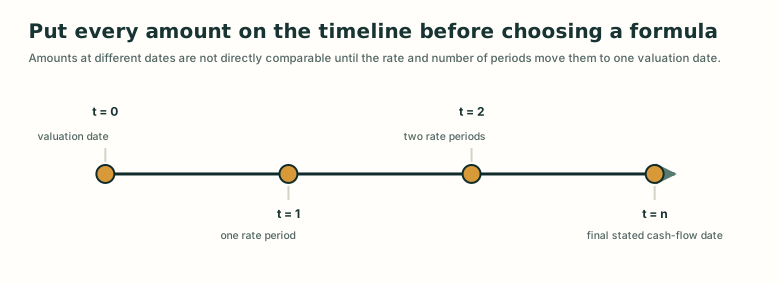
Detailed visual description
The timeline begins at the valuation date, advances in equal rate periods, and ends at period n. Its purpose is to prevent mixing annual, monthly, beginning-of-period, and end-of-period conventions.
Put the concept to work
Understand this concept
- Explain why cash flows at different dates require a common valuation date and why a result depends on the declared rate and timing assumptions.
Apply this concept
- Control the valuation date, cash-flow dates, period count, rate units, and assumptions before comparing bounded deterministic cash flows.
Learning resources
Choose a lesson, try an application, or inspect the sources behind this concept.
Build on these ideas
- Cash-flow timeline — Understand
To understand this concept: Required. Different dates and the selected comparison date must be visible.
- Periodic interest rate — Understand
To understand this concept: Required. Translation across dates depends on a rate whose period unit is known.
- Time value of money — Understand
To apply this concept: Required. A comparison must preserve the principle and its assumptions.
Lessons
Worked examples and cases
Practice
Common mistaken ideas
Sources
More specific topics
Show 7 more more specific topics
Related concepts
Use this idea next
- Future value — Understand
Required level here: understand. Required. Future value is a common-date translation under declared assumptions.
- Present value — Understand
Required level here: understand. Required. Present value translates dated cash flows under declared assumptions.
- Significant financing component — Understand
Required level here: understand. Required. Financing separates the transfer-date cash-equivalent price from later payment.
Show 1 more next steps
- Time value of money — Apply
Required level here: understand. Required. A comparison must preserve the principle and its assumptions.