Different opportunity costs can create room for mutually beneficial exchange. If Rowan gives up fewer reconciliations to produce one forecast while Vale gives up fewer forecasts to produce one reconciliation, specialization can increase their combined feasible output. A trade term between their opportunity costs can leave each with a bundle preferred to the no-trade starting point in the model.
Potential total gain is not automatic distribution
The existence of a larger total does not say how bargaining divides it. One party can capture most of the gain, and some workers, units, suppliers, or communities can bear transition costs even if the modeled parties gain in aggregate. Compensation is a separate institutional choice, not a theorem.
Implementation can also consume the apparent gain. Search, contracting, quality verification, coordination, taxes, transport, currency, delay, capacity, and relationship-specific investment all matter. If those costs exceed the modeled surplus, the simple exchange will not deliver the predicted result.
“Trade creates gains” is therefore a conditional mechanism, not proof that every person gains from every transaction or policy. State the parties, baseline, opportunity costs, terms, quantities, omitted costs, and distribution before interpreting the result.
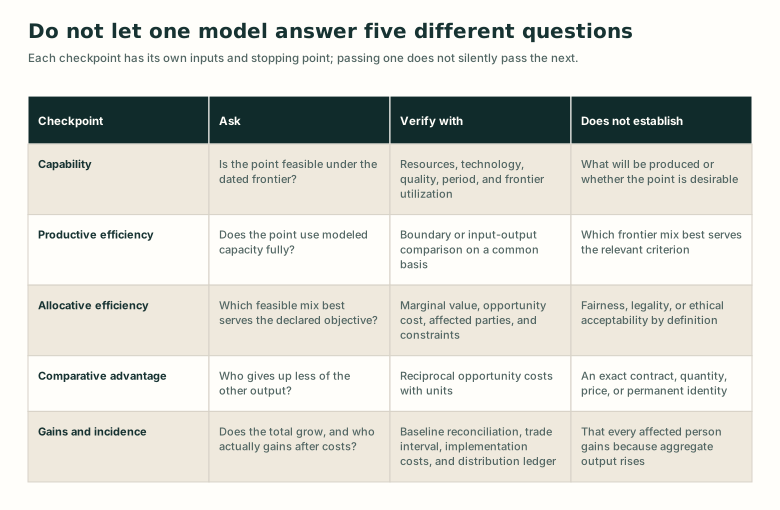
Five checkpoints from production capability to distributed gains
Detailed visual description
The capability row asks whether a point is feasible under a dated frontier and warns that feasibility is not a forecast or recommendation. Productive efficiency checks boundary use but cannot select a preferred mix. Allocative efficiency applies an explicit criterion but does not define fairness or legality. Comparative advantage uses reciprocal opportunity costs but does not write a contract. The final row reconciles total modeled gains and separately investigates implementation costs and distribution.
Put the concept to work
Analyze this concept
- Demonstrate potential gains from specialization and exchange under stated opportunity costs, then separate total modeled gains from bargaining, transition, distribution, quality, and implementation effects.
Learning resources
Choose a lesson, try an application, or inspect the sources behind this concept.
Build on these ideas
- Comparative advantage — Apply
To analyze this concept: Required. The foundational specialization result depends on parties having different opportunity costs.
- Normative economics — Analyze
To analyze this concept: Helpful. A larger modeled total does not determine whether the distribution, rights, or transition consequences are acceptable.