Comparative advantage compares sacrifices, not gross output. Suppose Rowan is more productive than Vale in both reconciliation work and forecasting. Rowan should not automatically perform both tasks. If one forecast costs Rowan many reconciliations while costing Vale only a few, Vale has the comparative advantage in forecasting.
Compute both directions
For each producer, hold the resource and period fixed. Compute how much of Output B is forgone for one more unit of Output A, then compute the reciprocal cost of B in terms of A. Unit labels matter. “Two” is not an opportunity cost unless the sacrificed output and gained output are both named.
A lower opportunity cost identifies comparative advantage. It does not by itself determine an exact specialization plan, trade quantity, price, contract, or distribution of gains. Capacity, indivisibility, increasing opportunity costs, switching costs, quality, coordination, and bargaining can limit the simple result.
Comparative advantage is also conditional on the modeled alternatives. New technology, learning, regulation, or resource changes can alter opportunity costs. It is not a permanent label attached to a person, company, or country.
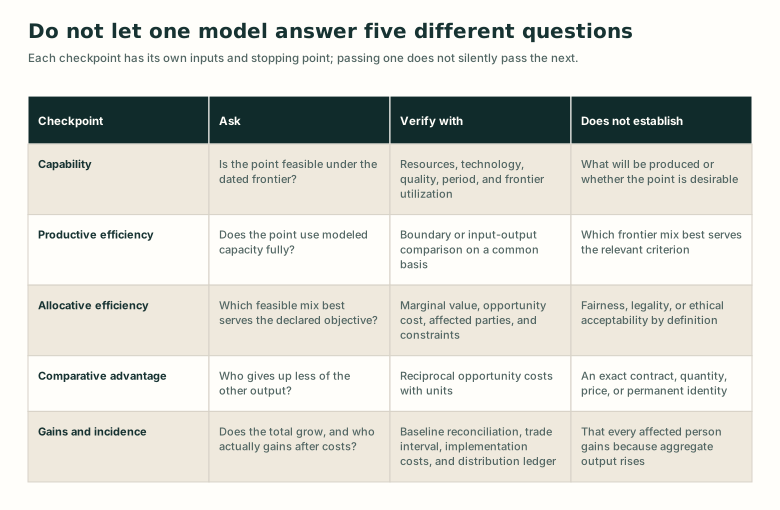
Five checkpoints from production capability to distributed gains
Detailed visual description
The capability row asks whether a point is feasible under a dated frontier and warns that feasibility is not a forecast or recommendation. Productive efficiency checks boundary use but cannot select a preferred mix. Allocative efficiency applies an explicit criterion but does not define fairness or legality. Comparative advantage uses reciprocal opportunity costs but does not write a contract. The final row reconciles total modeled gains and separately investigates implementation costs and distribution.
Put the concept to work
Apply this concept
- Compute reciprocal opportunity costs from comparable production possibilities, identify comparative advantage by lower sacrifice, and distinguish it from absolute output advantage.
Learning resources
Choose a lesson, try an application, or inspect the sources behind this concept.
Build on these ideas
- Absolute advantage — Apply
To apply this concept: Helpful. A direct contrast prevents greater productivity from being mistaken for lower opportunity cost.
- Opportunity cost — Apply
To apply this concept: Required. Comparative advantage is defined by the output sacrificed for one more unit of another output.
Lessons
Worked examples and cases
Practice
Common mistaken ideas
Sources
Related concepts
Show 2 more related concepts
Use this idea next
- Gains from trade — Analyze
Required level here: apply. Required. The foundational specialization result depends on parties having different opportunity costs.