A production possibilities frontier compresses a resource-allocation problem into two output dimensions. A point on the boundary uses the modeled resources fully under the stated technology and quality assumptions. A point inside is attainable but leaves some modeled capacity unused or misallocated. A point outside is unattainable under the current assumptions—not impossible forever.
Movement along the boundary exposes a trade-off. Producing more of one output requires giving up some of the other. The opportunity cost belongs to a stated segment and direction; it need not be constant across the frontier.
The frontier can move
New technology, more resources, learning, damage, regulation, or a changed quality standard can shift or rotate the boundary. A recession can move actual production inside an existing frontier without necessarily reducing productive capacity. These are different claims.
The frontier is not a forecast of what will be produced or a recommendation of which boundary point should be chosen. Selection requires preferences, marginal benefits and costs, distributional and institutional considerations, and decision authority. A two-output diagram also omits outputs and harms outside its axes.
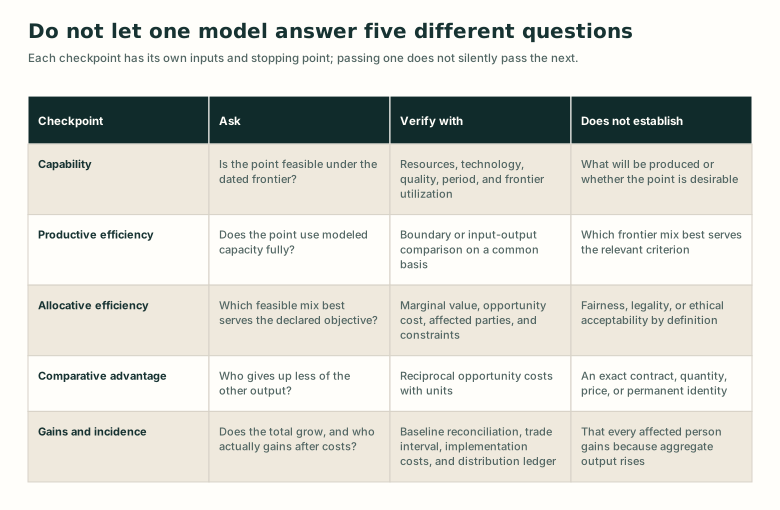
Five checkpoints from production capability to distributed gains
Detailed visual description
The capability row asks whether a point is feasible under a dated frontier and warns that feasibility is not a forecast or recommendation. Productive efficiency checks boundary use but cannot select a preferred mix. Allocative efficiency applies an explicit criterion but does not define fairness or legality. Comparative advantage uses reciprocal opportunity costs but does not write a contract. The final row reconciles total modeled gains and separately investigates implementation costs and distribution.
Put the concept to work
Analyze this concept
- Classify points as feasible, productively efficient, inefficient, or unattainable under a stated production-possibilities model and interpret opportunity cost without treating the frontier as a forecast.
Learning resources
Choose a lesson, try an application, or inspect the sources behind this concept.
Build on these ideas
- Economic model — Analyze
To analyze this concept: Required. The boundary is meaningful only with its resources, technology, period, outputs, and quality assumptions.
- Opportunity cost — Apply
To analyze this concept: Required. Movement along the frontier measures the output forgone when resources shift between the two modeled uses.
Lessons
Worked examples and cases
Practice
Common mistaken ideas
Sources
Broader topics
Related concepts
Show 4 more related concepts
Use this idea next
- Productive efficiency — Analyze
Required level here: analyze. Helpful. A frontier provides one visible representation of maximum attainable output combinations.