Productive efficiency concerns the use of resources, not whether the chosen output deserves to be produced. On a production possibilities frontier, a boundary point is productively efficient under the model because increasing one output requires reducing the other. An interior point signals unused or misallocated modeled capacity.
An input-oriented version asks whether the same quantity and quality could be produced with fewer resources. That question must preserve the output specification. Cutting review hours is not an efficiency gain if evidence quality falls below the required standard.
Diagnose before assigning cause
An interior point can arise from demand weakness, downtime, coordination failure, worker training, missing materials, deliberate slack, or a measurement error. The geometry identifies a gap under assumptions; it does not establish which mechanism caused the gap.
Productive efficiency also does not prove allocative efficiency. A factory can operate on its frontier while producing a mix that poorly matches customers, social objectives, or contractual duties. Nor does the concept imply that every resource must be used continuously; resilience and options may justify reserve capacity outside a narrow output-maximization model.
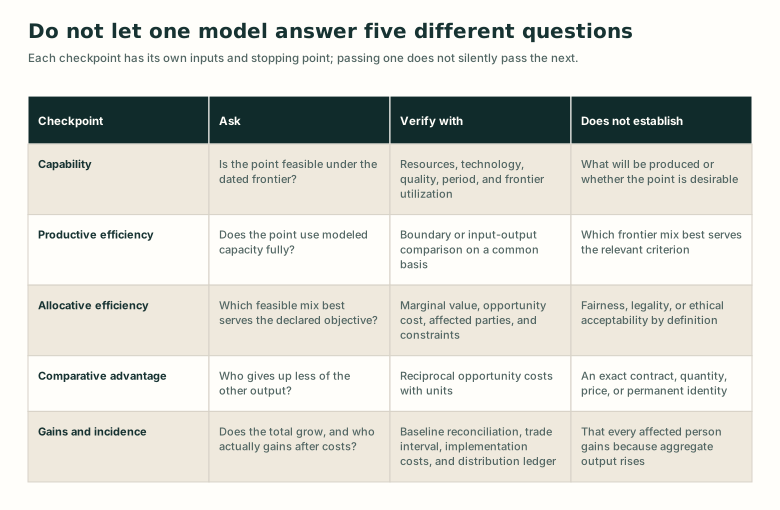
Five checkpoints from production capability to distributed gains
Detailed visual description
The capability row asks whether a point is feasible under a dated frontier and warns that feasibility is not a forecast or recommendation. Productive efficiency checks boundary use but cannot select a preferred mix. Allocative efficiency applies an explicit criterion but does not define fairness or legality. Comparative advantage uses reciprocal opportunity costs but does not write a contract. The final row reconciles total modeled gains and separately investigates implementation costs and distribution.
Put the concept to work
Analyze this concept
- Diagnose productive efficiency from a stated feasible set or input-output comparison while preserving quality, capacity, period, and omitted-resource boundaries.
Learning resources
Choose a lesson, try an application, or inspect the sources behind this concept.
Build on these ideas
- Economic efficiency — Understand
To analyze this concept: Required. The learner must distinguish resource-use efficiency from selection of the preferred output mix.
- Production possibilities frontier — Analyze
To analyze this concept: Helpful. A frontier provides one visible representation of maximum attainable output combinations.
Lessons
Worked examples and cases
Practice
Common mistaken ideas
Sources
Broader topics
Related concepts
Show 3 more related concepts
Use this idea next
- Absolute advantage — Apply
Required level here: analyze. Helpful. Both concepts require a controlled input-output comparison, though one compares producers and the other evaluates resource use against a feasible boundary.