Allocative efficiency asks whether resources are directed toward the modeled mix that creates the greatest stated value, not merely whether production sits on a boundary. A point can be productively efficient but allocatively poor if the next unit of one output is valued less than the output sacrificed to obtain it.
In a simplified competitive-market model without omitted harms or benefits, the comparison is often expressed as marginal benefit equal to marginal cost. In an organizational decision, the relevant value might be service reliability, risk reduction, mission fulfillment, or another justified objective.
Expose what the criterion counts
Whose preferences count? Are effects on workers, suppliers, communities, or the environment included? Does willingness to pay reflect ability to pay? Are legal rights and minimum-quality duties constraints rather than tradeable outcomes? An allocation can maximize a narrow surplus measure while failing another criterion.
Allocative efficiency is therefore a conditional model conclusion, not a synonym for fair, lawful, ethical, or politically legitimate. A professional analysis should report the criterion and omitted consequences before using the label to support a recommendation.
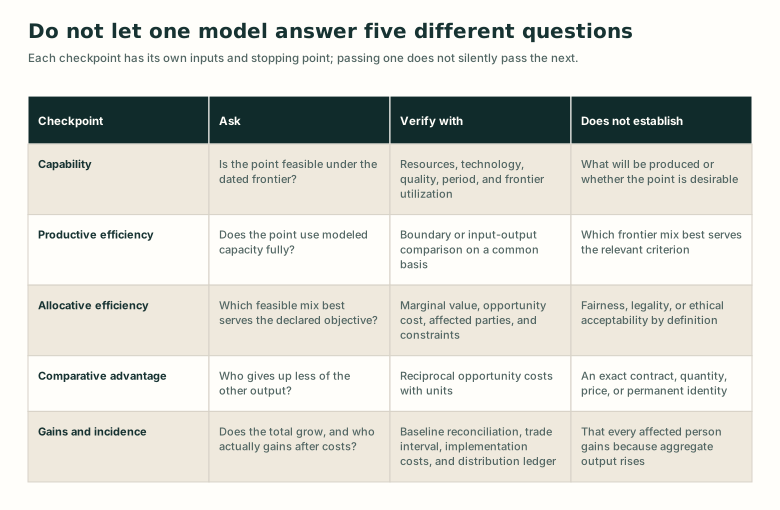
Five checkpoints from production capability to distributed gains
Detailed visual description
The capability row asks whether a point is feasible under a dated frontier and warns that feasibility is not a forecast or recommendation. Productive efficiency checks boundary use but cannot select a preferred mix. Allocative efficiency applies an explicit criterion but does not define fairness or legality. Comparative advantage uses reciprocal opportunity costs but does not write a contract. The final row reconciles total modeled gains and separately investigates implementation costs and distribution.
Put the concept to work
Analyze this concept
- Evaluate whether a product or resource mix is allocatively efficient under a stated marginal criterion and identify omitted preferences, distribution, external effects, rights, and authority.
Learning resources
Choose a lesson, try an application, or inspect the sources behind this concept.
Build on these ideas
- Economic efficiency — Understand
To analyze this concept: Required. Allocative efficiency must be distinguished from full use of productive capacity.
- Marginal analysis — Apply
To analyze this concept: Required. The model compares the marginal value and marginal opportunity cost of changing the output mix.