For one unit, consumer surplus is willingness to pay minus the transaction price. Across a continuous linear demand segment, the familiar triangle sums those modeled differences over traded quantity.
The measure depends on who receives the units. Under a binding price ceiling, the standard area often assumes the short-side quantity is allocated to buyers with the highest willingness to pay. Queues, favoritism, search, or random rationing can produce a different result.
Model value is not accounting revenue or cash
Consumer surplus is a welfare-model construct. It does not appear as an asset, revenue, gain, or cash receipt in the seller's financial statements. Nor does willingness to pay necessarily capture ability to pay, rights, distribution, nonmarket values, external effects, or information problems.
A complete use states demand provenance, traded quantity, allocation rule, price, market, period, and omitted parties before treating the area as evidence about buyer benefit.
Show the scope of the area
If a buyer would pay $90 for one unit and pays $70, the modeled consumer surplus for that unit is $20. A market triangle extends that logic only under the stated demand curve, price, allocation, and quantity assumptions. Taxes, search costs, quality, rationing, external effects, and differences among buyers can change the interpretation. Label the units and population, then keep the modeled area separate from accounting profit, cash, and a complete measure of buyer welfare.
A price-control conclusion needs two ledgers
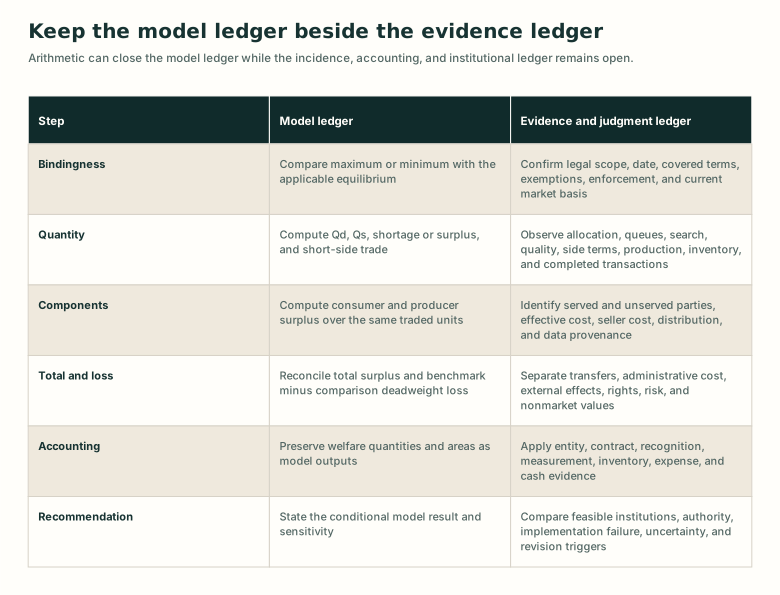
Detailed visual description
The table first compares a ceiling or floor with equilibrium, then computes demand, supply, imbalance, and short-side trade. Consumer and producer surplus use the same traded quantity, and deadweight loss reconciles total surplus rather than component transfers. A separate evidence ledger records legal scope, allocation, effective costs, production, inventory, transactions, distribution, external effects, rights, accounting recognition, alternatives, authority, and uncertainty.
Put the concept to work
Apply this concept
- Compute consumer surplus for a linear demand segment and traded quantity, then qualify willingness-to-pay, allocation, ability-to-pay, distribution, quality, and nonmarket-value limitations.
Learning resources
Choose a lesson, try an application, or inspect the sources behind this concept.
Build on these ideas
- Demand curve — Analyze
To apply this concept: Required. The area uses willingness to pay represented by the inverse demand relationship.
- Market equilibrium — Analyze
To apply this concept: Helpful. The equilibrium benchmark supplies one price and traded quantity for comparison.
Lessons
Worked examples and cases
Practice
Common mistaken ideas
Sources
Related concepts
Show 2 more related concepts
Use this idea next
- Total surplus — Analyze
Required level here: apply. Required. Consumer surplus is one component of the total.