Total surplus adds buyer and seller model areas using the same market, period, units, price, traded quantity, and allocation assumptions. Under a competitive model with no omitted external effects or other failures, equilibrium maximizes this narrow measure.
That result is conditional. The sum can conceal who receives benefits and who bears costs. Willingness to pay reflects ability to pay. Harms to third parties, rights, public goods, information, market power, risk, quality, and nonmarket values may be absent.
Total surplus is also not revenue, profit, equity, cash flow, enterprise value, or GDP. An accounting or valuation conclusion must return to its own entity, recognition, measurement, period, and source rules.
Report the benchmark as “total surplus under the stated model and exclusions,” not as complete social welfare or a policy instruction.
Reconcile before interpreting
In a simple market model, add consumer and producer surplus calculated for the same price, quantity, units, and scope. If buyer surplus is $400 and seller surplus is $300, total surplus is $700. The sum can compare allocations within the model. It does not show how gains are distributed or include taxes, external effects, unpaid activity, transition costs, rights, or fairness. A larger modeled total therefore supports a narrow efficiency result, not an automatic policy choice or complete welfare ranking.
A price-control conclusion needs two ledgers
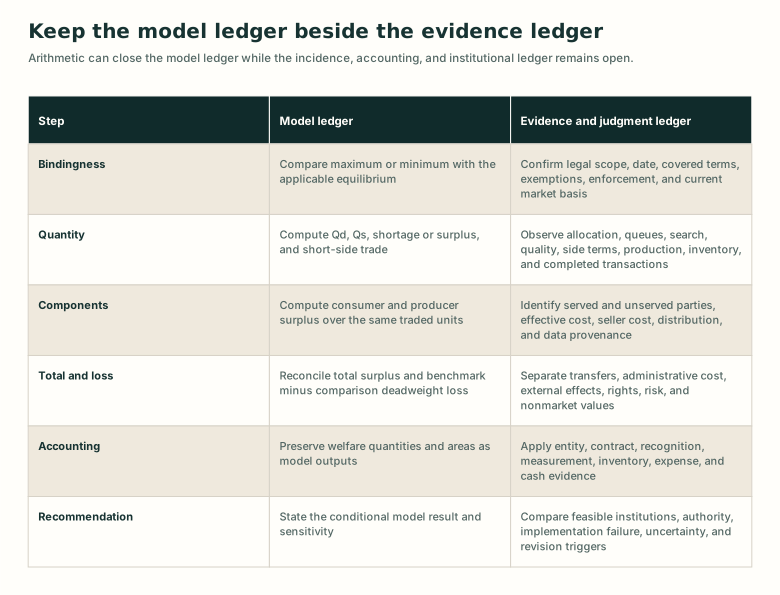
Detailed visual description
The table first compares a ceiling or floor with equilibrium, then computes demand, supply, imbalance, and short-side trade. Consumer and producer surplus use the same traded quantity, and deadweight loss reconciles total surplus rather than component transfers. A separate evidence ledger records legal scope, allocation, effective costs, production, inventory, transactions, distribution, external effects, rights, accounting recognition, alternatives, authority, and uncertainty.
Put the concept to work
Analyze this concept
- Reconcile consumer plus producer surplus over the same traded quantity and evaluate what the total excludes about distribution, external effects, rights, information, nonmarket value, and accounting measures.
Learning resources
Choose a lesson, try an application, or inspect the sources behind this concept.
Build on these ideas
- Consumer surplus — Apply
To analyze this concept: Required. Consumer surplus is one component of the total.
- Producer surplus — Apply
To analyze this concept: Required. Producer surplus is the other component in the foundational model.
Lessons
Worked examples and cases
Practice
Common mistaken ideas
- Mistaken idea: An economic surplus area is accounting profit or cash
- Mistaken idea: Deadweight loss is a transfer or accounting loss
- Mistaken idea: Market failure means no market or any disliked outcome
Show 1 more mistaken ideas
Sources
Related concepts
Show 3 more related concepts
Use this idea next
- Deadweight loss — Analyze
Required level here: analyze. Required. Deadweight loss is defined as a change in the declared total-surplus benchmark.
- Market failure — Analyze
Required level here: analyze. Helpful. Many foundational diagnoses use a total-surplus efficiency benchmark whose scope must be explicit.