Market failure does not mean that no market exists or that someone dislikes the outcome. It identifies a gap between an actual or modeled allocation and a declared benchmark. A mechanism such as an external effect, public-good problem, information asymmetry, or market power must explain that gap.
Diagnose before prescribing
State the market and benchmark. Identify the violated assumption and causal mechanism. Measure the affected margin and parties. Evaluate property rights, contracts, disclosure, standards, taxes, subsidies, provision, competition, liability, or other institutional alternatives.
Then examine implementation, enforcement, information, administrative cost, capture, unintended effects, and distribution. A market-failure diagnosis does not prove that one government intervention improves the outcome; government and organizational failures are comparison cases, not reasons to ignore the original problem.
Accounting records can reveal costs, obligations, contingencies, transactions, or disclosures relevant to the mechanism. They do not automatically measure the external or social value outside the reporting entity.
Diagnose the mechanism before choosing a remedy
For example, pollution can impose a cost on people outside a buyer-seller transaction. That observation identifies a candidate externality; it does not establish the size of harm or the best response. Define the market and affected parties, measure the missing cost or benefit, test rival explanations, and compare feasible institutions. Taxes, standards, bargaining rules, disclosure, public provision, and enforcement have different information and implementation demands. Preserve distribution, administrative cost, legal authority, and uncertainty as separate decision evidence.
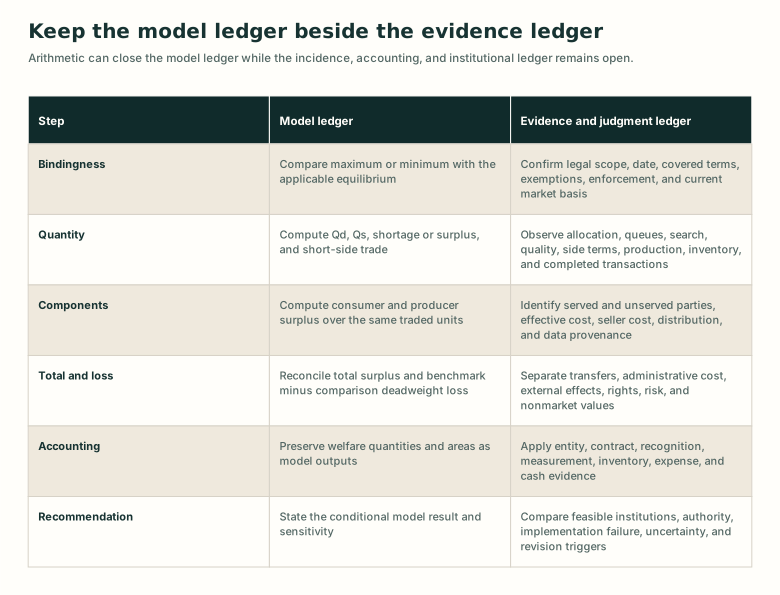
A price-control conclusion needs two ledgers
Detailed visual description
The table first compares a ceiling or floor with equilibrium, then computes demand, supply, imbalance, and short-side trade. Consumer and producer surplus use the same traded quantity, and deadweight loss reconciles total surplus rather than component transfers. A separate evidence ledger records legal scope, allocation, effective costs, production, inventory, transactions, distribution, external effects, rights, accounting recognition, alternatives, authority, and uncertainty.
Put the concept to work
Analyze this concept
- Diagnose a candidate market failure by naming the benchmark, violated mechanism, affected parties, evidence, institutional alternatives, government-failure risk, and conclusions the diagnosis does not establish.
Learning resources
Choose a lesson, try an application, or inspect the sources behind this concept.
Build on these ideas
- Market — Analyze
To analyze this concept: Required. The diagnosis applies to a defined market and institutional setting.
- Total surplus — Analyze
To analyze this concept: Helpful. Many foundational diagnoses use a total-surplus efficiency benchmark whose scope must be explicit.