A market is not merely a physical place or a ticker symbol. It can be a local auction, an online platform, a labor market, a bond market, or a negotiated business-to-business setting. What joins these cases is an institutional process through which potential exchange partners encounter prices, terms, rules, and one another.
Draw the boundary before using the data
“The market price rose” is incomplete until the analyst names the product and quality, geographic reach, customer and seller set, period, contract form, currency, and transaction stage. New and used equipment may be different markets. Wholesale and retail transactions may differ. A quoted price, an executed trade, and an accounting measurement are not interchangeable facts.
The boundary should follow the question and substitution possibilities rather than administrative convenience. Too narrow a market can hide alternatives; too broad a market can average unlike products, institutions, and risks.
Institutions shape exchange
Property rights, contract enforcement, disclosure, search, payment systems, regulation, platform rules, professional duties, and market power affect who can participate and on what terms. The basic supply-and-demand model initially holds many of these features fixed so price and quantity coordination remain visible. They return when the model is used for an actual decision.
A market outcome is not automatically competitive, fair, lawful, or welfare- maximizing. Those conclusions require additional structure, evidence, and a declared criterion.
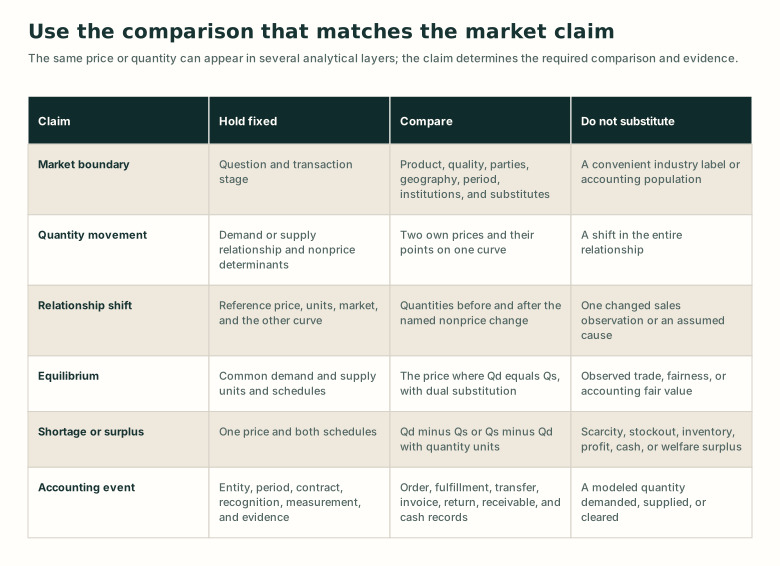
Market claims require different comparisons and records
Detailed visual description
The table requires a defined product, parties, geography, period, institutions, and transaction stage for market boundaries. Quantity movements compare own-price points on one fixed relationship, while shifts compare quantities at a common price after a named nonprice change. Equilibrium requires quantity demanded to equal quantity supplied and does not establish fairness or observed trade. Shortage and surplus retain quantity units and are not scarcity, inventory, profit, or welfare measures. Accounting claims return to entity, contract, event, recognition, measurement, and source records.
Put the concept to work
Analyze this concept
- Define a market's product, participants, geography, period, trading mechanism, information, legal constraints, and close substitutes before interpreting price or quantity evidence.
Learning resources
Choose a lesson, try an application, or inspect the sources behind this concept.
Build on these ideas
- Choice — Apply
To analyze this concept: Required. Market behavior aggregates choices made within feasible alternatives and institutional constraints.
- Economic model — Analyze
To analyze this concept: Helpful. A market boundary is an analytical construction whose inclusions and exclusions must fit the question.
Lessons
Worked examples and cases
- Define the Linden market and its transaction layers
- Separate a demand movement from a buyer shift
- Standard Oil: separate economic power, challenged conduct, doctrine, and remedy
Show 2 more examples and cases
Practice
- Define a market before interpreting its price
- Qualify a cross-price relationship before using it
- Reconcile equilibrium without inventing transactions
Show 1 more practice items
Common mistaken ideas
Sources
Related concepts
Show 9 more related concepts
Use this idea next
- Barriers to entry — Analyze
Required level here: analyze. Required. An entry condition must be evaluated against a defined product, participant, geography, period, and scale.
- Demand — Analyze
Required level here: analyze. Required. Demand belongs to a defined product, buyer population, geography, and period.
- Market failure — Analyze
Required level here: analyze. Required. The diagnosis applies to a defined market and institutional setting.
Show 3 more next steps
- Market power — Analyze
Required level here: analyze. Required. Power is evaluated relative to a defined market or a supported direct-effects framework.
- Market structure — Analyze
Required level here: analyze. Required. A structure label is meaningless until the product, participants, geography, period, and transaction stage define the market.
- Supply — Analyze
Required level here: analyze. Required. Supply belongs to a defined product, seller population, geography, and period.