Market structure organizes recurring differences in how sellers and buyers interact. The familiar four-model sequence—perfect competition, monopolistic competition, oligopoly, and monopoly—is a comparison tool, not four bins into which every real market drops without judgment.
| Feature | Questions before classification |
|---|---|
| Participants | How many meaningful sellers and buyers operate at the relevant level? |
| Product | Homogeneous, differentiated, bundled, compatible, or platform-linked? |
| Entry | What legal, technological, financial, contractual, network, or reputation conditions affect entry and expansion? |
| Information | Who observes price, quality, terms, cost, and alternatives, and when? |
| Interaction | Do firms take market conditions as given or anticipate rivals' responses? |
| Terms | Can a firm profitably change price, quality, quantity, access, or contract terms? |
The answers can differ by product definition, geography, customer group, time, and transaction layer. A global input market can coexist with a local retail market. A firm can face competition in one product and strong bargaining power in another.
Model, observation, and law are separate
A model may assume many price-taking firms to derive a benchmark. An empirical study may measure shares, entry, switching, margins, or conduct. A legal inquiry applies current authority to a defined question and record. These are connected but not interchangeable.
A structure label does not prove collusion, abuse, efficiency, profitability, fairness, or illegality. Nor does an accounting segment disclose the relevant economic market automatically. Segment reporting, legal entities, brands, and markets answer different boundary questions.
Use the classification to organize evidence and predict which mechanisms may matter. Then test those mechanisms rather than treating the label as the conclusion.
Market structure is a screen, not a verdict
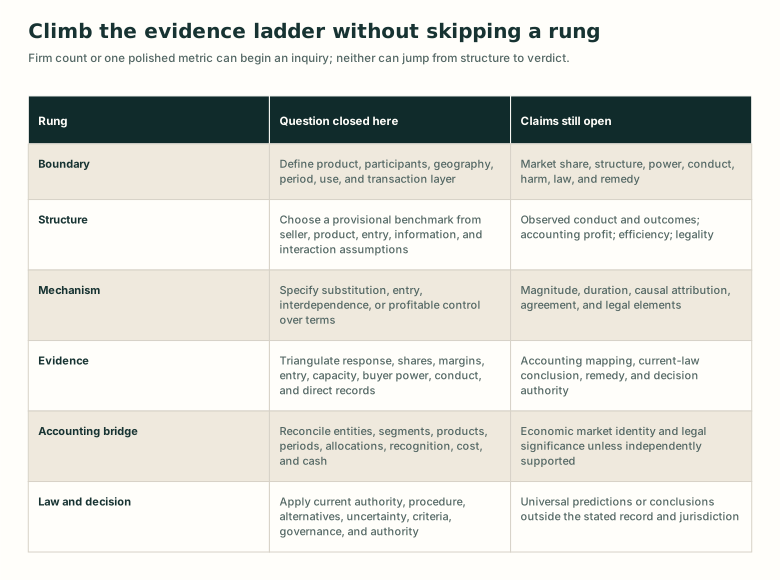
Detailed visual description
The ladder begins with a defined market boundary, chooses a provisional structure benchmark, specifies substitution, entry, interdependence, or power mechanisms, triangulates empirical evidence, reconciles accounting records to economic variables, and only then applies current legal authority and decision criteria. Every row lists claims that cannot yet be inferred.
Put the concept to work
Analyze this concept
- Classify a market-structure model from seller, buyer, differentiation, entry, information, and strategic-interaction assumptions, then audit the evidence and non-claims behind applying that model to a real market.
Learning resources
Choose a lesson, try an application, or inspect the sources behind this concept.
Build on these ideas
- Economic model — Analyze
To analyze this concept: Required. Perfect competition, monopoly, monopolistic competition, and oligopoly are analytical models whose assumptions must remain visible.
- Market — Analyze
To analyze this concept: Required. A structure label is meaningless until the product, participants, geography, period, and transaction stage define the market.
Lessons
Worked examples and cases
Practice
Common mistaken ideas
Sources
Broader topics
More specific topics
Show 1 more more specific topics
Related concepts
Use this idea next
- Monopolistic competition — Analyze
Required level here: analyze. Required. The model combines many-seller rivalry with product differentiation and entry.
- Monopoly — Analyze
Required level here: analyze. Required. Single-seller status is evaluated only within a defined market and model horizon.
- Oligopoly — Analyze
Required level here: analyze. Required. Oligopoly is distinguished by strategic interdependence within a defined market, not by a universal firm-count cutoff.
Show 1 more next steps
- Perfect competition — Analyze
Required level here: analyze. Required. The benchmark is one market-structure model whose assumptions must be compared with the defined setting.