Monopolistic competition combines rivalry with differentiation. Many sellers offer products that buyers do not treat as identical. Each firm can face a downward-sloping demand relationship for its version, yet substitutes and entry limit its discretion.
Differentiation can involve quality, service, location, design, reputation, compatibility, convenience, or brand. It is not automatically wasteful or deceptive; it can convey real differences or reduce search. Nor does advertising prove differentiation succeeded.
Under the benchmark's long-run entry conditions, attractive economic profit can draw entry and shift a firm's demand until economic profit is eroded. That is not a prediction that accounting net income becomes zero. Economic profit charges opportunity costs, while accounting profit follows reporting definitions and can remain positive.
Real settings may have sunk investment, network effects, contracts, regulation, scale, data, loyalty, or scarce locations that make entry less free than the simple model assumes. State those departures instead of forcing the label.
Market structure is a screen, not a verdict
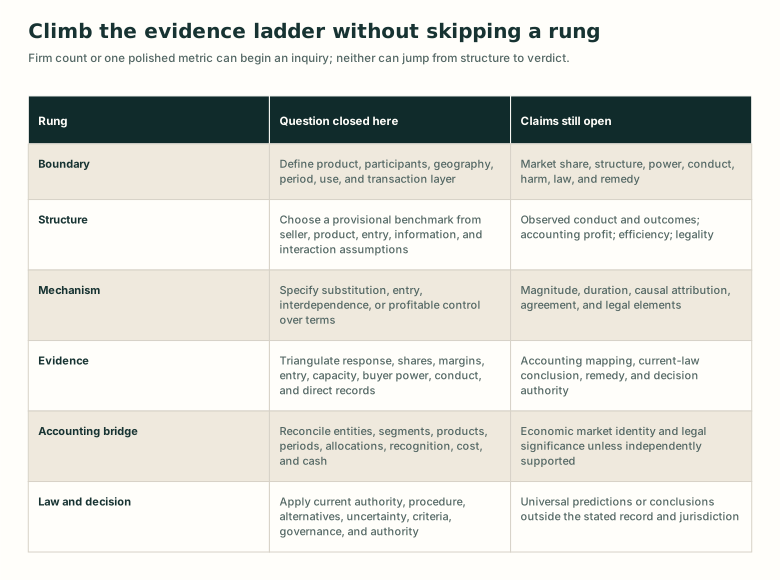
Detailed visual description
The ladder begins with a defined market boundary, chooses a provisional structure benchmark, specifies substitution, entry, interdependence, or power mechanisms, triangulates empirical evidence, reconciles accounting records to economic variables, and only then applies current legal authority and decision criteria. Every row lists claims that cannot yet be inferred.
Put the concept to work
Analyze this concept
- Distinguish differentiated-product competition from price taking, monopoly, and oligopoly by analyzing substitution, entry, brand or quality investment, firm-level demand, and the difference between accounting and economic profit.
Learning resources
Choose a lesson, try an application, or inspect the sources behind this concept.
Build on these ideas
- Market structure — Analyze
To analyze this concept: Required. The model combines many-seller rivalry with product differentiation and entry.
- Substitute good — Analyze
To analyze this concept: Helpful. Differentiated products can remain imperfect substitutes rather than homogeneous units.