Perfect competition is a benchmark. Each firm is small relative to the market and takes the market price as given. Products are treated as homogeneous; participants can enter or exit under the model's conditions; and no single seller can profitably set a market-wide price merely by announcing one.
The word “perfect” names assumptions, not a moral ranking. Real markets can approximate some features while departing from others through location, quality, brand, information, capacity, contracts, regulation, search cost, or entry barriers.
What the benchmark helps isolate
The model separates a firm's output choice from market-price determination and provides a reference for productive and allocative efficiency under restrictive conditions. It can reveal which conclusion changes when a departure—market power, external effect, asymmetric information, or entry barrier—is introduced.
It does not prove that observed prices are fair, sustainable, lawful, or equal to accounting cost. Economic cost includes opportunity cost; financial statements apply recognition and measurement rules. A competitive model also does not establish completed sales, revenue, inventory, or cash.
Use “approximately competitive” only after defining the market and documenting the relevant price-taking, product, entry, information, and transaction facts.
Market structure is a screen, not a verdict
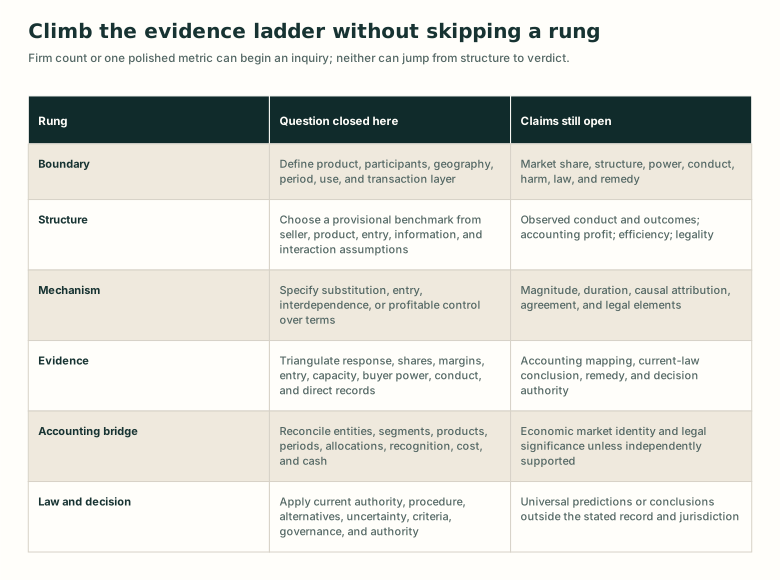
Detailed visual description
The ladder begins with a defined market boundary, chooses a provisional structure benchmark, specifies substitution, entry, interdependence, or power mechanisms, triangulates empirical evidence, reconciles accounting records to economic variables, and only then applies current legal authority and decision criteria. Every row lists claims that cannot yet be inferred.
Put the concept to work
Analyze this concept
- Apply the price-taking benchmark to a stated scenario, identify departures in product, information, entry, capacity, transaction cost, and participant power, and limit efficiency and accounting conclusions accordingly.
Learning resources
Choose a lesson, try an application, or inspect the sources behind this concept.
Build on these ideas
- Market equilibrium — Analyze
To analyze this concept: Required. A competitive benchmark coordinates individual price-taking choices through a market clearing condition.
- Market structure — Analyze
To analyze this concept: Required. The benchmark is one market-structure model whose assumptions must be compared with the defined setting.