Monopoly begins with a market boundary, not a company name. One seller of a brand is not necessarily the only seller in the relevant market if buyers can switch to products that discipline its terms. Conversely, a market can be narrower than a broad industry label when alternatives do not serve the same buyers, use, location, or time.
A monopolist faces the market demand relationship rather than a horizontal price-taking demand line. That does not mean it can charge any price. Buyer response, willingness and ability to pay, costs, capacity, durable-good resale, entry threats, innovation, contracts, regulation, and buyer power constrain choices.
Structure is not a verdict
Single-seller structure does not by itself prove unlawful conduct. Antitrust questions depend on jurisdiction, current law, defined market, power, conduct, effects, defenses, procedure, and evidence. The Standard Oil history belongs in that institutional analysis; it is not a timeless shortcut from “large firm” to liability.
Accounting revenue, margin, assets, and segment data can inform the record, but do not alone define the market or prove durable market power. A high accounting margin may reflect risk, innovation, intangible investment, measurement, temporary scarcity, differentiation, or power; those explanations must be tested.
Market structure is a screen, not a verdict
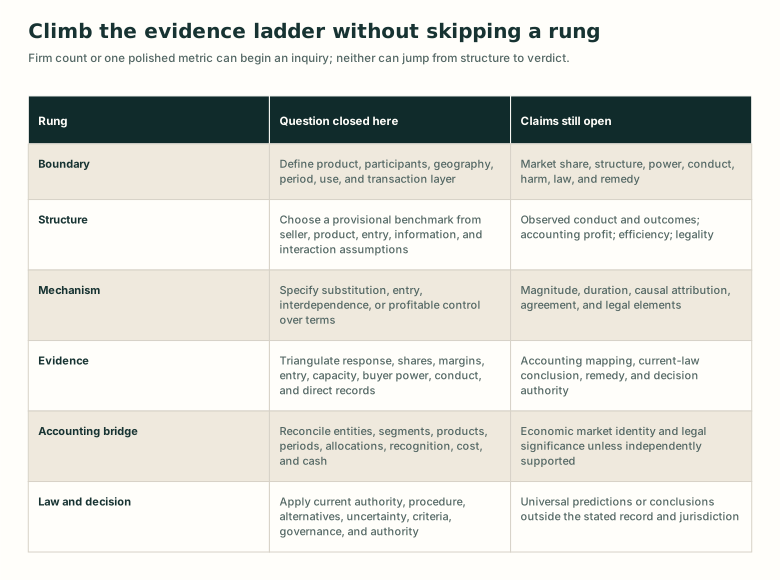
Detailed visual description
The ladder begins with a defined market boundary, chooses a provisional structure benchmark, specifies substitution, entry, interdependence, or power mechanisms, triangulates empirical evidence, reconciles accounting records to economic variables, and only then applies current legal authority and decision criteria. Every row lists claims that cannot yet be inferred.
Put the concept to work
Analyze this concept
- Test a monopoly claim by defining the market, seller, substitutes, entry and expansion conditions, time horizon, buyer power, regulation, and constraints, while separating structure from conduct and legal conclusions.
Learning resources
Choose a lesson, try an application, or inspect the sources behind this concept.
Build on these ideas
- Market structure — Analyze
To analyze this concept: Required. Single-seller status is evaluated only within a defined market and model horizon.
- Substitute good — Analyze
To analyze this concept: Required. Reasonable substitution can make a one-brand boundary too narrow for the economic question.
Lessons
Worked examples and cases
- Compare four market-structure models without forcing a label
- Microsoft: trace platform entry threats, conduct, and remedy
- Standard Oil: separate economic power, challenged conduct, doctrine, and remedy