Market power is an ability, not a synonym for size, popularity, a high price, or a positive margin. The firm must be able to influence competitive terms profitably and for a period that matters to the question.
Evidence can include substitution patterns, demand response, market shares, capacity, margins, entry and expansion, switching, contracts, direct customer or internal evidence, conduct, duration, buyer power, and natural experiments. Each measure has alternative explanations and data requirements.
Triangulate rather than crown one metric
A high share in a boundary drawn too narrowly can overstate power. A low share can obscure differentiated segments or direct effects. A price-cost margin can reflect fixed and sunk costs, risk, innovation, accounting measurement, product mix, regulation, temporary scarcity, or power. Entry history can reflect unattractive demand as well as barriers.
State the mechanism connecting evidence to profitable control over terms, test rival explanations, and report uncertainty. Accounting data should be mapped from reported segments, periods, transfer prices, allocations, and recognition rules to the economic variables actually needed.
Economic market power does not itself establish a legal violation. Current law, jurisdiction, conduct, effects, defenses, procedure, and authority remain a separate analysis.
Institutions create different kinds of economic evidence
Detailed visual description
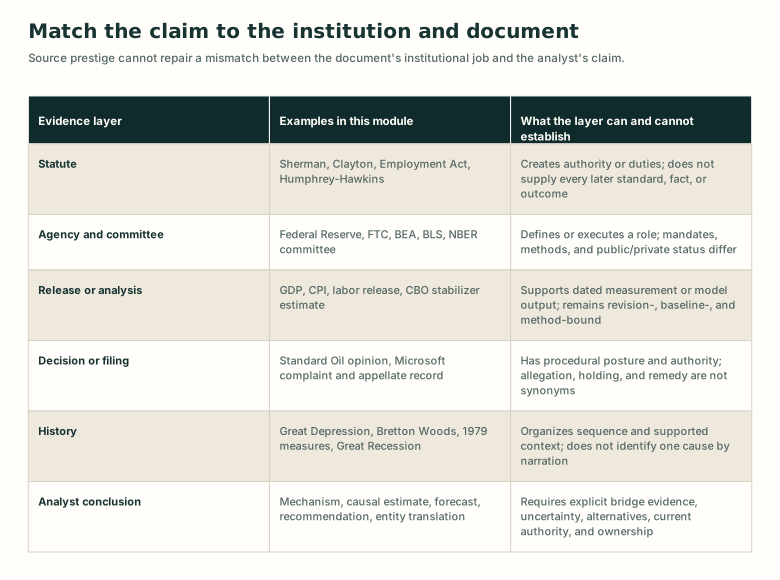
The table separates laws from institutions, statistical releases from analyses, legal complaints from holdings, and historical sequence from causal inference. The final row requires bridge evidence, uncertainty, alternatives, authority, and decision ownership for an analyst conclusion.
Market structure is a screen, not a verdict
Detailed visual description
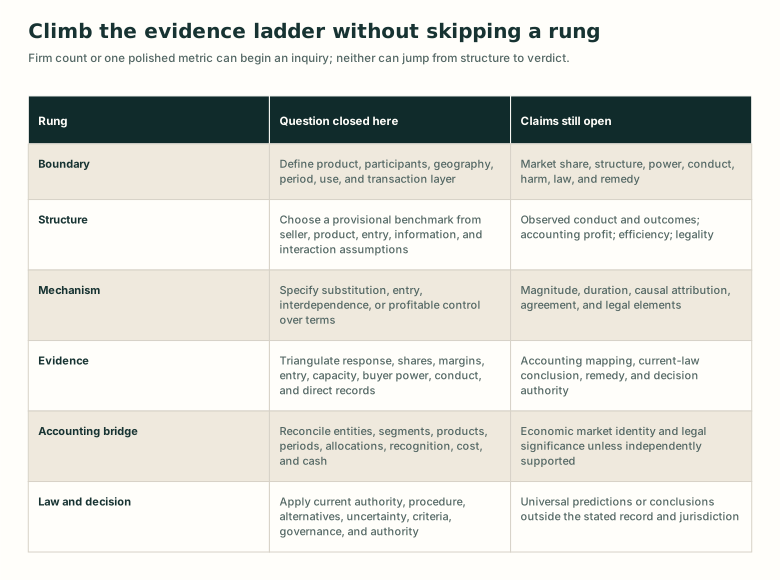
The ladder begins with a defined market boundary, chooses a provisional structure benchmark, specifies substitution, entry, interdependence, or power mechanisms, triangulates empirical evidence, reconciles accounting records to economic variables, and only then applies current legal authority and decision criteria. Every row lists claims that cannot yet be inferred.
Put the concept to work
Analyze this concept
- Build a bounded market-power analysis from substitution, shares, margins, entry, capacity, conduct, duration, buyer power, and direct evidence while separating economic inference from accounting and legal conclusions.
Learning resources
Choose a lesson, try an application, or inspect the sources behind this concept.
Build on these ideas
- Barriers to entry — Analyze
To analyze this concept: Required. Entry or expansion can discipline current terms and affect whether power is durable.
- Market — Analyze
To analyze this concept: Required. Power is evaluated relative to a defined market or a supported direct-effects framework.
- Price elasticity of demand — Analyze
To analyze this concept: Helpful. Buyer response and substitution can constrain a firm's ability to change terms profitably.
Lessons
Worked examples and cases
- Microsoft: trace platform entry threats, conduct, and remedy
- Separate concentration from market-power proof
- Standard Oil: separate economic power, challenged conduct, doctrine, and remedy