Substitutes can satisfy overlapping uses. If tea becomes more expensive and coffee demand rises under controlled conditions, coffee is a substitute for tea in that relationship. The statement is directional: “coffee demand responds to tea price” is not automatically identical to “tea demand responds to coffee price.”
Substitution can be close or weak, immediate or delayed, and limited to a segment. A commuter may substitute bus travel for rail on one route while using both on a connecting trip. A firm's own products may substitute across customer uses while also sharing a complementary platform.
Do not infer a permanent label from category resemblance or one anecdote. Specify quality, location, timing, customer, use, switching cost, availability, and the range of prices observed. A positive cross-price estimate supports the classification only to the extent that measurement and identification support the response.
Substitution evidence can inform demand, competition, and planning analysis. It does not itself define a legal market, prove market power, forecast sales, or determine accounting treatment.
An elasticity coefficient needs an interpretation ledger
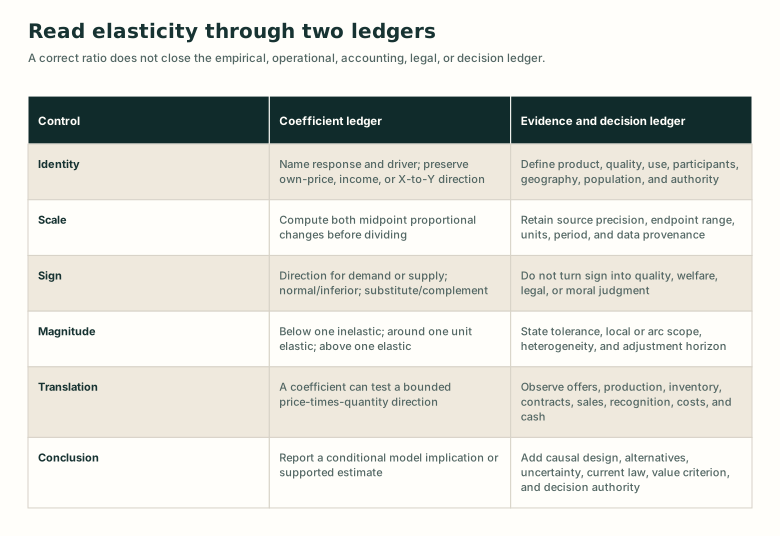
Detailed visual description
The coefficient ledger names response and driver, computes both midpoint percentage changes, preserves sign, classifies absolute magnitude, and reports a conditional result. The evidence ledger defines market scope, data provenance, adjustment horizon, causal posture, operational records, accounting events, legal authority, alternatives, uncertainty, value criteria, and decision authority.
Put the concept to work
Analyze this concept
- Classify a substitute relationship from supported cross-price direction and qualify product order, use, segment, market, period, switching conditions, evidence design, and conclusions not established.
Learning resources
Choose a lesson, try an application, or inspect the sources behind this concept.
Build on these ideas
- Cross-price elasticity of demand — Analyze
To analyze this concept: Required. A positive cross-price response is the foundational quantitative signal for substitution.
Lessons
Worked examples and cases
- Classify two Harbor related-good responses
- Microsoft: trace platform entry threats, conduct, and remedy
- Separate concentration from market-power proof
Show 1 more examples and cases
Practice
Common mistaken ideas
Sources
Related concepts
Show 5 more related concepts
Use this idea next
- Monopolistic competition — Analyze
Required level here: analyze. Helpful. Differentiated products can remain imperfect substitutes rather than homogeneous units.
- Monopoly — Analyze
Required level here: analyze. Required. Reasonable substitution can make a one-brand boundary too narrow for the economic question.