Complements are used together in a way that links demand. If milk becomes more expensive and cereal demand falls under controlled conditions, cereal is a complement to milk in that relationship. The sign of cross-price elasticity is negative.
Joint use is not all-or-nothing. Hardware and software, equipment and consumables, transport legs, financing and an asset purchase, or two inputs can be complementary for some users and not others. Bundling, compatibility, installed base, contracts, timing, and alternative uses can change the measured relationship.
The classification is directional and bounded. A price change in X may affect Y differently from a price change in Y affecting X. A historical segment-level estimate should not be promoted to a permanent product fact.
Complementarity can matter for forecasts and multi-product decisions, but the relationship alone does not establish transaction volume, recognized revenue, profit, cash, a legal market, or a recommended bundle. Those claims require their own evidence and authority.
An elasticity coefficient needs an interpretation ledger
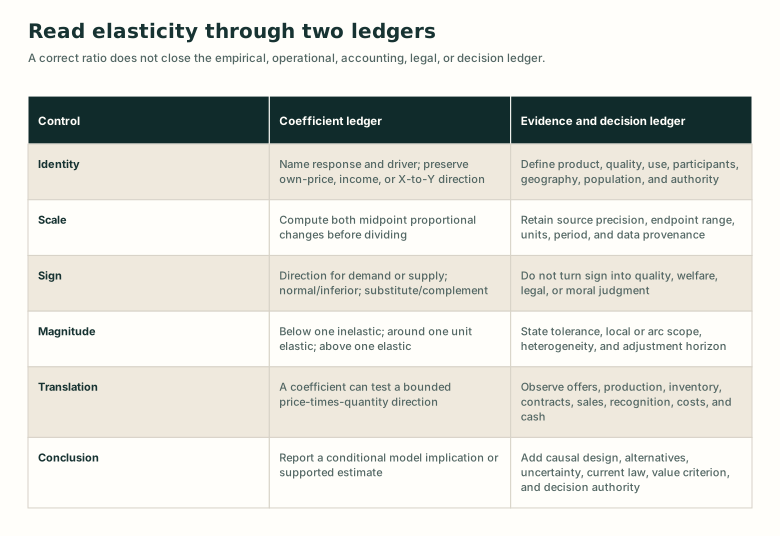
Detailed visual description
The coefficient ledger names response and driver, computes both midpoint percentage changes, preserves sign, classifies absolute magnitude, and reports a conditional result. The evidence ledger defines market scope, data provenance, adjustment horizon, causal posture, operational records, accounting events, legal authority, alternatives, uncertainty, value criteria, and decision authority.
Put the concept to work
Analyze this concept
- Classify a complementary relationship from supported cross-price direction and qualify product order, joint use, segment, market, period, bundle conditions, evidence design, and conclusions not established.
Learning resources
Choose a lesson, try an application, or inspect the sources behind this concept.
Build on these ideas
- Cross-price elasticity of demand — Analyze
To analyze this concept: Required. A negative cross-price response is the foundational quantitative signal for complementarity.