An entry barrier is not merely something difficult or expensive. The question is whether a potential rival can enter or expand on a timely and sufficient scale, with a reasonable prospect of recovering the required commitment, in the market and period being analyzed.
Relevant conditions can include licenses, patents, standards, scale economies, network effects, switching costs, data, scarce inputs, distribution, reputation, installed base, compatibility, financing, sunk investment, location, and strategic incumbent response. The categories can interact.
Cost alone is not enough
Incumbents also incurred many ordinary costs. A large expenditure can be a barrier when entrants face an asymmetry, irrecoverable commitment, scale gap, coordination problem, or delayed path that prevents timely discipline. A small formal fee can matter when paired with a scarce authorization or long approval process.
Evidence should address attempts, failures, expansion, minimum viable scale, lead time, expected post-entry price, access terms, customer switching, and incumbent responses. Announced entry without actual ability to discipline the market is weak evidence.
Capitalized assets, expenses, commitments, and contracts can inform the entry record. Their accounting classification does not decide economic recoverability or competitive significance by itself.
Market structure is a screen, not a verdict
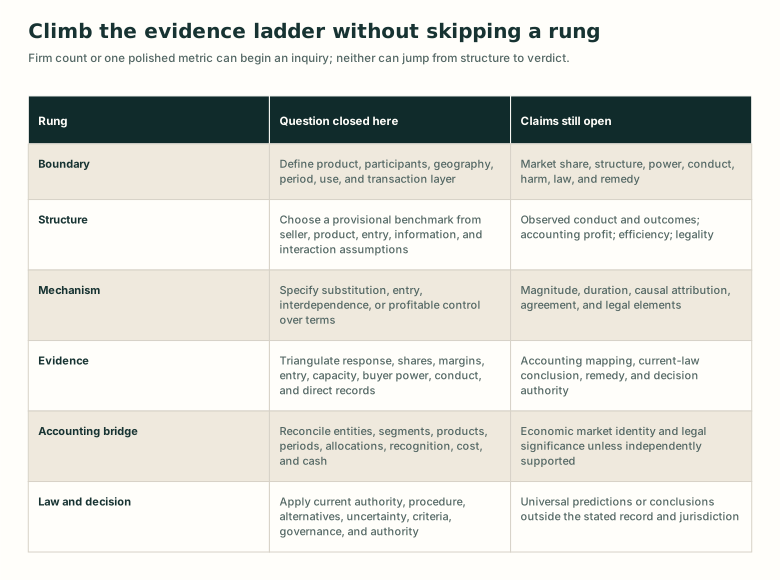
Detailed visual description
The ladder begins with a defined market boundary, chooses a provisional structure benchmark, specifies substitution, entry, interdependence, or power mechanisms, triangulates empirical evidence, reconciles accounting records to economic variables, and only then applies current legal authority and decision criteria. Every row lists claims that cannot yet be inferred.
Put the concept to work
Analyze this concept
- Classify legal, scale, network, switching, data, capital, input, reputation, location, and strategic entry conditions, then test whether entry or expansion is timely, likely, and sufficient for the stated market question.
Learning resources
Choose a lesson, try an application, or inspect the sources behind this concept.
Build on these ideas
- Incentive — Analyze
To analyze this concept: Helpful. Entry depends on expected post-entry returns, incumbent response, uncertainty, and recoverability rather than engineering feasibility alone.
- Market — Analyze
To analyze this concept: Required. An entry condition must be evaluated against a defined product, participant, geography, period, and scale.
Lessons
Worked examples and cases
- Microsoft: trace platform entry threats, conduct, and remedy
- Separate concentration from market-power proof
- Standard Oil: separate economic power, challenged conduct, doctrine, and remedy
Show 2 more examples and cases
Practice
Common mistaken ideas
Sources
Related concepts
Show 4 more related concepts
Use this idea next
- Market power — Analyze
Required level here: analyze. Required. Entry or expansion can discipline current terms and affect whether power is durable.