Market equilibrium is a model consistency condition. At the equilibrium price, the quantity buyers would purchase equals the quantity sellers would offer under the stated schedules. In a linear model, solve the equality and substitute the price back into both equations. The two quantities must reconcile.
The crossing is conditional
Change demand, supply, market boundaries, institutions, expectations, or the period and the equilibrium can change. A diagram with one crossing does not prove that adjustment is instantaneous, costless, unique, or stable. Search, contracts, inventories, price-setting practices, regulation, and market power can alter the process.
Clearing is not a complete evaluation
An equilibrium quantity can exclude buyers who cannot pay, impose external costs, reflect unequal bargaining power, or arise under unlawful conduct. A model-clearing price is not automatically fair. Under additional competitive and no-externality assumptions, equilibrium can support a narrow surplus result; those assumptions must be stated rather than imported by the word equilibrium.
The model price is also not automatically an observable transaction price, accounting fair value, revenue amount, or forecast. Each of those claims has its own evidence and authority requirements.
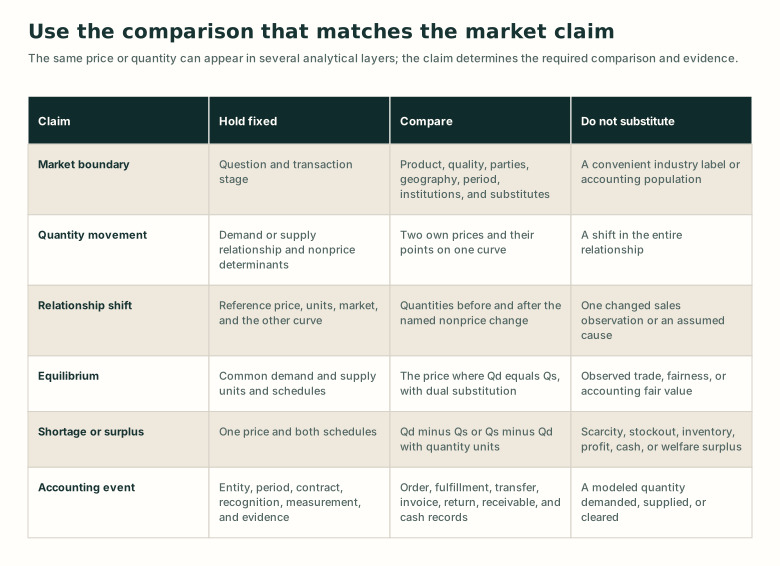
Market claims require different comparisons and records
Detailed visual description
The table requires a defined product, parties, geography, period, institutions, and transaction stage for market boundaries. Quantity movements compare own-price points on one fixed relationship, while shifts compare quantities at a common price after a named nonprice change. Equilibrium requires quantity demanded to equal quantity supplied and does not establish fairness or observed trade. Shortage and surplus retain quantity units and are not scarcity, inventory, profit, or welfare measures. Accounting claims return to entity, contract, event, recognition, measurement, and source records.
Put the concept to work
Analyze this concept
- Solve and reconcile a market equilibrium from stated demand and supply relationships, then distinguish the model-clearing point from observed transactions, fairness, legal acceptability, and allocative efficiency under omitted effects.
Learning resources
Choose a lesson, try an application, or inspect the sources behind this concept.
Build on these ideas
- Demand curve — Analyze
To analyze this concept: Required. Equilibrium requires a demand relationship defined over a common price, quantity, market, and period.
- Supply curve — Analyze
To analyze this concept: Required. Equilibrium requires a supply relationship on the same units and market boundary.
Lessons
Worked examples and cases
- Classify a Linden shortage and surplus
- Diagnose a market failure before choosing a remedy
- Reconcile Linden consumer, producer, and total surplus
Show 2 more examples and cases
Practice
Common mistaken ideas
Sources
Related concepts
Show 11 more related concepts
Use this idea next
- Consumer surplus — Apply
Required level here: analyze. Helpful. The equilibrium benchmark supplies one price and traded quantity for comparison.
- Perfect competition — Analyze
Required level here: analyze. Required. A competitive benchmark coordinates individual price-taking choices through a market clearing condition.
- Price ceiling — Analyze
Required level here: analyze. Required. Bindingness depends on the ceiling's position relative to the applicable equilibrium.
Show 3 more next steps
- Price floor — Analyze
Required level here: analyze. Required. Bindingness depends on the floor's position relative to the applicable equilibrium.
- Shortage — Analyze
Required level here: analyze. Required. A shortage is interpreted relative to common demand and supply schedules and their clearing point.
- Surplus — Analyze
Required level here: analyze. Required. A surplus is interpreted relative to common demand and supply schedules and their clearing point.