A shortage is price-specific. If buyers would purchase 900 chairs per week at $50 while sellers would offer 700, the model shortage is 200 chairs per week. State both schedules, the price, unit, market, and period.
The opposite imbalance is a surplus, in which quantity supplied exceeds quantity demanded. OpenStax Section 3.1 explains both gaps around market equilibrium.
Scarcity is broader: resources have competing uses even at equilibrium. A stockout is operational: one seller has no inventory at a place and time. Unmet orders are observed records that may reflect allocation, search, delivery, or measurement. These facts can coexist, but they are not synonyms.
Adjustment is a mechanism, not a definition
In a flexible competitive model, excess demand can put upward pressure on price, reducing quantity demanded and increasing quantity supplied. Actual adjustment may instead use waiting, queues, search, quality changes, side payments, favoritism, rationing, entry, or rule changes. A price control can prevent the modeled price movement. A binding price ceiling can preserve excess demand in the basic model.
The arithmetic establishes the gap under supplied curves. It does not prove the curves, identify who goes without, measure welfare, or prescribe a remedy.
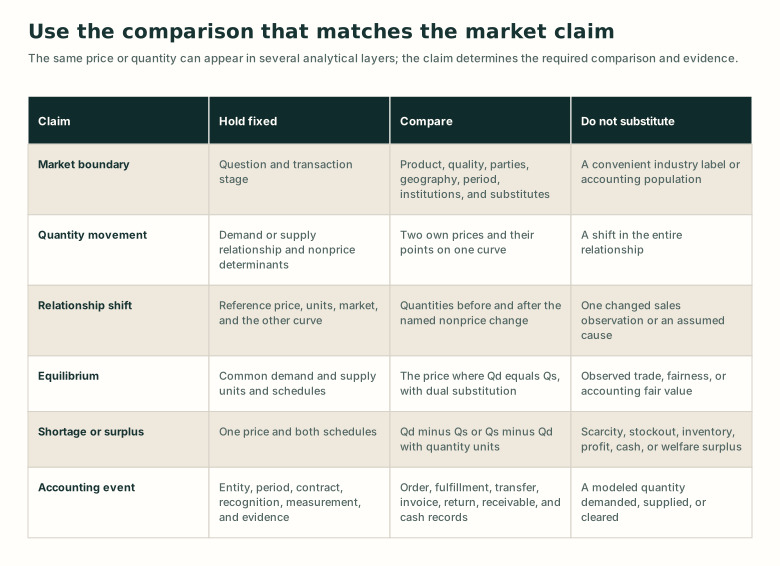
Market claims require different comparisons and records
Detailed visual description
The table requires a defined product, parties, geography, period, institutions, and transaction stage for market boundaries. Quantity movements compare own-price points on one fixed relationship, while shifts compare quantities at a common price after a named nonprice change. Equilibrium requires quantity demanded to equal quantity supplied and does not establish fairness or observed trade. Shortage and surplus retain quantity units and are not scarcity, inventory, profit, or welfare measures. Accounting claims return to entity, contract, event, recognition, measurement, and source records.
Put the concept to work
Analyze this concept
- Compute excess demand at a stated price and distinguish the model imbalance from universal scarcity, a firm-level stockout, observed unfilled orders, and the mechanism by which adjustment may occur.
Learning resources
Choose a lesson, try an application, or inspect the sources behind this concept.
Build on these ideas
- Market equilibrium — Analyze
To analyze this concept: Required. A shortage is interpreted relative to common demand and supply schedules and their clearing point.
- Scarcity — Understand
To analyze this concept: Required. The learner must distinguish universal constrained choice from price-specific excess demand.
Lessons
Worked examples and cases
Practice
Common mistaken ideas
Sources
Related concepts
Show 3 more related concepts
Use this idea next
- Price ceiling — Analyze
Required level here: analyze. Required. A binding ceiling can create price-specific excess demand under the stated curves.