Deadweight loss is the part of the benchmark surplus that no modeled party receives. A price change can transfer surplus from buyers to sellers or the reverse without destroying it. The lost gains from trades that no longer occur are different.
For a linear market and a controlled price, first compute the short-side traded quantity. Then compute consumer surplus, producer surplus, their total, and the difference from equilibrium total surplus. Keep the assumed allocation rule and omitted implementation costs visible.
The result is not an accounting loss or cash outflow. It is not necessarily a government revenue figure, and it does not decide whether distributional, legal, ethical, or nonmarket objectives justify a policy. A small measured deadweight loss does not prove a policy is good; a large one does not by itself select an alternative.
Compare two allocations on one basis
Compute deadweight loss as the total-surplus difference between a stated benchmark and another allocation, using the same demand, supply, units, period, and welfare scope. If benchmark surplus is $900 and controlled-price surplus is $750, the modeled loss is $150. Do not add transfers between buyers, sellers, and government to the loss merely because distribution changes. Rationing, quality, enforcement, external effects, and other omitted costs may require a wider model before the number can inform a decision.
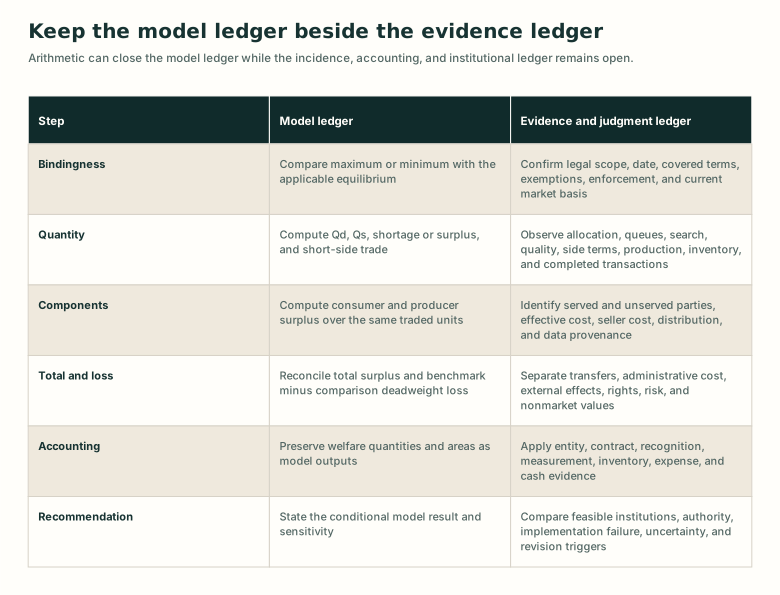
A price-control conclusion needs two ledgers
Detailed visual description
The table first compares a ceiling or floor with equilibrium, then computes demand, supply, imbalance, and short-side trade. Consumer and producer surplus use the same traded quantity, and deadweight loss reconciles total surplus rather than component transfers. A separate evidence ledger records legal scope, allocation, effective costs, production, inventory, transactions, distribution, external effects, rights, accounting recognition, alternatives, authority, and uncertainty.
Put the concept to work
Analyze this concept
- Compute deadweight loss as benchmark total surplus minus controlled or distorted total surplus, reconcile the components, and distinguish lost modeled gains from transfers, accounting losses, and distributional judgments.
Learning resources
Choose a lesson, try an application, or inspect the sources behind this concept.
Build on these ideas
- Total surplus — Analyze
To analyze this concept: Required. Deadweight loss is defined as a change in the declared total-surplus benchmark.