Price elasticity of supply measures how offered quantity changes proportionally with own price. Its sign is positive on an upward-sloping supply relationship. Classification uses magnitude: below one is inelastic, one is unit elastic, and above one is elastic over the specified arc.
Price elasticity of demand uses the same own-price driver but responds with buyer quantity rather than seller offers. Income elasticity and cross-price elasticity measure demand responses to other drivers.
Linden's supplied line moves from 700 chairs at $50 to 900 at $70. Quantity's midpoint change is 25%; price's is 33.33%; supply elasticity is 0.75. The calculation is symmetric when the endpoints are reversed.
Time and capacity belong in the result
The same sellers may respond little within a day when finished inventory and staffing are fixed. They may respond more over a year when shifts, equipment, suppliers, or entry can change. Storage, spare capacity, input availability, production lead time, perishability, finance, regulation, and contracting can matter. “Supply is elastic” without a horizon and market boundary is not a complete statement.
Do not infer a physical capacity number from an elasticity alone. It measures a proportional response over the observed or modeled interval, not the maximum attainable output or the cost of reaching it.
Offered quantity is not an accounting event
Quantity supplied is what sellers are willing and able to offer under the defined relationship. It need not equal production, units completed, inventory, orders accepted, shipments, sales, recognized revenue, receivables, or cash. Those layers can diverge because output can be stored, orders can be canceled, goods can be returned, and recognition can occur on a different date.
Supply elasticity can inform capacity and price-risk work. An analyst must add operational records, cost behavior, constraints, competitor response, uncertainty, and authority before recommending an action.
An elasticity coefficient needs an interpretation ledger
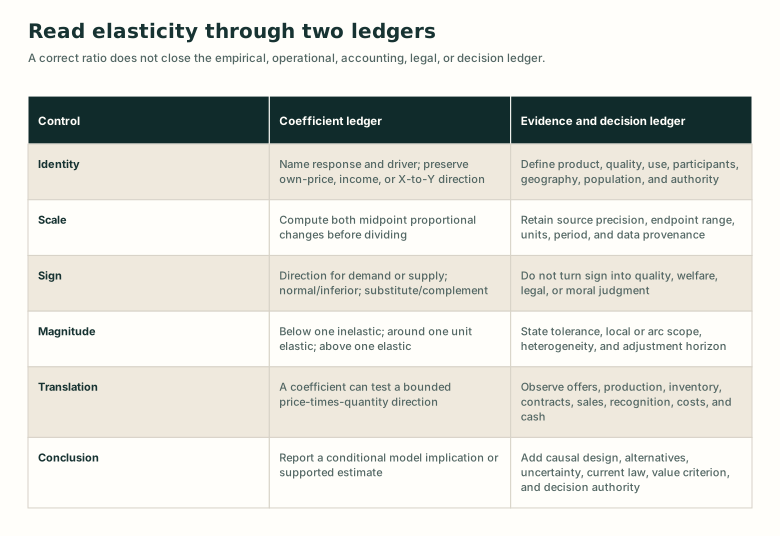
Detailed visual description
The coefficient ledger names response and driver, computes both midpoint percentage changes, preserves sign, classifies absolute magnitude, and reports a conditional result. The evidence ledger defines market scope, data provenance, adjustment horizon, causal posture, operational records, accounting events, legal authority, alternatives, uncertainty, value criteria, and decision authority.
Put the concept to work
Analyze this concept
- Compute midpoint own-price supply elasticity, interpret its magnitude over the stated horizon, and separate modeled offers from production capacity, inventory, sales, revenue, and cash records.
Learning resources
Choose a lesson, try an application, or inspect the sources behind this concept.
Build on these ideas
- Elasticity — Analyze
To analyze this concept: Required. Supply responsiveness uses the general midpoint and magnitude controls.
- Supply curve — Analyze
To analyze this concept: Required. Endpoints must remain on one held-constant supply relationship.