Participation asks what share of the reference population is employed or unemployed—that is, in the labor force. With a labor force of 125 and population of 200, participation is 62.5%. Unlike unemployment, the denominator includes people outside the labor force.
Participation changes with demographics, schooling, caregiving, health, retirement, migration, institutions, job prospects, and survey classification. It is not simply the share with jobs; that is an employment-population ratio.
Compare like populations and periods. An aggregate movement can reflect group composition even when within-group rates are stable. The rate alone does not judge whether nonparticipation is voluntary, constrained, temporary, or harmful.
Reconcile participation with unemployment
Using 95 employed people, five unemployed people, and 20 people outside the labor force, participation is 100 / 120, or 83.33%. The unemployment rate uses the smaller labor-force denominator. The BLS CPS definitions establish the classifications. A person who begins an active job search enters both the labor force and, until employed, unemployment. Participation and unemployment can therefore rise together. State the population scope, period, and adjustment status, and use other measures for hours, earnings, underemployment, and job quality.
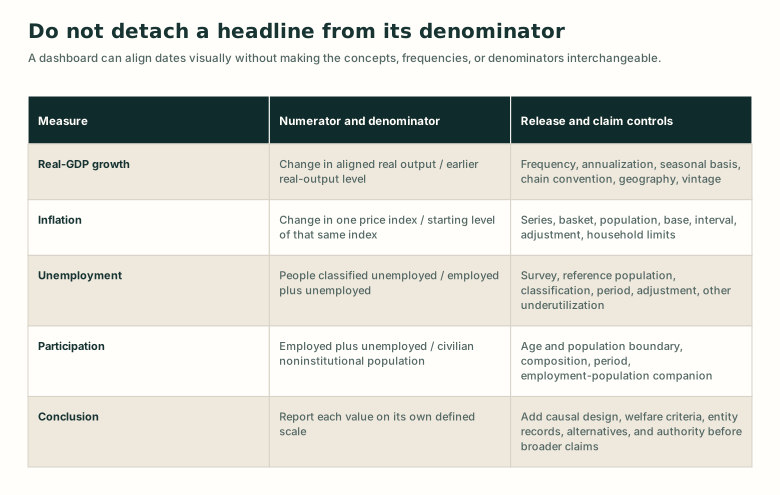
Four familiar indicators use four different comparison contracts
Detailed visual description
Real-GDP growth uses an earlier real-output level. Inflation uses the starting value of the same price index. Unemployment uses the labor force, while participation uses the civilian noninstitutional population. Each row adds frequency, adjustment, population, and release-vintage controls. The final row warns that causal, welfare, accounting, and decision conclusions require separate evidence.
Put the concept to work
Analyze this concept
- Compute labor-force participation, reconcile employed, unemployed, and outside-labor-force counts, and distinguish its denominator from the unemployment rate.
Learning resources
Choose a lesson, try an application, or inspect the sources behind this concept.
Build on these ideas
- Unemployment rate — Analyze
To analyze this concept: Helpful. Contrasting the denominators prevents a common rate substitution.