A business cycle describes co-movement in broad activity, not a clockwork periodicity. Expansions run from trough to peak; contractions run from peak to trough. Duration and depth vary.
Output, income, employment, sales, and production provide overlapping evidence. One release can be noisy or revised, and different series can turn at different times. Chronology is distinct from a real-time nowcast and from a causal theory.
For the United States, the NBER committee retrospectively evaluates multiple indicators. Its chronology is widely used but is not a government statistical rule, and it does not reduce recession to two negative real-GDP quarters.
Read the chronology carefully
Suppose real output falls in two quarters while employment and real income continue to expand. The two-quarter result is a warning signal, but it does not by itself settle the U.S. peak date. The NBER procedure FAQ explains the committee's broader, retrospective method. Record each series, frequency, release date, and revision vintage before comparing them. A peak or trough date organizes chronology. It does not prove which shock caused the change or tell a company what action to take.
Institutions create different kinds of economic evidence
Detailed visual description
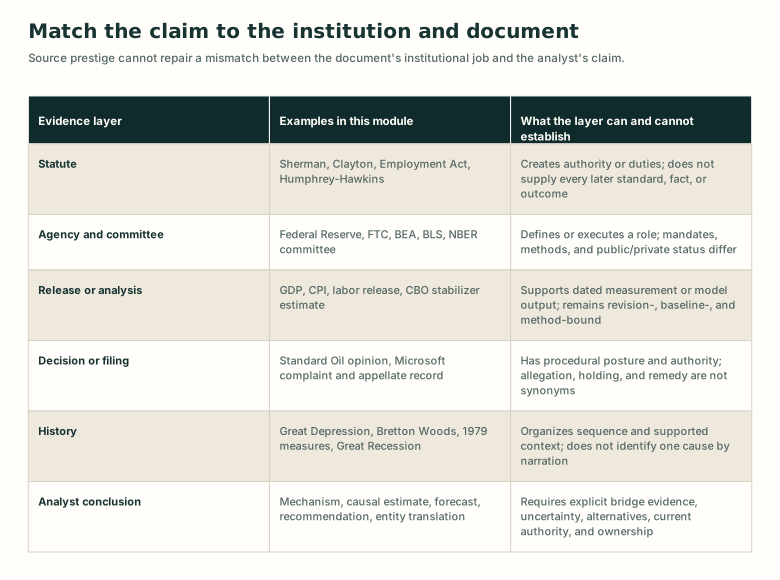
The table separates laws from institutions, statistical releases from analyses, legal complaints from holdings, and historical sequence from causal inference. The final row requires bridge evidence, uncertainty, alternatives, authority, and decision ownership for an analyst conclusion.
Put the concept to work
Analyze this concept
- Distinguish expansion, peak, contraction, and trough chronology from individual indicators, forecasts, mechanical rules, and causal explanations.
Learning resources
Choose a lesson, try an application, or inspect the sources behind this concept.
Build on these ideas
- Real GDP — Analyze
To analyze this concept: Helpful. Real output is one important but nonexclusive cycle indicator.
Lessons
Worked examples and cases
- Evaluate the two-quarter recession rule
- Great Depression: build a multi-ledger chronology before explaining
- Separate automatic stabilizers from discretionary fiscal action
Show 1 more examples and cases
Practice
Common mistaken ideas
Sources
Broader topics
More specific topics
Related concepts
Show 3 more related concepts
Use this idea next
- Monetary policy — Analyze
Required level here: analyze. Helpful. Policy operates within changing aggregate conditions rather than outside chronology.
- Recession — Analyze
Required level here: analyze. Required. A recession is the contraction phase within a broader chronology.