Real GDP removes the effect of price change to support comparisons of aggregate production volume. Its percentage change is usually more interpretable than adding chained-dollar components, because chain-type measures are not generally additive outside their reference conditions.
“Real” does not mean exact, physical, or welfare-adjusted. The estimate still depends on source data, seasonal methods, deflators, quality adjustment, chain weights, and revision cycles. It can grow while per-person output falls or while important harms rise.
Do not compare an annualized quarterly rate with a year-over-year or annual- average rate as though they shared a denominator and horizon. Name both periods and recompute the rate from the appropriate levels when possible.
Use the measure for its stated job
For example, compare two aligned real-GDP levels to calculate output growth, then state whether the published rate is quarterly, annualized, year-over-year, or annual. The BEA GDP guide explains current-dollar and inflation-adjusted GDP and the revision process. Preserve the release vintage and do not add chained-dollar components unless the table supports that use. Real GDP is useful for aggregate production trends. It does not measure household welfare, distribution, unpaid work, or a specific company's sales.
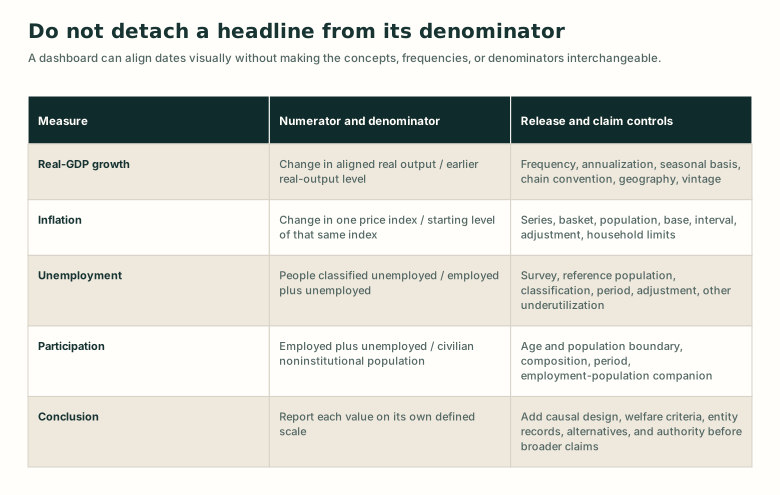
Four familiar indicators use four different comparison contracts
Detailed visual description
Real-GDP growth uses an earlier real-output level. Inflation uses the starting value of the same price index. Unemployment uses the labor force, while participation uses the civilian noninstitutional population. Each row adds frequency, adjustment, population, and release-vintage controls. The final row warns that causal, welfare, accounting, and decision conclusions require separate evidence.
Put the concept to work
Analyze this concept
- Use real GDP to measure aggregate output change while preserving chain-type units, period, annualization, vintage, and welfare limits.
Learning resources
Choose a lesson, try an application, or inspect the sources behind this concept.
Build on these ideas
- Gross domestic product — Analyze
To analyze this concept: Required. Real GDP retains GDP's production boundary.
Lessons
Worked examples and cases
Practice
Common mistaken ideas
Sources
Broader topics
Related concepts
Show 3 more related concepts
Use this idea next
- Business cycle — Analyze
Required level here: analyze. Helpful. Real output is one important but nonexclusive cycle indicator.
- Economic growth — Analyze
Required level here: analyze. Required. Real GDP provides the controlled output comparison used here.
- GDP deflator — Apply
Required level here: analyze. Required. The denominator must be the aligned real measure.
Show 1 more next steps
- Labor productivity — Analyze
Required level here: analyze. Required. The output numerator must use a controlled real basis.