Professional judgment connects an accounting requirement to the company's facts. Correct arithmetic is necessary, but it cannot decide which records belong in a calculation or whether an assumption is supported by evidence.
For example, Alder Instruments manufactures sensors and promises to repair qualifying defects under a warranty. Assume it must record an estimated warranty liability. Its accountant can calculate an estimate using last year's repair rate, but first needs to consider whether product defects, repair costs, or warranty terms have changed. Ignoring a known defect would not become acceptable merely because the calculation uses a familiar formula.
The mistaken idea is that judgment permits management to choose whichever estimate produces the desired income. The correction is that the estimate must follow the applicable requirements and use appropriate evidence. A range of possible outcomes does not make every chosen amount equally supportable.
What should the accountant document?
A review of Alder's estimate should establish:
- Which obligation and reporting date the estimate concerns.
- Which accounting requirements apply.
- Which records support the assumptions and which evidence contradicts them.
- Which reasonable alternatives were considered and why one was selected.
- Whether pressure to report higher income affected the decision.
- Which uncertainties remain and what new evidence could change the estimate.
Documentation lets another person follow the reasoning; it does not correct missing facts or an inappropriate method. Later repair costs can differ from a properly developed estimate. That difference alone does not prove that the original judgment was wrong.
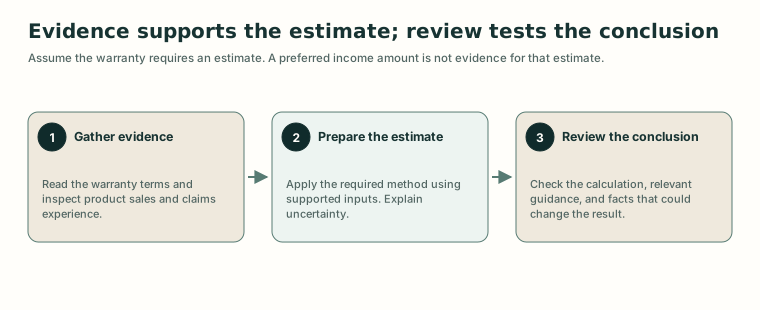
Support a warranty estimate with evidence
Detailed visual description
The diagram illustrates a warranty estimate whose recognition is assumed to be required. Contract terms, product sales, and claims experience support the inputs. The accountant applies the required method and explains uncertainty. Review checks the calculation, applicable guidance, and facts that could change the result. The flow is not permission to select a desired income amount.
Put the concept to work
Understand this concept
- Explain why professional judgment requires criteria, evidence, assumptions, alternatives, and documentation rather than unsupported personal preference.
Analyze this concept
- Evaluate a stated accounting or finance judgment by testing its authority, relevant facts, assumptions, alternatives, incentives, uncertainty, and documentation.
Learning resources
Choose a lesson, try an application, or inspect the sources behind this concept.
Build on these ideas
- Professional judgment — Understand
To analyze this concept: Required. Evaluation requires a prior model of what makes judgment disciplined and reviewable.
Lessons
- Evaluate non-GAAP measures and market communication
- From an open issue to a reviewable accounting memo
- Map institutions and authority before assigning blame
Show 1 more lessons
Worked examples and cases
- AIG: insurance contract or balance-sheet window dressing?
- Lehman Brothers: a quarter-end balance-sheet disappearing act
- Repair Linden Peak's year-end reporting memo
Show 6 more examples and cases
- Separate model, fact, value, and decision
- Sunbeam: pull tomorrow's sales into today?
- Waste Management: small estimate changes, long cumulative shadow
- WeWork: what does Community Adjusted EBITDA leave out?
- WorldCom: when an expense becomes an asset on paper
- Xerox: decompose the lease before moving revenue
Practice
- Critique quotation-only memo analysis
- Evaluate a non-GAAP adjustment
- Identify a disciplined judgment record
Show 2 more practice items
Common mistaken ideas
Sources
Related concepts
Use this idea next
- Accounting research memo — Create
Required level here: analyze. Required. A reviewable conclusion must expose evidence, alternatives, incentives, uncertainty, and change conditions.
- Faithful representation — Analyze
Required level here: analyze. Helpful. Estimates and classifications require reviewable criteria, evidence, alternatives, and documentation.
- Materiality — Analyze
Required level here: understand. Required. A reviewable materiality conclusion requires evidence, alternatives, incentives, and documentation.
Show 1 more next steps
- Professional judgment — Analyze
Required level here: understand. Required. Evaluation requires a prior model of what makes judgment disciplined and reviewable.
Used in these readings
These chapters explain or apply this concept. The label states how the chapter uses it.