In this chapter
- Different questions require different information
- Identify who does what
- Interpret the auditor's conclusion
- Choose the report for the question
- Apply report selection to Apple
- Distinguish filings from other public information
- Find the company's report
- Apply the filing index to Apple
- Follow the statement headings
- Apply the structure to Apple
- Notice disclosures that can change the analysis
- Separate later evidence from a new event
- Recognize other disclosures that affect interpretation
- Read the amount in context
- Apply the statement context to Apple
- Connect a reported amount to its accounting policy
- Apply the policy distinction to Apple
- Determine what the filing can establish
- Apply the same questions to other accounts
- Apply the records question to NIKE
- Recognize the reporting system
- Keep the document and its copies connected
- End-of-chapter practice
- Apple inventory evidence
- Apple revenue
- NIKE property and equipment
- Sources and further practice
In Chapters 1–3, we followed transactions through the accounting system to the financial statements. Chapter 4 explained who establishes US generally accepted accounting principles (GAAP) and how authoritative guidance governs that work. Management uses the guidance to recognize, measure, present, and disclose the effects of the company's activities. Now put yourself in the place of someone who receives the finished statements. How much of that work can you inspect?
An outside reader usually sees the statements and other information the company provides, with no access to its journals, ledgers, contracts, or calculations. A nonpublic company may send statements directly to its owners or lenders. A US public company subject to Securities and Exchange Commission (SEC) reporting requirements files reports that anyone can inspect.
Suppose we are considering buying shares in Apple and want to understand the
assets it reports. We open its annual filing and find 5,718 in the inventory
row at September 27, 2025. Before we use that figure to judge Apple's assets,
we need to know what it represents. Is it in dollars, thousands, or millions?
Does it cover Apple Inc. alone or Apple and its subsidiaries? We read the
statement heading, row label, and date column to answer those questions.
How Apple measured that inventory also matters to our interpretation. We turn to the accounting-policy note for the method and to the auditor's report to understand the assurance provided on the statements. We can inspect both, but checking the accounting for a particular inventory item may require internal records we cannot see. As outside investors, we need to understand the filing and its context.
Different questions require different information
The word inventory appears in several parts of a filing. The balance sheet reports an inventory balance. The accounting-policy note identifies the cost method. Another note may explain write-downs or the types of inventory held. Management's Discussion and Analysis (MD&A) or the risk factors may discuss supply problems or changing demand. These passages concern inventory, but they do not answer the same question.
| What do you want to know? | Information to examine | What it tells you |
|---|---|---|
| What inventory balance did the company report? | Inventory row and complete balance-sheet headings | Balance, reporting date, entity, currency, and scale |
| How much did the reported balance change? | Current and comparative balance-sheet columns | Net change between two reporting dates |
| Why did inventory change? | Notes and relevant MD&A discussion, considered with the comparative balances | Disclosed transactions, conditions, or management explanations that may help explain the change |
| Which inventory method does the company use? | Inventory accounting-policy note | The company's disclosed cost method |
| What makes up the inventory balance? | Inventory detail note, when provided | Disclosed categories such as raw materials, work in process, or finished goods |
| What inventory risks does management discuss? | MD&A and risk factors | Management's discussion of supply, demand, obsolescence, or other business risks |
| Was the disclosed method applied correctly to particular items? | Filing plus underlying inventory records and calculations | The filing supplies the reported result and policy; the underlying records are needed to test individual applications |
Comparative balance sheets establish how much the reported balance changed. They do not necessarily explain why it changed. Purchases, sales, write-downs, business acquisitions, currency changes, and other activity can contribute to the difference. The notes or MD&A may explain some of those causes.
Identify who does what
Public investors need information about a business whose daily records they cannot inspect. The Securities Act of 1933 addresses disclosure when securities are offered for sale. The Securities Exchange Act of 1934 created the SEC and authorizes continuing reports. The SEC's account of the two Acts explains that distinction.
Four organizations have different responsibilities for a public company's financial reporting:
| Participant | Contribution |
|---|---|
| Financial Accounting Standards Board (FASB) | Sets US GAAP |
| Company management | Prepares the statements and disclosures and takes responsibility for them |
| Independent auditor | Examines evidence and expresses an opinion on the financial statements |
| SEC | Sets securities-disclosure requirements, receives filings, and reviews compliance |
The SEC makes the company's filing public; it does not write the report or vouch for its accuracy. A company's annual report to shareholders may include its filed Form 10-K, or it may be a different publication. The SEC's explanation of these roles distinguishes management's statements from the auditor's opinion and the SEC's review.
Interpret the auditor's conclusion
An auditor's report identifies the financial statements and periods covered by the opinion. The opinion addresses those statements as a whole. It does not cover every other part of a Form 10-K or give a separate conclusion about each transaction.
The auditor may express that opinion only after obtaining sufficient evidence and reasonable assurance that the statements as a whole are free of material misstatement. Material misstatement sets the kind of error the opinion addresses: one that could affect a user's decision, either by itself or together with other misstatements. Reasonable assurance describes how much confidence the auditor must obtain before expressing the opinion. The auditor reduces the risk of an inappropriate opinion to a low level, not to zero. An audit can therefore support the opinion that the statements are not materially misstated without proving that every recorded amount and estimate is correct. The PCAOB connects the evidence obtained, the assurance level, and the resulting opinion in AS 1000, paragraphs .03 and .13-.18.
Apple's auditor concludes that the company's financial statements present fairly, in all material respects, in accordance with US GAAP. The report names the statements and periods to which that conclusion applies.
Quick checkAn analyst reads Apple's audit opinion and concludes that the auditor guarantees every amount in the financial statements is correct. What is wrong with that conclusion?
Answer: The opinion provides reasonable assurance about the financial statements as a whole, in all material respects. It is not an absolute guarantee about every amount. Testing the accounting for a particular item requires the relevant underlying evidence.
Choose the report for the question
A Form 10-K is a domestic operating company's annual filing. It contains business information, risks, management's discussion, and audited annual financial statements. Under current SEC rules, a Form 10-Q is a quarterly report. A domestic operating company generally files one for each of its first three fiscal quarters. A 10-Q contains interim statements and related disclosures. Individual statements can show both the quarter and the fiscal year to date, so read each column heading. Those statements receive an independent accountant's review, which provides less assurance than an audit. A Form 8-K reports certain events or other current information between scheduled reports. See the SEC's filing guide.
In May 2026, the SEC proposed an optional semiannual reporting system. If the proposal is adopted, eligible companies could file a new six-month Form 10-S instead of three Forms 10-Q. The proposal would not make a 10-Q semiannual, and it does not change the rules for an existing filing. The SEC proposal was still listed as proposed in the SEC rulemaking index when this chapter was checked on September 12, 2026.
| Question | Starting document |
|---|---|
| What did the company report for the complete fiscal year? | Annual report on Form 10-K |
| What did it report for a later interim period? | Relevant Form 10-Q; inspect each table's period |
| What did it announce about a particular event? | Relevant Form 8-K and any related exhibit |
An earnings release attached to a Form 8-K is not the audited annual financial-statement set. A June 10-Q also cannot report a balance at the following September year-end.
Apply report selection to Apple
Suppose you need Apple's inventory balance at September 27, 2025. The table lists three actual filings that may appear in a search result.
| Choice | Form and period of report | Filing date |
|---|---|---|
| A: Apple annual filing | 10-K; September 28, 2024 | November 1, 2024 |
| B: Apple interim filing | 10-Q; June 28, 2025 | August 1, 2025 |
| C: Apple annual filing | 10-K; September 27, 2025 | October 31, 2025 |
Distinguish filings from other public information
Public company communications can have different SEC statuses. Filed material is submitted to the SEC as part of a filing. Some information is instead furnished to the SEC, often as an exhibit to Form 8-K. Other information appears only on the company's investor website or in a live presentation. These sources are all public, but their status and level of assurance differ.
| Public source | What it can add | Important limit |
|---|---|---|
| Financial statements and notes filed with the SEC | Reported amounts, accounting policies, estimates, and required disclosures | Read the auditor's report to determine which statements and periods the opinion covers |
| MD&A in a filing | Management's explanation of results, liquidity, known trends, and uncertainties | Management's explanation does not replace the statement amount or related note |
| Earnings release | Timely results, management-selected highlights, and reconciliations for some non-GAAP measures | A release furnished as a Form 8-K exhibit is not thereby part of the audited financial statements |
| Earnings call | Prepared remarks and answers to analysts' questions about results, strategy, and expectations | The discussion may include estimates and forward-looking statements and does not establish an accounting requirement |
| Investor presentation | Strategy, operating measures, and management's view of the business | The presentation may use measures or groupings that differ from the financial statements |
| Company investor website | Access to filings, releases, presentations, recordings, and governance materials | Hosting a document does not determine whether it was filed, audited, or prepared under GAAP |
A call or presentation can help explain why management believes an amount changed. It cannot change the amount the company reported in its financial statements. A third-party transcript can make a call searchable, but it should be checked against a company recording or transcript before relying on exact wording.
Find the company's report
The SEC makes filings available through EDGAR, its Electronic Data Gathering, Analysis, and Retrieval database. A company may also publish the report on its investor website.
The filing source packet provides downloadable report copies, data files, and selected extracts with policy summaries. Use the full report for navigation practice; use the extracts when you need help or an offline reference.
An EDGAR filing index identifies one submission and lists the documents in it. For a Form 10-K, follow the document whose Type is 10-K to open the annual report. Exhibits in the same list are separate documents. Their presence in the submission does not make them part of the annual report or the audited financial statements.
Apply the filing index to Apple
This image shows the top of Apple's 2025 filing index. The first row under Document Format Files identifies the annual report by its 10-K description and type.
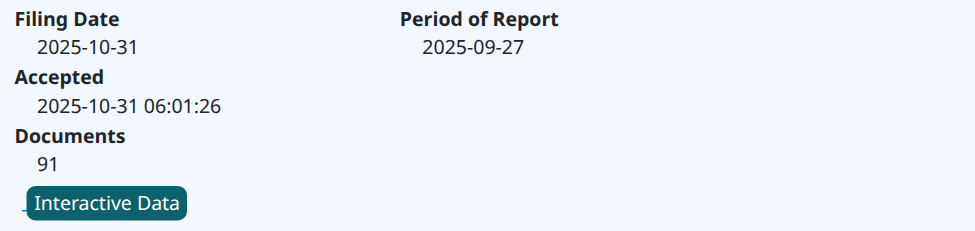

The index identifies this filing with these fields:
| Filing field | Apple example |
|---|---|
| Company | Apple Inc. |
| Form | 10-K |
| Period of report | September 27, 2025 |
| Filing date | October 31, 2025 |
| Filing identifier | 0000320193-25-000079 |
| Company identifier | 0000320193 |
The SEC calls the filing identifier an accession number and the company identifier a Central Index Key, or CIK. A CIK identifies a legal registrant across its SEC filings, even if that registrant changes its name or ticker. Facebook Inc. and Meta Platforms, Inc., for example, appear under CIK 0001326801. A corporate reorganization can create a new registrant and a new CIK. Alphabet's formation did that, so Google Inc. and Alphabet Inc. do not share a CIK. The accession number identifies one submission by the registrant.
A filing date is the date a company submits the report to the SEC. The period of report is the reporting date or period the filing covers. Neither field identifies the period of every amount inside because statements often include comparative amounts. Apple, for example, submitted this Form 10-K on October 31, 2025, for a fiscal year that ended September 27, 2025.
An amended filing, identified by a form such as 10-K/A, requires a separate check of what changed. Read its explanation and identify the amended items. A later amendment may address only one part of the report; do not assume that every earlier figure has been replaced. Compare the original and amendment when both bear on the question.
Quick checkYou need Apple's inventory balance at September 27, 2025. Apple filed the Form 10-K on October 31, 2025. Does the later filing date make this the wrong report?
Answer: No. September 27 is the date of the balance reported in the financial statements. October 31 is the date Apple submitted the Form 10-K to the SEC.
Follow the statement headings
Form 10-K prescribes four Parts and numbered Items for domestic operating companies. An Item is a numbered disclosure requirement within the form. Companies prepare their own information within that structure, and a form may permit an item to be omitted, marked not applicable, or incorporated by reference from another filing. Use the report's table of contents and heading links to see how that company satisfied each requirement.
| Form 10-K part | Main contents | How it helps a reader |
|---|---|---|
| I | Business, risks, and other company information | Understand the business and relevant risks |
| II | Market information, management discussion, statements, and controls | Follow the numbered items to management's analysis, the statements, and controls |
| III | Directors, governance, compensation, and ownership | Follow any references to separately filed information |
| IV | Exhibits and financial statement schedules | Identify supporting documents without confusing them with the main report |
Item 7 contains Management's Discussion and Analysis, or MD&A. Item 8 contains the financial-statement set and related reports. Item 9A addresses controls and procedures. Their purposes differ even when they discuss the same accounting amount. These item numbers come from Form 10-K, not from Apple's choice of headings. The SEC's Form 10-K lists the required Parts and Items.
Search can help locate a statement title or account label, but inspect the heading around each result. A term may appear in the statements, a note, MD&A, or a risk discussion. The heading and surrounding text tell you what the search result can answer.
Apply the structure to Apple
Suppose you need Apple's accounts payable balance at September 27, 2025. In the Apple 2025 Form 10-K, follow the table of contents to Item 8, Financial Statements and Supplementary Data. Within Item 8, the consolidated balance sheets contain the Accounts payable row. The statement heading supplies the entity, scale, and date needed to interpret the amount.
Quick checkA search for accounts payable leads to Apple's liquidity discussion in MD&A. What source should establish the reported balance at September 27, 2025?
Answer: Use the Accounts payable row and complete heading in the consolidated balance sheets. MD&A can help explain liquidity and changes in working capital, but it does not replace the statement row as the direct source for the reported balance.
Notice disclosures that can change the analysis
The statement row and accounting-policy note are not the whole financial statement package. Other notes may identify later events, relationships, agreements, concentrations, or parts of the business that change how a reader interprets an amount. These disclosures do not all follow the same accounting rule.
Separate later evidence from a new event
A subsequent event occurs after the balance-sheet date but before the financial statements reach the applicable issuance date.
The timeline below separates the reporting date from that evaluation window. An event inside the window still must be connected to the condition that existed at the reporting date.
- December 31Reporting dateYear-end amounts reflect conditions at this date.
- January 18Lawsuit settledThe claim arose before December 31.
- March 1Statements issuedThe evaluation window ends.
Suppose the company was defending a major lawsuit at December 31 and reached a settlement on January 18 for an amount different from the liability it had estimated. The events that gave rise to the claim occurred before December 31. The settlement therefore provides additional evidence for measuring the year-end liability. ASC 855-10-55-1(a) gives this example; the guidance for loss contingencies determines the liability's recognition and measurement.
A January event can instead create a new condition. A fire at a facility that was operating normally on December 31 does not, by itself, change the condition of that facility at year-end. The company does not adjust the December 31 amount merely because the fire occurred before issuance. A material event may still require a note describing its nature and financial effect, or stating that the effect cannot be estimated. ASC 855-10-25-1, 25-3, and 50-2 establish these basic branches. The subsequent-events guidance identifies which period contains the condition; the guidance for the affected account determines how to measure any adjustment.
Quick checkA company settles a lawsuit after year-end. What fact determines whether the settlement provides evidence about the year-end liability?
Answer: Determine when the events that gave rise to the claim occurred. If they occurred before the balance-sheet date, the settlement can provide evidence for measuring the year-end liability. A claim arising from a new event after year-end does not change the condition at the balance-sheet date.
Recognize other disclosures that affect interpretation
- Related-party transactions identify dealings in which control or influence may affect the terms. The note identifies the relationship, transactions, dollar amounts, and amounts due to or from related parties.
- Commitments and contingencies describe future agreements and uncertain outcomes. Signing an agreement does not automatically create a liability for the full future exchange. Unit 3 develops the recognition and measurement of loss contingencies.
- Risks and concentrations may identify dependence on a customer, supplier, market, or estimate that leaves the company vulnerable to severe near-term effects. A securities risk factor covers broader investment risks.
- Segment disclosures show how management views parts of the business and reconcile required segment information with consolidated amounts.
- Interim reports cover periods shorter than a year. Read the exact quarter and year-to-date headings; one quarter is not automatically one-fourth of the annual result.
Read disclosures beyond the reported figure for a fuller introduction to subsequent events, related parties, commitments, concentrations, segments, and interim reports.
Read the amount in context
A statement amount must be read with the statement title, reporting entity, account label, date or period, currency, scale, and comparative column. Copying the digits alone can change the meaning.
Apply the statement context to Apple
The statement excerpt below contains the Inventories row and its column headings from Apple's consolidated balance sheets.
| Apple Inc. consolidated balance sheets: US dollars in millions | September 27, 2025 | September 28, 2024 |
|---|---|---|
| Inventories | 5,718 | 7,286 |
The 2025 figure means $5,718 million, or $5,718,000,000. Copying only
5,718 drops information needed to interpret it.
Apple's annual accounting period uses a fiscal year that ends on the last Saturday of September; consequently, Apple's financial statements contain either 52 or 53 weeks. That explains the different September dates in these headings. Other companies use different year-ends; "2025" does not identify the same period for every company.
Inventory is a balance at a stated date, while revenue describes activity over a stated period. The complete heading tells the reader which kind of amount the statement reports.
The reporting entity is the business or group whose financial information the statements describe. Apple's consolidated statements include Apple Inc. and the subsidiaries within its consolidated group. The word consolidated tells you that the figures cover the group rather than the parent alone.
Without its row label, column date, currency, scale, and reporting entity,
5,718 could describe a different account, period, company, or unit of
measurement. The same comparative amount may also appear in more than one
year's filing. The complete statement heading distinguishes those cases.
Quick checkA colleague records 7,286 as Apple parent-company inventory at September 27, 2025. Which parts of that description need correction?
Answer: The 7,286 amount belongs to September 28, 2024, and the table covers the consolidated group, not the parent alone. The requested 2025 column reports 5,718. Both amounts are in millions of US dollars. Correct the date and entity description as well as preserving the scale.
Connect a reported amount to its accounting policy
An accounting policy identifies a principle or method used to prepare the statements. The relevant policy depends on the reported information and the question being asked. An inventory policy may identify the cost-assignment method. A revenue policy may explain when the company recognizes revenue. A property and equipment policy may identify the measurement basis and depreciation method. A receivables policy may explain how the company estimates its allowance. These policies affect different parts of the statements and notes; they are not limited to inventory.
A policy differs from an estimate used in applying that policy. For example, a property note may identify straight-line depreciation as the method, an asset's useful life as an estimate, and the asset's location as a business fact. A single note can contain all three.
Apply the policy distinction to Apple
Apple discloses its inventory method in Note 1, Summary of Significant Accounting Policies. Under the Inventories heading, the company states that it measures inventories using first-in, first-out, or FIFO. Under FIFO, the costs of the earliest purchases are assigned to the earliest goods sold. The policy identifies a cost-assignment method; it does not prove the physical order in which goods leave a warehouse. The auditor's conclusion that the statements are presented in accordance with US GAAP does not identify that method. The specific policy does. Later chapters develop the inventory calculations.
Quick checkA company says that a machine is in Ohio and has an estimated five-year useful life. Have those facts identified its depreciation method?
Answer: No. The location is a business fact and the useful life is an estimate. You still need the policy that names the depreciation method.
Determine what the filing can establish
An explanation of reported information may include several points: an amount, units, date, reporting entity, accounting policy, or conclusion about how the policy was applied. Each point must be connected to the part of the filing that can establish it. A correct amount does not make the other points correct. If the filing omits the underlying transaction records, it also may not settle whether a disclosed policy was applied correctly to every item.
An artificial intelligence (AI) tool may suggest a filing location or draft an answer. Apply the same tests to its answer as to a person's draft. Open the cited document, inspect the context, and check each assertion. A fluent explanation cannot supply a missing transaction record. You can complete every exercise here directly from the filing without an AI tool.
Apply the same questions to other accounts
Every reported account raises the same starting questions about the amount, date or period, units, entity, and relevant disclosures. Inventory, revenue, and property and equipment illustrate how the answers differ; they are not the only applicable accounts. For any account, the statement supplies the reported amount and its headings, while notes may supply related policies, estimates, or detail.
Working backward from a reported amount is one way to check your accounting understanding. Ask which transactions could change the amount and which records and calculations would connect those transactions to the statements. Working backward is not a required step in every financial statement analysis. It connects the reported information to the accounting cycle, and the underlying records usually are not part of a public filing.
| Illustrative account | Statement amount | Time represented | Related disclosure in these examples | Evidence needed to test individual items |
|---|---|---|---|---|
| Inventory | Balance sheet | At a date | Cost-assignment method, such as FIFO | Quantity records, purchase costs, and inventory calculations |
| Revenue | Statement of operations | Over a period | When control transfers to the customer | Contracts, shipment or service evidence, invoices, and accounting entries |
| Property and equipment | Balance sheet | At a date | Measurement basis, depreciation method, and useful-life estimates | Asset register, acquisition records, useful-life support, and depreciation calculations |
The filing establishes each reported amount and disclosed policy. Testing the policy's application requires different underlying evidence for each account: inventory records for inventory, contracts and fulfillment evidence for revenue, and asset records for property and equipment. The audit opinion on the statements as a whole does not eliminate those account-level differences.
Apply the records question to NIKE
Quick checkNIKE reports property and equipment net of accumulated depreciation and discloses straight-line depreciation. What records would you need to determine whether depreciation for a particular asset was recorded correctly?
Answer: You would need the asset's acquisition cost, date available for use, estimated useful life and residual value, depreciation calculation, and related ledger entries. Those records connect the disclosed policy to the expense and accumulated depreciation recorded for the asset. An external reader generally cannot inspect these internal records, so the public filing alone usually cannot establish whether depreciation for that particular asset was recorded correctly.
Recognize the reporting system
Domestic operating companies generally use Form 10-K for annual reporting, Form 10-Q for interim reporting, and Form 8-K for specified events and current information. Not every SEC registrant uses that set. A foreign private issuer may use Form 20-F, and an eligible Canadian issuer may use Form 40-F. Check the form, reporting period, accounting framework, and currency rather than assuming that every annual filing is a US-dollar Form 10-K prepared in accordance with US GAAP.
The optional reading How SEC reporting forms developed explains the reporting chronology, former small-company forms, foreign-issuer forms, and proposed changes in more detail.
Quick checkA Canadian company's annual filing is a Form 40-F. Does the absence of a Form 10-K prove that its annual report is missing?
Answer: No. An eligible Canadian issuer may report on Form 40-F. Inspect the company's actual filing and reporting period before deciding what evidence is missing.
Keep the document and its copies connected
The filed HTML report preserves the company's headings, tables, and links. A PDF created from that page fixes a layout, but its page breaks may not match the filing. An excerpt prepared for a class can omit a heading or footnote, while a Markdown translation can flatten table relationships. Those changes can alter the meaning of a copied amount even when the digits remain unchanged.
The packet supplies complete report copies, selected extracts, and data files. A matching filename or an AI-generated citation does not establish that a copy matches the filed version. The company, accession number, reporting period, and relevant passage reveal whether the copy represents the same filing.
Read how SEC reporting forms and tagged data developed to examine historical forms and connect an Inline XBRL fact to the displayed statement.
End-of-chapter practice
Use Apple and NIKE filings to interpret reported information. Choose an answer to receive feedback. Your responses are not submitted.
Apple inventory evidence
Use the balance sheet and inventory policy already examined. Decide what each source can establish and where the conclusion requires information outside the public filing.
Apple revenue
Use Apple's 2025 Form 10-K. Locate Total net sales for fiscal 2025 and its 2024 comparative. Then find Note 2, Revenue, and determine how recognition differs for Products and Services. Revenue enters the financial statements when the recognition criteria are met.
NIKE property and equipment
Use NIKE's 2026 Form 10-K. Locate net property, plant, and equipment for May 31, 2026, and its comparative amount. Then find the related policy in Note 1 and identify the measurement basis, depreciation method, and useful-life ranges.
Sources and further practice
The examples use Apple's 2025 Form 10-K, filed October 31, 2025. The relevant locations are the consolidated balance sheets, consolidated statements of operations, Note 1, and Note 2. The filing is evidence of Apple's reported amounts and policies. Current accounting requirements come from the governing accounting literature discussed in Reading 1-4.
The NIKE exercise uses NIKE's 2026 Form 10-K, filed July 15, 2026. The relevant locations are the consolidated balance sheets and Note 1, Summary of Significant Accounting Policies. The SEC company-concept data was accessed September 11, 2026.
For another application, use the Chapter 5 practice page. Its questions ask you to locate and interpret depreciation expense in Microsoft's annual report. They distinguish a period's expense from an accumulated balance and ask what a general policy can establish about individual assets.