Add the observations and divide by their count. For Juniper Year 1:
[ \bar{x}=\frac{510}{16}=31.875\text{ days}. ]
The unit remains days. The bar marks this as a sample mean; it is not the unknown mean for all 480 qualifying invoices.
Every value moves the mean
The mean is the point at which signed deviations sum to zero. That property makes it central to variance, standard error, and many estimation methods. It also makes the mean responsive to tails. Juniper Year 2's 78-day invoice raises its mean above its median. Deleting the invoice would lower the mean, but a numerical effect is not a reason to delete valid data.
Average of what, weighted how?
One row receives one unit of weight in this arithmetic mean. If rows represent invoice lines rather than invoices, or if the decision needs dollars weighted by invoice amount, the estimand changes. A mean of entity returns also differs from a value-weighted portfolio return. State the unit and weighting rule.
Use the mean with an ordered-value or graphical view and a spread measure. A smaller mean settlement time is a sample observation, not proof of improved collections, lower credit risk, or future cash performance.
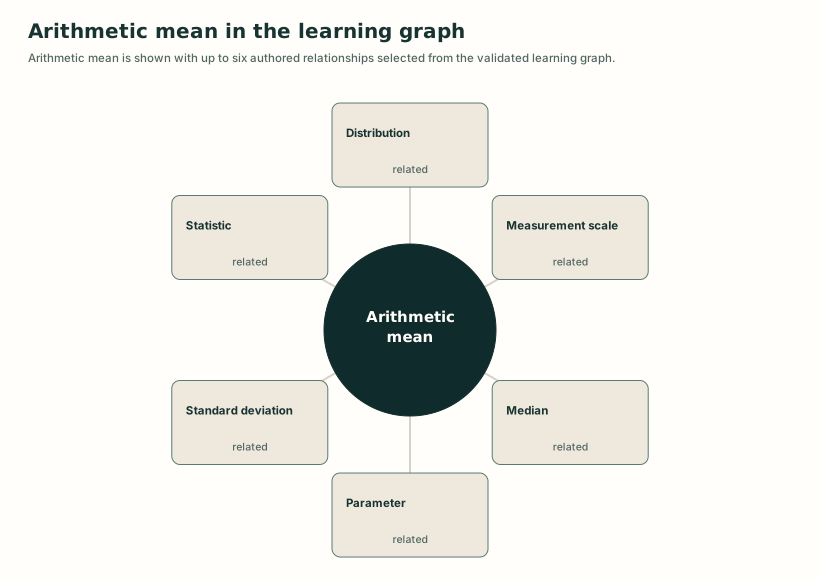
Arithmetic mean in the learning graph
Detailed visual description
A structural map places Arithmetic mean at the center and connects it to related concepts, prerequisite concepts, or lessons from the knowledge graph. Edge labels distinguish broader, narrower, related, prerequisite, and teaching relationships where present.
Put the concept to work
Understand this concept
- Explain the arithmetic mean as a balance-point summary that uses every quantitative value and is therefore sensitive to extreme observations.
Apply this concept
- Compute and compare sample or population means from declared quantitative series while preserving units, denominator, scope, and outlier treatment.
Learning resources
Choose a lesson, try an application, or inspect the sources behind this concept.
Build on these ideas
- Arithmetic mean — Understand
To apply this concept: Required. Calculation applies the sum-and-count definition and its interpretation.
- Distribution — Understand
To understand this concept: Required. The mean is one summary of a complete value pattern.
Lessons
Worked examples and cases
Practice
Common mistaken ideas
Sources
Related concepts
Show 4 more related concepts
Use this idea next
- Arithmetic mean — Apply
Required level here: understand. Required. Calculation applies the sum-and-count definition and its interpretation.
- Variance — Understand
Required level here: apply. Required. Variance measures squared distance from the correctly computed mean.