For one mean with unknown population standard deviation, this module computes:
[ \bar{x}\pm t^*(s/\sqrt{n}). ]
The critical value (t^*) is a cutoff from the Student-t distribution selected for the confidence level and degrees of freedom. Juniper supplies that value and (n-1) degrees of freedom, so this module uses rather than derives the distribution cutoff. The engine computes the standard error, margin of error, and endpoints; it does not choose the population, validate the frame, or certify the method's conditions.
Interpret the procedure
If the same design were repeated many times and the interval recomputed each time, a 95% procedure would cover the fixed population mean in about 95% of those repetitions under its assumptions. The particular interval already computed either covers the fixed parameter or does not. The confidence level does not assign a 95% post-data probability to that event in this framework.
An interval is not all uncertainty
The width responds to sample spread, sample size, and critical value. It does not automatically include frame undercoverage, wrong cutoffs, duplicates, measurement error, nonresponse, model misspecification, or future process change. A narrow interval can be precisely centered on the wrong target.
Juniper Year 2's 78-day observation widens the computed interval and challenges the suitability of the simple mean method. Compute the interval to understand the mechanics; then state why the numerical result is not yet decision-grade.
A confidence interval is a procedure with assumptions
Detailed visual description
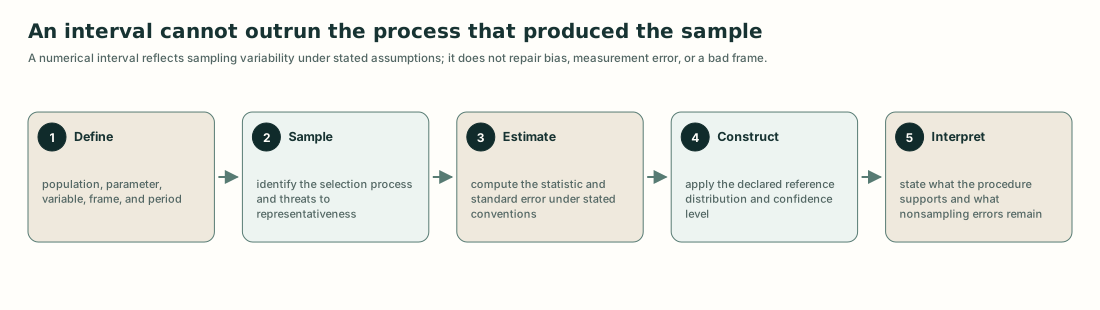
The final stage distinguishes sampling variability from nonsampling errors such as selection bias, measurement error, and frame defects.
Put the concept to work
Understand this concept
- Explain a confidence level as long-run coverage of an interval procedure rather than a post-data probability that one fixed parameter lies in one computed interval.
Apply this concept
- Construct a supplied-critical-value two-sided one-sample mean interval and qualify its sample design, independence, distributional, frame, and data-quality conditions.
Learning resources
Choose a lesson, try an application, or inspect the sources behind this concept.
Build on these ideas
- Confidence interval — Understand
To apply this concept: Required. Construction must retain the procedure-level interpretation.
- Parameter — Understand
To understand this concept: Required. The target parameter is fixed under the foundational frequentist interpretation.
- Sampling variability — Understand
To understand this concept: Required. The interval changes because the selected sample and statistic change.
Show 1 more prerequisites
- Standard error — Apply
To apply this concept: Required. The interval half-width uses the estimated standard error.
Lessons
Worked examples and cases
Practice
Common mistaken ideas
Sources
Related concepts
Show 3 more related concepts
Use this idea next
- Confidence interval — Apply
Required level here: understand. Required. Construction must retain the procedure-level interpretation.
- Margin of error — Understand
Required level here: understand. Required. The half-width has meaning only within a declared interval procedure.
- Statistical inference — Analyze
Required level here: apply. Required. The module's population estimate uses the declared one-sample interval procedure.