A population is the full set the question is about—not every record a system can return. Juniper's teaching question concerns ordinary external trade-credit invoices both issued and fully settled within one calendar year. Cash sales, credit memos, intercompany items, and invoices still open after year-end do not belong to that target.
The boundary makes the result interpretable, but it also narrows it. The mean settlement time for completed invoices is not the mean age of ending receivables and does not describe invoices that never settled within the year.
Define before selecting
State at least five parts:
- the unit;
- entity or market scope;
- start and end dates;
- inclusion and exclusion conditions; and
- the variable or parameter of interest.
In accounting, populations often depend on posting date, transaction date, account classification, legal entity, and document status. In finance they may depend on security universe, listing survival, currency, rebalancing date, or availability of return history. Each restriction can change the estimand—the quantity the analysis is trying to learn.
Population is not a compliment
Calling a file “the population” does not prove completeness. A system export may omit late postings, archived records, rejected transactions, delisted securities, or unmatched identifiers. First define the target set. Then test whether the operational data source covers it.
Population in the learning graph
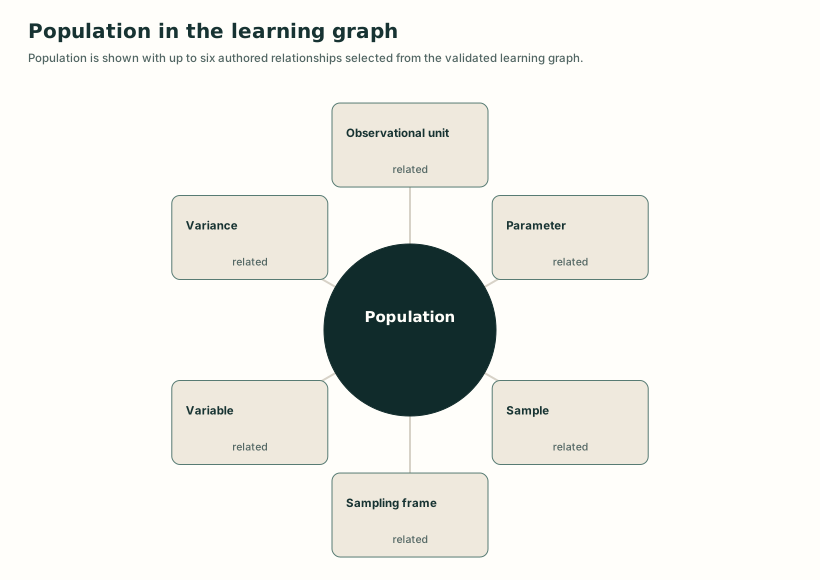
Detailed visual description
A structural map places Population at the center and connects it to related concepts, prerequisite concepts, or lessons from the knowledge graph. Edge labels distinguish broader, narrower, related, prerequisite, and teaching relationships where present.
Put the concept to work
Understand this concept
- Explain how unit, entity scope, period, eligibility, exclusions, and cutoff jointly define a target population.
Analyze this concept
- Diagnose when an analysis silently changes its target population through date, status, entity, product, customer, survival, or settlement restrictions.
Learning resources
Choose a lesson, try an application, or inspect the sources behind this concept.
Build on these ideas
- Observational unit — Understand
To understand this concept: Required. A population is a set of a defined kind of observational unit.
- Population — Understand
To analyze this concept: Required. Detecting target drift requires an explicit original population boundary.
- Variable — Understand
To understand this concept: Helpful. The question must name which characteristic is sought for the population.
Lessons
Worked examples and cases
Practice
Common mistaken ideas
Sources
Related concepts
Show 3 more related concepts
Use this idea next
- Parameter — Understand
Required level here: understand. Required. A parameter is fixed only relative to an explicitly defined population.
- Population — Analyze
Required level here: understand. Required. Detecting target drift requires an explicit original population boundary.
- Sample — Understand
Required level here: understand. Required. A sample is interpreted relative to the population it is intended to represent.
Show 1 more next steps
- Sampling frame — Understand
Required level here: understand. Required. Frame coverage can be judged only against a defined target population.