In this chapter
- Why financial statements separate some disposals
- Step 1: Determine whether the disposal qualifies
- Apply the three conditions
- How to answer each question
- Apply the conditions to Sable Ridge
- Step 2: Measure the discontinued operation
- Build the pre-tax result
- Measure a component held for sale
- Apply the measurement rule to Sable Ridge
- Allocate the income tax effect
- Step 3: Present the discontinued operation
- Present the current-period result after continuing operations
- Recast comparative income statements
- Present held-for-sale balances separately
- Review the discontinued-operation note
- Compare two EDGAR filings
- Distinguish unusual or infrequent items
- Evaluate the event in the company's context
- Present the item within continuing operations
- Compare the presentation in two SEC filings
- Apply the rule to Sable Ridge
- Practice: Apply the steps to a service company
- Sources
Sable Ridge has sold veterinary instruments for 11 years. In August 2026, its board approved a plan to sell that entire line and leave the animal-health market. Sable will continue selling medical instruments after the sale.
The controller must apply U.S. generally accepted accounting principles (GAAP) to determine how Sable presents the veterinary line. Under GAAP, must Sable keep the result in continuing operations or present it below continuing operations? Moving recognized amounts into discontinued operations does not, by itself, change net income. It changes the income attributed to Sable's continuing business. If the line is also classified as held for sale, that classification can change measurement and stop depreciation, as Step 2 explains.
You will use the classification, measurement, and presentation rules below to make that decision.
Why financial statements separate some disposals
Investors and creditors use income from continuing operations to evaluate the business that will remain after the reporting date. If a company leaves a major market, combining that former business with the operations that remain can make the continuing subtotal a poor starting point for evaluating future performance.
Separating every disposal would create the opposite problem. A company could move routine equipment sales, ordinary location closures, or losses from weak operations below continuing operations. The continuing subtotal would then look stronger even though those events arose from managing the business that continues.
The discontinued-operations conditions balance those concerns. Separate presentation is reserved for an activity the company can distinguish, that has been disposed of or is genuinely held for sale, and whose departure marks a major change in the business. The conditions therefore protect the meaning of both sections: continuing operations describes the business that remains, and discontinued operations describes a major business that is leaving.
Step 1: Determine whether the disposal qualifies
Apply the three conditions
Report a disposed component, or one classified as held for sale, in discontinued operations only when the disposal represents a strategic shift that has or will have a major effect on the entity's operations and financial results.
ASC 205-20-45-1A through 45-1C establish the component, disposal, and strategic-shift requirements. ASC 205-20-45-1E supplies the held-for-sale criteria used in the second condition.
Use the following decision tree in order. Stop at the first no answer. A component qualifies for discontinued-operations presentation only when all three answers are yes.
- Mistaken idea: Any disposal is a discontinued operation
Correction: A disposal is a discontinued operation only when all three conditions are met: the activity is a distinguishable component, it has been disposed of or meets the applicable held-for-sale criteria, and its disposal represents a strategic shift with a major effect on the entity's operations and financial results.
Read the full explanation
-
1. Distinguishable component
Can its operations and cash flows be distinguished from the rest of the entity for operating and reporting purposes?NoYes -
2. Disposal status
Has the component been disposed of, or does it meet the applicable held-for-sale criteria?NoYes -
3. Strategic shift with a major effect
Does the disposal represent a strategic shift that has or will have a major effect on operations and financial results?NoYes
How to answer each question
The next three explanations follow the decision tree in order. Use each one to answer the matching numbered question before moving to the next question.
Test 1: Identify a distinguishable component
A component has operations and cash flows that the entity can distinguish from the rest of the business. Start by defining the proposed component, then use the company's records to trace its:
- business activity: products or services and the customers who buy them;
- resources and obligations: employees, assets, and liabilities assigned to the activity; and
- financial results: revenue, expenses, cash flows, and internal reports.
The records do not have to be completely separate. The company must be able to use them to distinguish the component's operations and cash flows from the rest of the entity. A separate legal entity can provide evidence of that distinction, but it is not required. Management needs records that document the proposed boundary; a label alone is not enough.
This boundary matters because the company will remove the component's results from continuing operations. If it can identify a revenue stream but cannot identify the people, costs, assets, obligations, and cash flows that support that revenue, it may remove only the favorable or visible part of an activity. The reported results of both the component and the remaining business would then be incomplete. The component test requires enough operating and reporting evidence to support a faithful separation.
Test 1 example: Evaluate shared resources and records
A proposed component may share offices, software, employees, or administrative support with the rest of the company. Management cannot establish or rule out a component solely because it shares resources with the rest of the company. Management must determine whether the company can distinguish the proposed component's operations and cash flows for operating and reporting purposes.
Pine Lake Advisory plans to sell its cybersecurity practice. Consultants work on both cybersecurity and finance projects, and the practices share one billing system. The company tracks revenue by engagement, but it has not identified the payroll, outside services, or other costs of the cybersecurity work. Management calls the practice a component.
Quick checkPine Lake tracks the cybersecurity practice's revenue but has not identified its people, costs, or other resources. Can management conclude that the practice is a component?
Answer: The facts are not sufficient yet. Shared employees and systems do not prevent the practice from being a component, and Pine Lake does not need a separate record for every cost or resource. Management must determine whether its engagement, staffing, cost, and reporting records collectively allow it to distinguish the practice's operations and cash flows. If they do, Pine Lake must still test disposal status and whether the disposal represents a strategic shift with a major effect.
Pine Lake cannot remove the cybersecurity revenue while leaving unidentified payroll and service costs in continuing operations. Doing so could overstate the cybersecurity practice's result and understate the performance of the business that remains.
Test 2: Establish the disposal status
In Test 2, management evaluates whether the disposal has progressed far enough for the company to consider discontinued-operations presentation in the current period. The component must follow one of two routes as of the reporting date:
- Completed disposal: The company has sold, abandoned, or otherwise disposed of the component. Test 2 is satisfied.
- Sale planned but not completed: The company applies the held-for-sale criteria to the sale plan. If all six criteria below are met, the company classifies the component as held for sale, and Test 2 is satisfied.
If neither route applies, stop the classification process. The company reports the component's current-period results in continuing operations. A plan to sell the component is therefore not a separate disposal status. The plan must meet all six criteria before the company can classify the component as held for sale.
Together, the six criteria establish more than management's preference to sell. They show that authorized management is committed, the component is ready for sale, a realistic effort to find a buyer is underway, and completion is sufficiently probable. Classification and measurement should not change because of an announcement that the company has not begun to carry out, a price that buyers are unlikely to accept, or a plan management may withdraw.
To determine whether the company may classify the component as held for sale under ASC 205-20-45-1E, management must evaluate the sale plan against all of the following criteria as of the reporting date:
- Management with authority to approve the action has committed to a sale plan.
- The component is available for immediate sale in its present condition, subject only to usual terms for selling such a component.
- The company has started an active program to find a buyer and complete the sale plan.
- The sale is probable and is expected to qualify as a completed sale within one year, except when a permitted exception applies.
- The company is actively marketing the component for sale at a price that is reasonable in relation to its current fair value.
- A significant change to the plan, or withdrawal from it, is unlikely.
A board-approved plan meets only the first criterion. The company cannot classify the component as held for sale until it meets all six.
- Mistaken idea: Management intent alone makes an asset held for sale
Correction: Management's intent is only part of the evidence. Classify a long-lived asset or disposal group as held for sale only when all applicable criteria are met as of the reporting date.
Read the full explanation
Test 3: Evaluate the strategic shift and its effect
Test 3 asks two separate questions:
- Does the disposal change what the remaining business does? Compare the entity before and after the disposal. Identify any major products, services, customers, markets, geographical areas, or operating activities that the entity will leave.
- Does that change have a major effect on the entity? Evaluate the effect on both operations and financial results relative to the entity as a whole.
Both answers must be yes. A strategic shift describes a major change in the business that remains after the disposal. For example, leaving a major product line or market may represent a strategic shift. Selling one location while continuing to offer the same services to the same market usually does not.
The size of the gain or loss does not answer the first question. A company can recognize a large loss on a property sale without changing its business. Nor does management's description of a disposal as “strategic” establish that the change has a major effect. Test 3 keeps those events in continuing operations unless the disposal changes a major part of the business and significantly affects the entity's operations and financial results.
The following evidence helps identify whether the disposal changes the remaining business.
| Decision area | Evidence of a strategic shift | Evidence of limited change |
|---|---|---|
| Products or services | The entity leaves a major product or service line. | The entity continues offering the same products or services. |
| Customers or markets | The entity stops serving a major customer group or market. | The entity serves the same customers from its remaining operations. |
| Geography | The entity leaves a major geographical area. | The entity sells one location but remains in the same area. |
| Operating structure | The entity eliminates a major division, workforce, or group of operating assets. | The entity moves the work or capacity to another part of the business. |
After identifying a change, assess whether its effect is major relative to the entity as a whole. Quantitative evidence may include the component's revenue, profit or loss, assets, and cash flows. Qualitative evidence may include leaving a major market or eliminating a major operating division. GAAP provides no fixed percentage cutoff, so management must evaluate the evidence together.
If either answer is no, the company reports the result in continuing operations. If both answers are yes, the component satisfies the third and final condition for discontinued-operations presentation.
Quick checkA company sells one of six warehouses. The warehouse has separate cost records, but the company will serve the same customers from the other five. Does the sale qualify as a discontinued operation merely because the warehouse is a component?
Answer: No. Separate records are evidence of a component. Management must still determine whether the disposal represents a strategic shift with a major effect. Because the company continues the same business, management should report the warehouse sale in continuing operations.
Apply the conditions to Sable Ridge
Use the following facts for the complete classification analysis:
- In August 2026, Sable's board approved a plan to sell the veterinary- instrument line and leave the animal-health market.
- The veterinary line has its own products, customers, sales staff, and cost records. Sable can distinguish its operations and cash flows from those of the medical-instrument business.
- By September 30, the line was available for immediate sale. Sable had hired a broker, started seeking a buyer, and was actively marketing the line at a price that was reasonable in relation to the broker's fair-value estimate.
- Sable expected to complete the sale in the first quarter of 2027 and had taken no action to change or withdraw the plan.
- The veterinary line contributed 18% of Sable's 2025 revenue. Sable will continue selling medical instruments after the veterinary line is sold.
Apply the three conditions to those facts:
- Can Sable distinguish the veterinary line's operations and cash flows from the rest of the entity? The separate products, customers, sales staff, and cost records allow Sable to distinguish the line from the rest of the entity. The veterinary line is a component, so Sable continues to the disposal-status question.
- Has the component been disposed of, or does it qualify as held for sale? Sable has not completed the sale. The board-approved plan, immediate availability, active search for a buyer, active marketing at a price reasonable in relation to current fair value, expected sale within one year, and evidence that Sable is unlikely to change or withdraw the plan satisfy all six held-for-sale criteria. The veterinary line qualifies as held for sale, so Sable continues to the third condition.
- Does selling the veterinary line represent a strategic shift that has or will have a major effect on Sable's operations and financial results? The sale will remove Sable from the animal-health market while Sable continues its separate medical-instrument business. The veterinary line has separate products and customers, removes Sable from a market, and contributed 18% of the company's prior-year revenue. GAAP provides no 18% cutoff or safe harbor, so management considers those facts together. Management concludes that the disposal is a strategic shift that will have a major effect.
The veterinary line first qualifies for discontinued-operations classification on September 30, 2026, when it meets the held-for-sale criteria. That classification date does not limit the income-statement amount to activity after September 30. Sable includes the veterinary line's operating result for the full 2026 reporting period, through December 31, because the line remains unsold at year-end. Classification changes where the component's result for the reporting period appears; it does not erase the component's activity before the classification date. Sable reaches the classification conclusion only after identifying a distinguishable component, qualifying held-for-sale status, and a strategic shift with a major effect.
Step 2: Measure the discontinued operation
Build the pre-tax result
Before measuring a discontinued operation, determine that the component meets all three classification conditions. Then calculate its pre-tax discontinued- operation gain or loss from two amounts:
- the component's operating income or loss through the earlier of the sale date or the reporting date; and
- the gain or loss from a completed disposal or from held-for-sale measurement.
Both amounts describe the economic effect of owning and exiting the same component during the reporting period. Reporting only the disposal gain or loss would omit the component's final operating performance. Reporting only the operating result would omit the effect of selling the component or changing its recovery from use to sale.
Which gain or loss enters the calculation depends on the component's status at the reporting date:
| Component's status | Gain or loss included in discontinued operations |
|---|---|
| Disposed of during the period | Include the gain or loss from the completed disposal. Use the provided amount unless the given information permits a direct calculation. |
| Held for sale at the reporting date | Compare the long-lived asset's or disposal group's carrying amount with its fair value less cost to sell. Use the lower amount and recognize a loss when fair value less cost to sell is lower. Do not recognize an initial gain when it is higher. |
Measure a component held for sale
Use the lower of carrying amount or fair value less cost to sell
Measure a long-lived asset or disposal group classified as held for sale at the lower of its carrying amount or fair value less cost to sell. Recognize a loss when fair value less cost to sell is lower than carrying amount. Do not recognize an initial gain when fair value less cost to sell is higher.
ASC 360-10-35-40 and 35-43 contain this measurement rule.
Fair value less cost to sell may fall below carrying amount when demand for the assets weakens, the assets become obsolete or deteriorate, or the expected costs of completing the sale increase. The carrying amount reflects prior accounting for the assets; it does not guarantee that the company can recover that amount through a current sale.
Held-for-sale classification changes how the company expects to recover the long-lived assets. Before classification, recovery comes principally from using the assets in the business. After classification, recovery comes principally from sale, so expected sale proceeds after selling costs become the relevant comparison with carrying amount. A shortfall is recognized when that amount is lower. An excess is not recognized as an initial gain because the company has not yet completed the sale.
Stop depreciating assets classified as held for sale
Under ASC 360-10-35-43, depreciation stops on long-lived assets while they are classified as held for sale. Depreciation allocates cost over periods of use; once recovery is principally through sale and the asset is measured under the sale model, continuing that use-based allocation would no longer describe how the carrying amount will be recovered. Unit 6 teaches the underlying asset-disposal and impairment models, including assets held and used, abandonment, and involuntary conversion.
Measure the entire disposal group
A disposal group consists of assets, and sometimes related liabilities, that will be sold together. Before measuring the group under the held-for-sale model, apply the guidance that governs each asset or liability outside that model. Course problems will supply the resulting amounts when those separate calculations are outside the course's scope. Then compare the carrying amount of the entire group with the fair value less cost to sell of that same group. Do not compare the carrying amount of one asset with the fair value less cost to sell of a larger group. The problem will identify the assets and liabilities included in the comparison.
This measurement order comes from ASC 360-10-35-39 and 35-43.
Quick checkOne qualifying component was sold during the year. Another qualifying component remains held for sale at year-end. Which gain or loss belongs with each component's operating result?
Answer: For the sold component, include the gain or loss from the completed disposal. For the held-for-sale component, include any loss required by the lower-of-carrying-amount-or-fair-value-less-cost-to-sell comparison. Both results belong in discontinued operations because the components have already passed the classification test.
Apply the measurement rule to Sable Ridge
The classification analysis established that Sable's veterinary-instrument line qualified as both held for sale and a discontinued operation on September 30, 2026. The line remained unsold at the December 31 reporting date. Now use these measurement facts:
- The line earned $120,000 of operating income during 2026.
- The long-lived assets subject to held-for-sale measurement have an $800,000 carrying amount before the held-for-sale adjustment.
- Those assets have a $480,000 fair value less cost to sell.
- For this simplified example, the veterinary line has no other assets. Its $124,000 of related liabilities retain the amounts determined under the GAAP that applies to each liability.
Sable must first measure the held-for-sale assets and then combine any resulting loss with the line's operating income.
First, compare the assets' $800,000 carrying amount with their $480,000 fair value less cost to sell. Fair value less cost to sell is lower, so Sable writes the assets down by $320,000:
Second, combine the $320,000 held-for-sale loss with the line's $120,000 of operating income. Because the line remained unsold at year-end, the operating income includes its results through the December 31 reporting date.
Quick checkBefore considering tax, what result belongs to the veterinary line?
Answer: A $200,000 loss. The line's $120,000 operating income offsets part of the $320,000 held-for-sale loss.
Allocate the income tax effect
Intraperiod tax allocation presents income tax expense or benefit with the financial-statement components to which the tax effects are attributable. The tax effect attributable to continuing operations remains in continuing operations. The tax effect attributable to a discontinued operation is reported with that operation, which is presented net of tax.
ASC 740-20-45-2 requires this allocation between continuing operations and items reported outside continuing operations.
Keeping the related tax effect with each statement category makes the after-tax sections comparable and allows them to add directly to net income. Income from continuing operations includes the tax consequences attributable to the business that remains. The discontinued-operation line includes the tax consequences attributable to the component that is leaving. Moving the component's result below continuing operations while leaving its related tax effect in the continuing tax line would misstate both after-tax sections even though total net income might still be correct.
After calculating the pre-tax discontinued-operation gain or loss, apply the related income tax expense or benefit supplied in the problem.
When the result is a gain, the tax expense reduces the gain:
| Calculation | Amount |
|---|---|
| Pre-tax gain | $200,000 |
| Less: related tax expense | (50,000) |
| Net-of-tax gain | $150,000 |
When the result is a loss, the tax benefit reduces the loss:
| Calculation | Amount |
|---|---|
| Pre-tax loss | $(200,000) |
| Income tax benefit | 50,000 |
| Net-of-tax loss | $(150,000) |
The second table describes the size of the loss: a $50,000 tax benefit reduces a $200,000 loss to $150,000.
The pre-tax discontinued-operation gain or loss in these examples is a financial-reporting amount. It is not necessarily the component's taxable gain or loss. An asset's carrying amount can differ from its tax basis, so the financial-reporting gain or loss can differ from the amount reported on the tax return. Use the related income tax expense or benefit supplied in the problem; do not use the financial-reporting gain or loss to calculate taxable income or current tax payable.
The veterinary line's $200,000 pre-tax loss has a related $50,000 income tax benefit. Sable therefore reports a $150,000 loss from discontinued operations, net of tax.
Veterinary instruments discontinued operation
Year ended December 31, 2026
| Amount | Amount |
|---|---|
| Operating income of the line | $120,000 |
| Held-for-sale loss | (320,000) |
| Loss before income taxes | (200,000) |
| Income tax benefit | 50,000 |
| Loss from discontinued operations, net of tax | $(150,000) |
The $50,000 benefit is the financial-statement tax effect attributable to the discontinued operation. It does not establish the veterinary line's taxable loss or its effect on Sable's tax return.
- Mistaken idea: The tax effect is always pretax adjustment times one rate
Mistaken reasoning: This mistake ignores tax basis, jurisdiction, enacted rates, current and deferred components, attributes, and statement allocation.
Read the full explanation
Quick checkA discontinued component has a $60,000 pre-tax gain and a $15,000 related tax expense. What amount appears below continuing operations?
Answer: A $45,000 gain from discontinued operations, net of tax.
Step 3: Present the discontinued operation
Present the current-period result after continuing operations
An entity presents the discontinued operation after income from continuing operations on the income statement. Both amounts are after tax, so they combine to net income on the same basis.
ASC 205-20-45-3 through 45-3B contain the income-statement presentation requirements.
Two requirements determine the presentation:
- Location: Exclude the discontinued component's operating results and disposal or held-for-sale gain or loss from continuing operations. Present those amounts in discontinued operations below income from continuing operations.
- Tax presentation: Report the discontinued operation net of its related income tax effect. Income from continuing operations and the discontinued- operation amount are therefore both after-tax amounts.
Apply the presentation rule to Sable Ridge
Sable combines the veterinary line's $120,000 operating income and $320,000 held-for-sale loss into a $200,000 pre-tax loss. After its related $50,000 tax benefit, Sable presents a $150,000 loss from discontinued operations below its $750,000 of income from continuing operations:
Income statement excerpt
Year ended December 31, 2026
| Amount | Amount |
|---|---|
| Income from continuing operations | $750,000 |
| Discontinued-operation loss, net of tax | (150,000) |
| Net income | $600,000 |
Recast comparative income statements
Under ASC 205-20-45-3, when a component qualifies as a discontinued operation, the entity presents that component in discontinued operations for every prior period shown. The entity moves the component's results out of prior-period continuing operations. It does not change prior-period net income.
Recasting gives every column the same definition of the continuing business. Without it, a reader would compare current-year continuing operations after the veterinary line's removal with a prior-year subtotal that still included the veterinary line. The apparent change could reflect the inconsistent boundary rather than a change in the performance of Sable's medical-instrument business.
In 2025, Sable originally included the veterinary line's $180,000 pre-tax income and $45,000 tax expense in continuing operations. Sable now presents the $135,000 net amount below continuing operations in the comparative statement. Compare the two presentations below to see what Sable moves:
2025 income-statement presentation
As originally reported and as recast in the 2026 comparative statements
| Amount | 2025 as originally reported | 2025 as recast |
|---|---|---|
| Income before income taxes | $780,000 | $600,000 |
| Income tax expense in continuing operations | (195,000) | (150,000) |
| Income from continuing operations | 585,000 | 450,000 |
| Income from discontinued operations, net of tax | — | 135,000 |
| Net income | $585,000 | $585,000 |
In the recast column, Sable removes the veterinary line's $180,000 pre-tax income and $45,000 related tax expense from continuing operations. Sable moves the $135,000 net amount below continuing operations. Net income remains $585,000.
The complete recast 2025 statement appears as follows. Sable reports only its continuing medical-instrument business in the revenue, expense, gain, and loss lines above discontinued operations.
Income Statement
Year Ended December 31, 2025, as Recast · US Dollars
| Account | Amount |
|---|---|
| Instrument sales | $3,900,000 |
| Consumables sales | 1,650,000 |
| Installation and calibration revenue | 850,000 |
| Revenue | 6,400,000 |
| Cost of revenue | (3,520,000) |
| Gross profit | 2,880,000 |
| Selling and marketing | (900,000) |
| Research and development | (580,000) |
| General and administrative | (700,000) |
| Operating income | 700,000 |
| Interest and dividend income | 55,000 |
| Interest expense | (155,000) |
| Income before income taxes | 600,000 |
| Income tax expense | (150,000) |
| Income from continuing operations | $450,000 |
| Income from discontinued operations, net of tax | 135,000 |
| Net income | $585,000 |
Quick checkDoes presenting the veterinary line as a discontinued operation in the 2025 comparative column correct an error in the 2025 net income?
Answer: No. Sable changes where it presents the veterinary line in the current comparative statement. Sable does not change the $585,000 of net income previously reported for 2025.
Present held-for-sale balances separately
An entity reports the result of a discontinued operation net of tax on the income statement. When that discontinued operation is still held for sale at the reporting date, the entity reports the disposal group's assets separately from its liabilities on the balance sheet. It does not subtract the liabilities from the assets and report only one net amount.
ASC 205-20-45-10 and 45-11 contain the balance-sheet presentation and disclosure requirements.
The two sides provide different information. Assets are resources the entity expects to sell; liabilities are obligations associated with the disposal group. A single net amount would hide the scale of both the resources leaving the business and the obligations attached to them. Measuring a disposal group together does not create a right to offset its assets and liabilities on the balance sheet.
Apply the balance-sheet presentation rule to Sable Ridge
The veterinary line's only assets are the long-lived assets measured at $480,000 in Step 2. Sable separately reports the line's $124,000 of related liabilities at the amounts determined under the GAAP that applies to each liability.
At December 31, 2026, Sable reports both lines in the full balance sheet:
Balance Sheet
December 31, 2026 · US Dollars
| Account | Amount |
|---|---|
| Current assets | |
| Cash and cash equivalents | $823,000 |
| Accounts receivable, net | 1,186,000 |
| Inventories | 1,240,000 |
| Prepaid expenses | 130,000 |
| Assets held for sale | $480,000 |
| Total current assets | 3,859,000 |
| Noncurrent assets | |
| Available-for-sale debt securities | 1,275,000 |
| Property, plant and equipment, net | 2,180,000 |
| Intangible assets, net | 340,000 |
| Total assets | $7,654,000 |
| Current liabilities | |
| Accounts payable | $890,000 |
| Accrued liabilities | 415,000 |
| Contract liability | 15,000 |
| Current maturities of long-term debt | 300,000 |
| Liabilities held for sale | $124,000 |
| Total current liabilities | 1,744,000 |
| Noncurrent liabilities | |
| Long-term debt, less current maturities | 1,700,000 |
| Deferred income taxes | 285,000 |
| Total liabilities | 3,729,000 |
| Shareholders' equity | |
| Common stock | 1,000,000 |
| Retained earnings | 2,850,000 |
| Accumulated other comprehensive income | 75,000 |
| Total shareholders' equity | 3,925,000 |
| Total liabilities and shareholders' equity | $7,654,000 |
Sable does not report one $356,000 net amount. Sable uses separate lines for the $480,000 of resources leaving the business and the $124,000 of obligations attached to them. Reporting only $356,000 would prevent a reader from seeing either gross amount.
When Sable presents its 2025 and 2026 balance sheets side by side, it uses separate lines for the veterinary line's assets and liabilities in both columns. The change to the 2025 column is a presentation change only. The 2025 amounts remain the amounts recognized under GAAP as of December 31, 2025. Sable does not apply the 2026 held-for-sale measurement or the $320,000 write-down retroactively to 2025.
Review the discontinued-operation note
Start with the income statement and balance sheet. Identify which discontinued- operation totals and major classes already appear there. Then use the note to locate the required information that is not presented on the statements. GAAP does not prescribe the five questions below. They are a reading framework for organizing the disclosure requirements, including requirements that apply only when the related facts are present.
The note requirements come from ASC 205-20-50-1, 50-4A, 50-4B, and 50-5B through 50-5D.
| Student reading question | Required or conditional information to locate |
|---|---|
| What happened? | The facts and circumstances that led to the disposal and, for an incomplete disposal, its expected manner and timing. |
| How did it affect income? | Locate the disposal or held-for-sale gain or loss and the major classes of income and expense that are not already shown on the income statement. Trace the pre-tax amounts to the after-tax discontinued-operation total. |
| What assets and liabilities are leaving? | Locate the major asset and liability classes that are not already shown on the balance sheet and trace them to the separate balance-sheet totals. |
| What cash-flow information did the entity provide? | Determine whether the entity disclosed total operating and investing cash flows or used the permitted alternative: depreciation, amortization, capital expenditures, and significant noncash items. |
| Does the entity retain significant involvement? | If so, locate the nature and expected duration of that involvement and the related cash inflows and outflows. Also look for revenue or expense that now appears in continuing operations if transactions between the two businesses were eliminated before the disposal. |
Compare two EDGAR filings
Real companies use different labels and supply different levels of detail, but the relationship between the statements and notes remains the same. Start with the net-of-tax line on the income statement. Then use the discontinued- operations note to identify the business, the pre-tax components, the income tax effect, and any assets, liabilities, cash flows, or continuing involvement.
3M Company
3M completed the spin-off of its Health Care business, Solventum, on April 1, 2024. Its 2024 income statement reports the discontinued operation in one line below continuing operations:
| 2024 | 2023 | 2022 | |
|---|---|---|---|
| Net income (loss) from continuing operations attributable to 3M | 4,009 | (8,402) | 4,013 |
| Net income (loss) from discontinued operations, net of taxes | 164 | 1,407 | 1,764 |
| Net income (loss) attributable to 3M | $4,173 | $(6,995) | $5,777 |

The 2024, 2023, and 2022 columns do not measure equal periods of Solventum's activity. The 2023 and 2022 amounts include twelve months of Health Care results. The 2024 amount includes only January through March because Solventum became a separate company on April 1. A smaller 2024 amount therefore does not, by itself, show that the business performed worse. It primarily reflects that 3M reported only three months of the business in discontinued operations.
The Note 2 excerpt shows how the $164 million on the income statement was built. For the three months before the separation, the Health Care business earned $262 million before income taxes. After $98 million of income tax expense, the amount reported in discontinued operations was $164 million.
The complete source is available in 3M Company's 2024 Form 10-K on EDGAR.
The ODP Corporation
The ODP Corporation sold its Varis Division in October 2024. Its statement uses a shorter label than 3M's statement, but it places the amount in the same location:
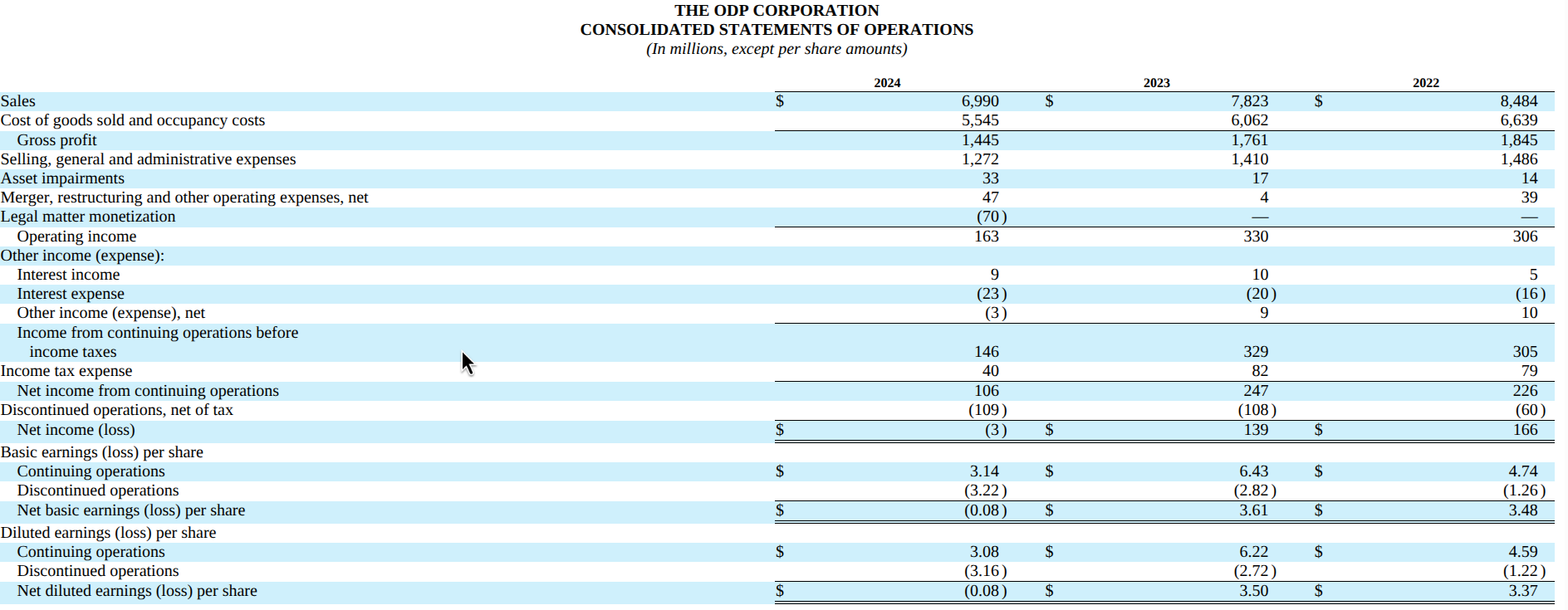
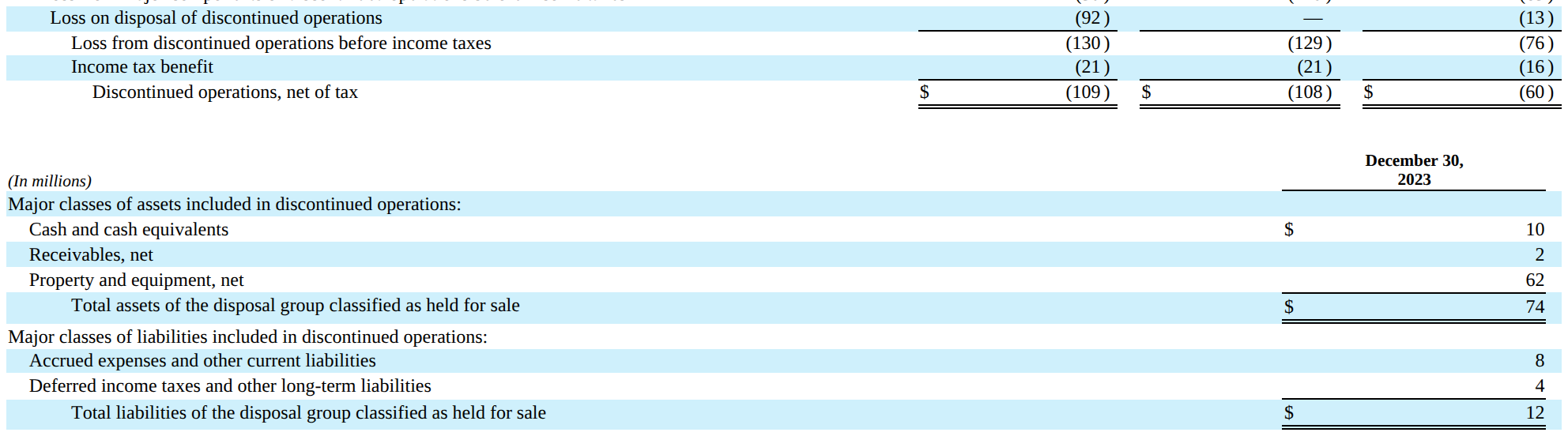
The Note 16 excerpt starts with a $38 million operating loss and a $92 million disposal loss. The disposal loss includes a $90 million noncash loss on the Varis sale and a $2 million loss related to guarantees for the previously disposed European Business. The operating and disposal losses produce a $130 million pre-tax loss. A $21 million income tax benefit reduces the net loss to $109 million.
The same note lists the Varis disposal group's $74 million of held-for-sale assets and $12 million of held-for-sale liabilities at December 30, 2023. ODP is required to present the disposal group's assets separately from its liabilities; it cannot replace those amounts with a $62 million net balance. ODP removed the Varis assets and liabilities from held-for-sale classification when it sold and deconsolidated Varis in October 2024. A reader therefore should not expect those held-for-sale balances at the end of 2024.
The complete source is available in The ODP Corporation's 2024 Form 10-K on EDGAR.
The labels vary, and the notes do not follow one visual template. In both filings, however, the income statement supplies the net-of-tax result and the note supplies the detail needed to understand that result.
Quick checkCompare the excerpts. What net-of-tax label does each company use on its income statement? Name one item for each company that you learn only by reading the note excerpt or its context.
Answer: 3M uses Net income (loss) from discontinued operations, net of taxes. ODP uses Discontinued operations, net of tax. 3M's note supplies the pre-tax income and tax expense used to produce the net-of-tax amount. ODP's note supplies the operating and disposal losses, tax benefit, and the separate held-for-sale asset and liability totals. The displayed excerpts do not provide continuing-involvement information. The statements report the net-of-tax results, but they do not supply the other details.
Distinguish unusual or infrequent items
A material transaction or event may be unusual, infrequent, or both. Those descriptions do not, by themselves, determine where the resulting gain or loss appears on the income statement. Unless another accounting rule requires different treatment, report the item within continuing operations and provide enough information for a reader to understand its nature and financial effect.
Evaluate the event in the company's context
Unusual nature and infrequency are separate judgments. An event may satisfy one, both, or neither.
| Judgment | Question | Evidence to consider |
|---|---|---|
| Unusual in nature | Is the event highly abnormal and unrelated, or only incidentally related, to the company's ordinary activities? | What the company normally does, where it operates, and the business environment in which the event occurred. |
| Infrequent in occurrence | Is this type of event not reasonably expected to recur in the foreseeable future? | The company's history, events affecting similar operations, and conditions that make recurrence more or less likely. |
The conclusion is company-specific. Storm damage might be neither unusual nor infrequent for a company with facilities in a storm-prone area and a history of similar losses. The same type of damage might satisfy one or both judgments for a company operating in a different environment. Size alone does not make an event unusual or infrequent, and management should not use the labels without evidence about the company's activities and expected recurrence.
These definitions and the emphasis on the entity's environment come from ASC 220-20-55-1 and 55-2. ASC 220-20-55-3 illustrates the point with rare storm damage to a tobacco manufacturer's crops, a land sale, and an earthquake that destroys an oil refinery.
Present the item within continuing operations
The company first measures the transaction under the accounting guidance that applies to it. Calling an event unusual or infrequent does not change the amount of the gain or loss. The company then applies these presentation rules:
- Keep the item within income from continuing operations. The continuing business still includes the activities and risks that produced the item.
- If the item is material, present its nature and financial effect separately within continuing operations or disclose that information in the notes.
- Present the item as a pre-tax amount on the face of the income statement. Include its tax effect in the tax expense or benefit for continuing operations rather than showing the item net of tax.
ASC 220-20-45-1 contains these presentation requirements.
This presentation keeps the reported result of the continuing business complete while preserving visibility for a material event. An event does not cease to affect the continuing business merely because it is rare or abnormal. Separate presentation or note disclosure allows a reader to see that effect without removing it from continuing operations.
The unusual-or-infrequent judgment also does not decide whether the item is an operating or nonoperating item. That placement depends on the nature of the transaction and the company's presentation policy. The special point here is visibility: a material item should not disappear inside a broad caption merely because it remains in continuing operations.
Compare the presentation in two SEC filings
ASC 220-20-45-1 requires an entity to make the nature and financial effect of a material event visible. The entity may present that information separately within continuing operations or disclose it in the notes. Linde and Turning Point Brands show the two approaches.
Linde plc: a separate statement line for conflict-related charges
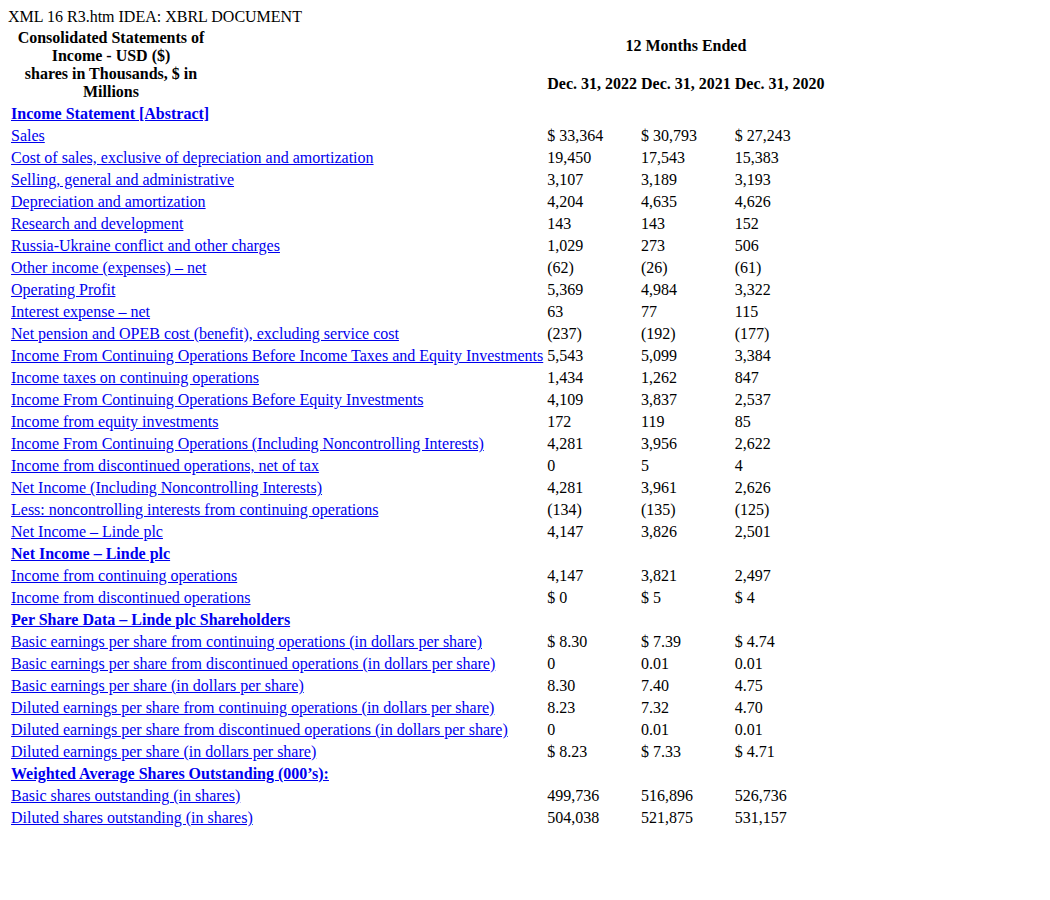
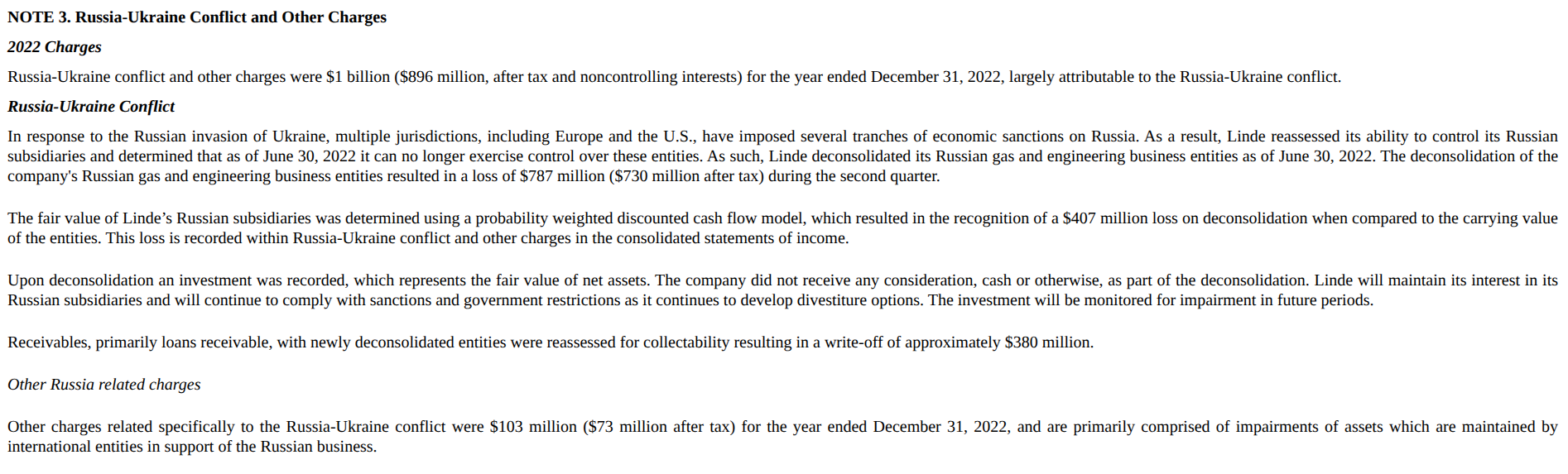
Linde reports Russia-Ukraine conflict and other charges as a separate line in its statement of income. Note 3 explains why the 2022 amount warrants that visibility: after Russia invaded Ukraine and sanctions followed, Linde concluded that it no longer controlled its Russian subsidiaries. The resulting deconsolidation, write-offs, and related conflict charges contributed to a $1.029 billion pre-tax total.
The event is unusual because a geopolitical conflict and the resulting loss of control are not ordinary, recurring costs of selling industrial gases. Yet the charge still arose while Linde's continuing business was operating. Linde therefore includes the separate line among the expenses used to calculate operating profit. The note provides the explanation and after-tax context that the short statement caption cannot provide by itself.
Open Linde plc's complete 2022 Form 10-K on EDGAR.
Turning Point Brands, Inc.: a broad statement caption plus note detail
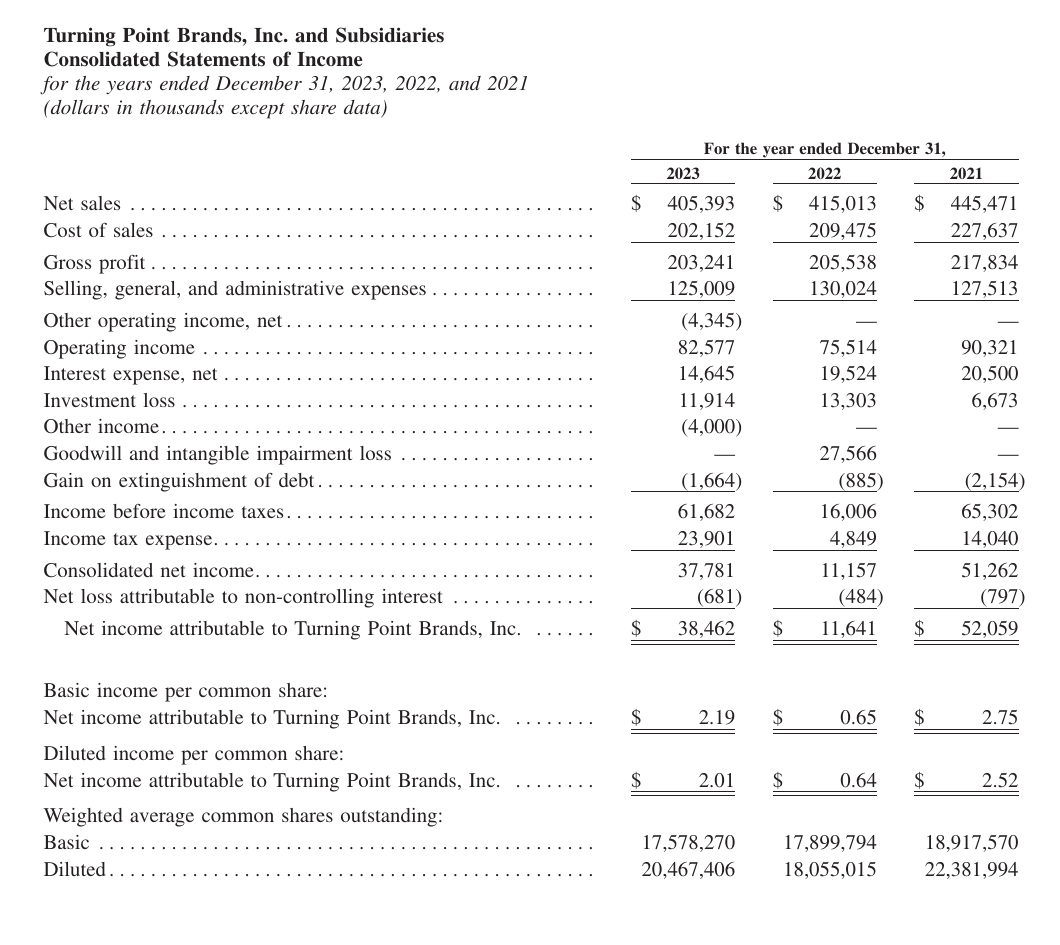
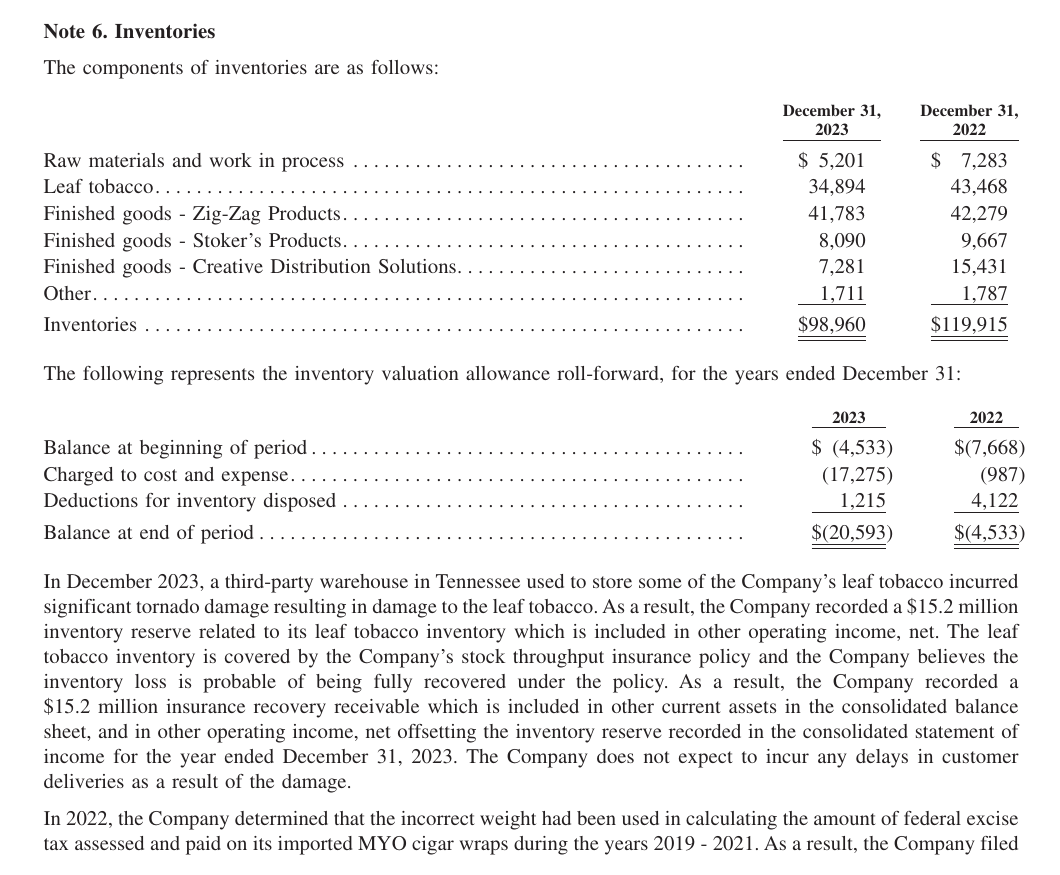
A December 2023 tornado damaged leaf tobacco stored for Turning Point Brands in a third-party Tennessee warehouse. Turning Point recorded a $15.2 million inventory reserve and a $15.2 million insurance recovery. Both amounts appear within Other operating income, net, so they offset each other within that broad income-statement caption.
The income statement does not name the tornado. Note 6 identifies the event, reports both amounts, and identifies the caption that contains them. In later correspondence with the SEC, Turning Point stated that the inventory damage was both unusual in nature and infrequent in occurrence under ASC 220-20. The company cited that conclusion when explaining why it used Other operating income, net rather than Cost of sales.
The comparison shows the two permitted presentation approaches. Linde names the event in a separate income-statement line and adds detail in a note. Turning Point uses a broader income-statement caption and relies on the note to make the event and its financial effects visible.
Open Turning Point Brands, Inc.'s complete 2023 Form 10-K on EDGAR. Read Turning Point's response to the SEC about the ASC 220-20 classification.
Apply the rule to Sable Ridge
In September 2026, a contract manufacturer to which Sable had advanced $95,000 entered liquidation. Sable will not recover the advance. The event does not involve the disposal of a Sable component or a strategic shift in Sable's business. The loss therefore remains in continuing operations. Under Sable's presentation policy, supplier-advance losses are operating expenses, so Sable places this loss within operating expenses. Because the loss is material, Sable either presents it separately within continuing operations, as Chapter 6 did, or discloses its nature and financial effect in the notes. On the face of the income statement, Sable reports the $95,000 loss as a pre-tax amount rather than subtracting a related tax benefit from that line.
These facts establish the amount and placement of the supplier loss, but they do not establish whether supplier failures are unusual or infrequent for Sable. That conclusion would require evidence about Sable's supplier history, ordinary operating risks, and expected recurrence. The loss remains in continuing operations either way.
Quick checkDeliberate product tampering forces Sable to recall and destroy one production run. The loss is material. Sable has never experienced product tampering, the event is highly abnormal for its operations, and a similar event is not reasonably expected to recur. Sable continues producing and selling the affected product. Is the loss unusual, infrequent, or both? Where and how does Sable present it?
Answer: The supplied facts support both judgments. The tampering is unusual in nature because it is highly abnormal in Sable's operations. It is infrequent because a similar event is not reasonably expected to recur. Neither conclusion makes it a discontinued operation: Sable did not dispose of a component or classify one as held for sale. Sable reports the loss in continuing operations, presents its nature and financial effect separately on the statement or in the notes, and shows any face amount before tax.
Practice: Apply the steps to a service company
Meridian Home Services repairs household appliances through four regional service centers. It also operated a home-warranty administration division with its own subscribers, claims staff, manager, contracts, and monthly financial statements.
During 2026, Meridian completed two transactions:
- It sold its Lakeshore repair center. The center had dedicated technicians, service vehicles, and local customers. Its monthly schedules identified the center's revenue, expenses, customer collections, and operating payments and reconciled those amounts to Meridian's general ledger. Meridian continues to provide the same appliance-repair services through its other three centers. The sale produced a $24,000 pre-tax loss.
- It sold the home-warranty administration division and left the subscription warranty market. Warranty administration was one of Meridian's two operating divisions. It served different customers under separate contracts, and management reviewed its results separately each month. After the sale, Meridian provides only appliance-repair services. Meridian will process open claims for the buyer for three months at market rates. The buyer depends on Meridian's claims system during that period, and Meridian expects the arrangement to produce significant cash flows. During 2026, the division earned $72,000 before tax and Meridian recognized a $132,000 loss on the sale. The division earned $80,000 before tax in 2025.
The $60,000 combined pre-tax loss from the home-warranty division's 2026 operating income and sale loss has a related $15,000 tax benefit. The related tax expense on its 2025 income is $20,000. Complete each decision and calculation below. The page gives feedback after each response.
Work through the Meridian case
Sort the facts by the decision they inform, choose the supported conclusions, and check each calculation row before continuing. Every response provides an explanation.
1. Classify the Lakeshore center sale
Lakeshore center: identify what each fact helps establish
Place each fact with the decision it informs. Some facts do not determine any classification condition.
5 items over 4 buckets. Your result is saved in this browser and is not sent.
2. Classify the home-warranty division sale
Home-warranty division: identify what each fact helps establish
Place each fact with the classification condition or post-sale disclosure issue it informs.
4 items over 4 buckets. Your result is saved in this browser and is not sent.
3. Measure the 2026 discontinued operation
Enter each amount as a positive number and use the menu to identify whether it is income, a loss, an expense, or a benefit.
4. Recast the 2025 comparative amount
5. Identify the continuing-involvement disclosures
Claims-processing arrangement: classify the information
Decide what the continuing-involvement guidance requires Meridian to disclose and how the post-sale service income is treated.
5 items over 3 buckets. Your result is saved in this browser and is not sent.
Sources
- ASC 205-20-45-1B and 45-1C, the strategic-shift and major-effect criterion
- ASC 205-20-45-3, income-statement presentation
- ASC 205-20-45-10 and 45-11, comparative balance-sheet presentation
- ASC 205-20-50-1, 50-4A, 50-4B, and 50-5B through 50-5D, note disclosures and reconciliations
- ASC 220-20-45-1, presentation of unusual or infrequently occurring items
- ASC 205-20-45-1E, held-for-sale criteria for a component or group of components
- ASC 360-10-35-39, 35-40, and 35-43, held-for-sale measurement
- ASC 740-20-45-2, intraperiod tax allocation
- FASB Accounting Standards Update 2014-08, Reporting Discontinued Operations and Disclosures of Disposals of Components of an Entity